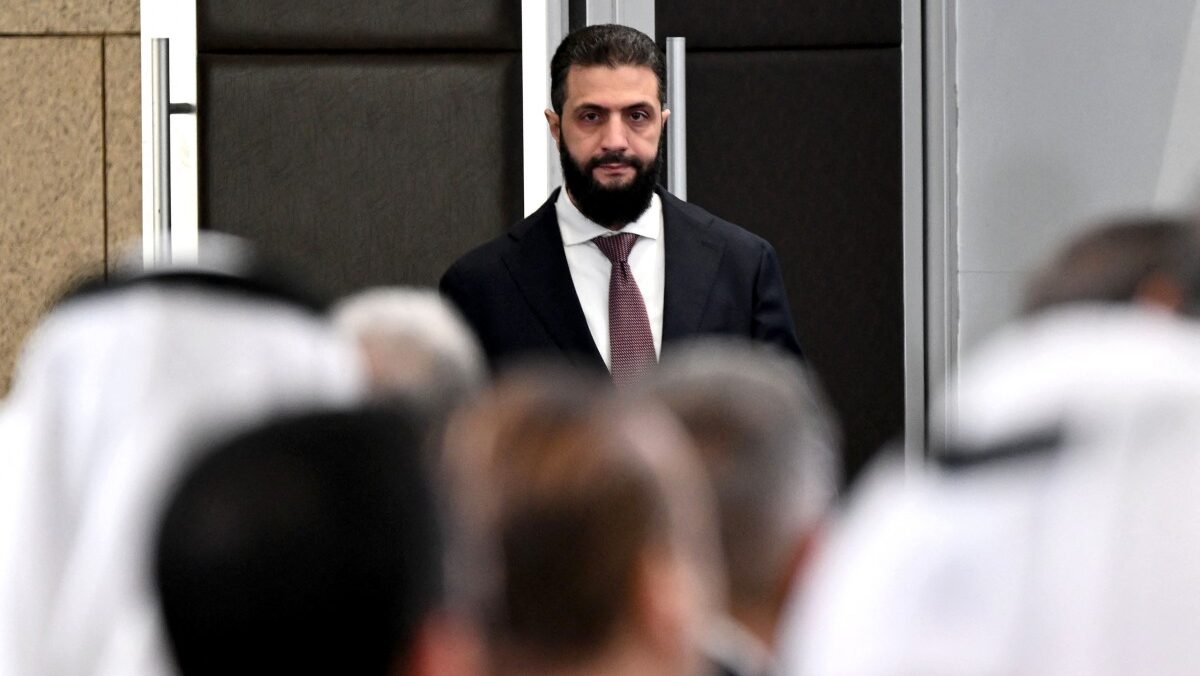
Syrian President Ahmed al-Sharaa
LOUAI BESHARA / AFP
The European Union has lifted sanctions on Syria’s Interior and Defense Ministries, marking another major step in rebuilding relations with Damascus after years of war and diplomatic isolation.
The decision, announced Monday, removes restrictions on seven Syrian entities, including the two ministries, as Brussels continues easing measures imposed during the rule of former Syrian president Bashar al-Assad.
#Syria: @EUCouncil renewed EU restrictive measures targeting the former Assad regime until 1 June 2027.
— EU Council Press (@EUCouncilPress) May 18, 2026
The EU also removed 7 entities from the sanctions lists, in line with its gradual & reversible approach towards Syria.
More 👇https://t.co/OLTAEDXcJU
The move follows the EU’s decision in May 2025 to lift many of its economic sanctions on Syria. The bloc has also agreed to reactivate a cooperation agreement with Damascus first signed in 1977.
EU officials say the goal is to support Syria’s stabilization and reconstruction following Assad’s fall. However, the country remains deeply unstable, with armed groups and foreign-backed forces still operating across different parts of Syria.
Although the government in Damascus has expanded its authority in recent months, large areas of the country remain outside its full control.
At the same time, the EU is maintaining sanctions against figures linked to Assad’s former regime. According to Brussels, 318 individuals and 51 entities remain under restrictions until at least 2027.
The easing of sanctions comes as several European governments increasingly focus on the issue of Syrian refugees living in Europe.
Syria was one of the main sources of migration into the EU during the civil war, with millions fleeing the country over the past decade. As security conditions partially improve, some European governments are discussing the possibility of increasing refugee returns.
The issue returned to public attention following Syrian President Abu Mohammad al-Jolani’s recent visit to Berlin, where migration and future cooperation with Europe were widely discussed.
However, Syria’s new leadership has so far avoided making firm commitments regarding large-scale refugee returns. Al-Jolani has publicly pushed back against suggestions that Damascus is prepared to accept broad return programs in the near future.
The EU says renewed cooperation with Syria is intended to encourage stability and support reconstruction efforts. But questions remain over how much authority the new Syrian leadership actually exercises across the country and whether current security conditions are sufficient for wider refugee returns.