Jean-Luc Mélenchon is gaining ground as France’s 2027 presidential race takes shape, exploiting a divided Left and sluggish centrist campaigns. Still deeply unpopular, the chameleon-like Insoumis leader may yet prove far more dangerous than his current ceiling suggests.
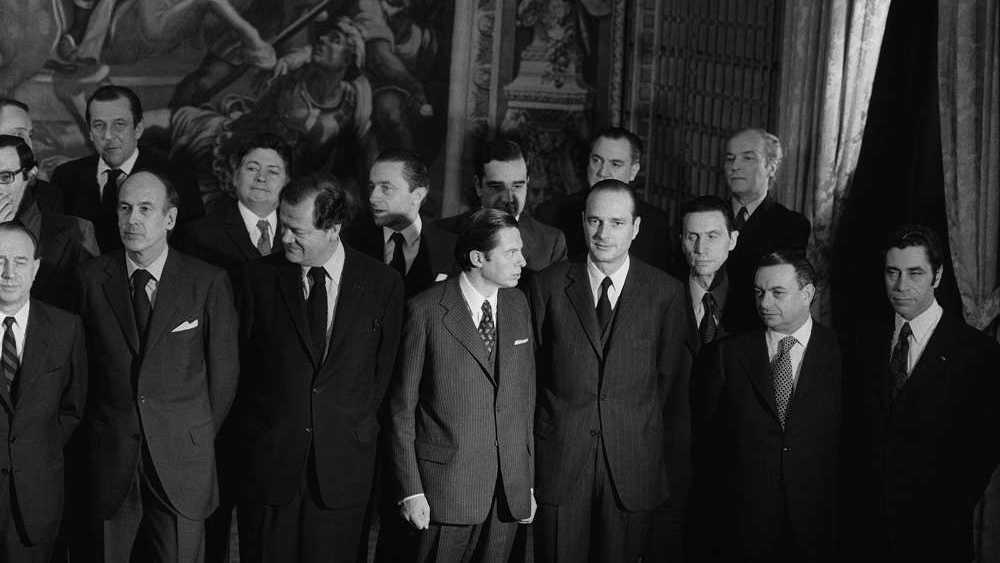
Members of the 2nd Chirac government on January 31, 1975 (Chirac is 3rd from the right, front row)
By sudouest.fr – https://images.sudouest.fr/2016/03/03/57e102ef66a4bde778c871b8/default/1000/CC BY-SA 4.0, https://commons.wikimedia.org/w/index.php?curid=69833855
Exactly fifty years ago, France introduced the principle of family reunification for immigrants who had come to work in France. Over the years, the measure has taken on symbolic significance as a sign of an out-of-control migration policy, making it highly unpopular today. But which politician will dare, in the coming years, to tackle what is also considered a taboo in France, the principle of the “land of welcome”?
On April 29, 1976, family reunification, as it remains in force in France today, was introduced under a centre-right government, with Jacques Chirac as Prime Minister and Valéry Giscard d’Estaing as President of the Republic.
The decree established the general framework for family reunification, allowing a foreign national legally resident in France to bring over their spouse and minor children. Other legal provisions already existed prior to this decree. Since the 1920s, a period when significant labour migration was flowing into France—which had suffered from a shortage of workers following the Great War—mainly from Poland and Italy, a ‘family reunification’ scheme existed. This was abolished in the 1970s, before being reinstated by Jacques Chirac and his then minister of labour, Michel Durafour.
The possibility for an immigrant worker in France to bring their family over is subject to certain conditions: they must have been legally resident in France for at least 18 months, must be able to prove stable financial resources and suitable accommodation, must respect public order and comply with specific French cultural norms: acceptance of monogamous marriage and gender equality. It was impossible, for example, to bring over a second wife. What seemed self-evident in 1976 is no longer taken for granted today, and there have been numerous abuses.
Fifty years on, the family reunification scheme has sparked widespread hostility among the French public. According to official figures, 16,429 people are estimated to have benefited from family reunification in the strict sense in 2024. In 2025, it accounted for only 5% of new entry permits–compared with 23% in the year 2000. Immigration for family reasons, which is broader than ‘family reunification’ alone, remains very significant, but for other reasons: nearly half (47%) of family visas are issued to “family members of French nationals” (spouses or parents of French children). Family structures have also changed: today, immigrants arrive in France as single people and start families later, whilst living there. The image of the family ‘left to the bled (the Algerian village)’ joining the father who has come to work in France is disappearing.
Whilst family reunification is not the primary channel for immigration, it serves as a symbol: it embodies the idea that one can enter French territory and enjoy the benefits of settling in France without contributing to the national wealth. “It is believed to be unproductive and [the beneficiaries] difficult to integrate, in contrast to so-called “selective” migration of skilled workers,” explains Julia Descamps, a researcher at the National Demographic Institute (INED).
According to a recent poll, 57% of French people would like to see an end to this policy. On the right, the National Rally and Reconquête have long called for its abolition or for stricter regulation of its implementation. But this position is also championed in the centre: at a time when Austria was debating the possible suspension of family reunification, Macronist MP Maud Bregeon felt that there was “a real problem with family reunification in France”, too, adding: “It is an initiative from which we should obviously take inspiration.”
The issue will certainly be on the table during the debates of the 2027 presidential campaign.