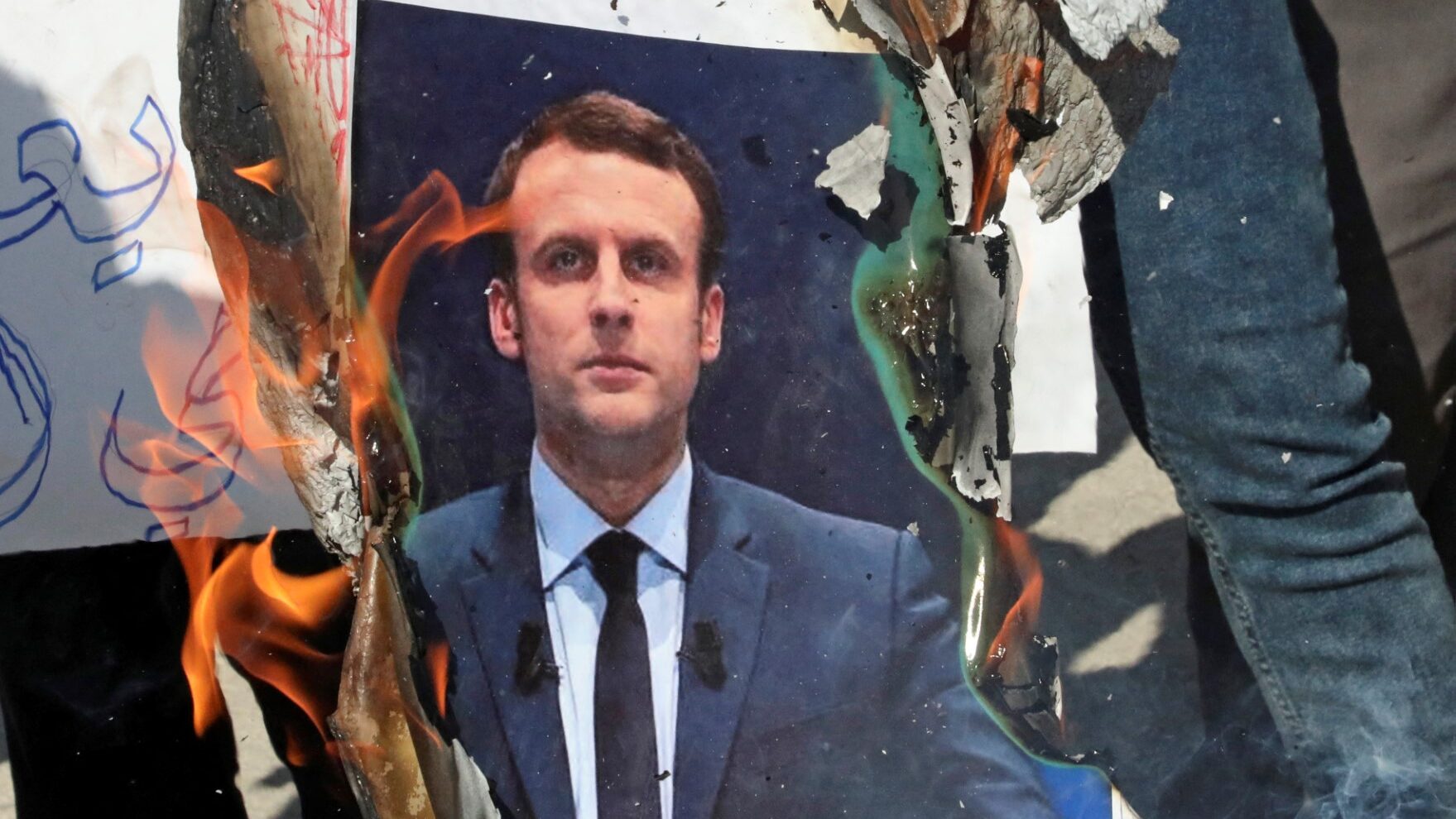
Palestinians burn a picture of French President Emmanuel Macron during a demonstration against him at the Palestine Technical University in al-Aroub, north of the West Bank city of Hebron on October 27, 2020.
Hazem Bader / AFP
Paris shook the diplomatic chessboard on Thursday, July 24, when President Emmanuel Macron announced that France would officially recognize the State of Palestine this coming September during the United Nations General Assembly.
The decision—labeled by Israel as “a reward for terrorism”—comes at a time of mounting international pressure on Netanyahu’s government due to the humanitarian situation in Gaza.
Macron justified his stance by invoking the urgent need to give real viability to the two-state solution, which is now more threatened than ever. “Neither Israel nor Hamas wants two states. That is precisely why we must build it,” declared the French president, who argued that a demilitarized Palestine recognizing Israel could be a stabilizing factor. France’s foreign minister, Jean-Noël Barrot, reinforced this argument: “Recognizing Palestine does not reward Hamas; on the contrary, it shows they are wrong.”
Le Hamas a toujours refusé la solution à deux États. En reconnaissant la Palestine, la France donne tort à ce mouvement terroriste. Elle donne raison au camp de la paix contre celui de la guerre.
— Jean-Noël Barrot (@jnbarrot) July 25, 2025
The Palestinian Authority, led by Mahmoud Abbas, welcomed the move, thanking France for its “commitment to international law.” In contrast, the United States—through Secretary of State Marco Rubio—strongly rejected the decision, calling it “an affront to the victims of October 7 and a propaganda victory for Hamas.”
France has thus joined the growing list of European nations—including Spain, Ireland, Slovenia, and Norway—that have recognized Palestine in recent months. While more than 140 countries already extend recognition, France’s move is particularly significant given its diplomatic influence within both the G7 and the European Union. Macron’s decision could pave the way for further endorsements in the Western sphere.
Spain’s prime minister Pedro Sánchez praised the French initiative, framing it as an attempt to halt what he described as “Netanyahu’s effort to destroy the two-state solution.” Sánchez has made the recognition of Palestine a hallmark of his foreign policy, seeking international visibility at a time when multiple corruption scandals besiege his government.
Celebro que Francia se sume a España y otros países europeos en su reconocimiento del Estado de Palestina.
— Pedro Sánchez (@sanchezcastejon) July 24, 2025
Entre todos debemos proteger lo que Netanyahu está tratando de destruir. La solución de los dos Estados es la única solución. https://t.co/fxlrSR1IPN
Many observers also see electoral calculations behind Macron’s announcement. France has the largest Muslim population in Western Europe, and public anger over the war in Gaza has sparked protests and domestic tensions. With presidential elections on the horizon and Marine Le Pen’s conservative Rassemblement National on the rise, Macron may be trying to reconnect with a disillusioned electorate and score points on the international stage as a peace broker.
Beyond the rhetoric, the reality on the ground remains grim: Gaza lies in ruins, hundreds of thousands of Gazans struggle to access humanitarian aid, Israeli hostages remain in Hamas hands, and the peace process has been frozen for over a decade. The French decision may be symbolic, but symbols matter in such an entrenched conflict. And above all, they are never innocent.