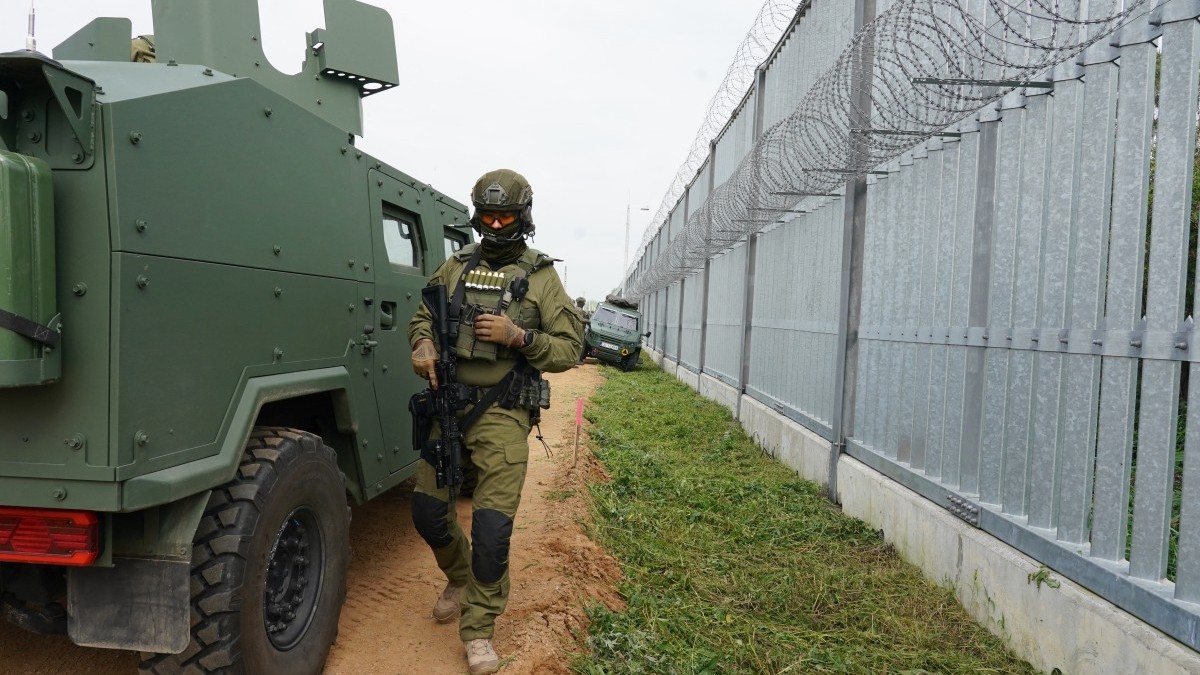
Polish border guards secure the area before Polish Prime Minister Donald Tusk and European Commission President Ursula von der Leyen visit the fence at the Poland-Belarus border on August 25, 2025 in Krynki, eastern Poland.
Janek Skarzynski / AFP
The latest data published by Frontex have been received in Brussels with a tone of cautious optimism. According to consolidated figures from the European Border and Coast Guard Agency, detections of illegal border crossings at the European Union’s external borders fell by 26% in 2025, to around 178,000. This is the lowest level since 2021 and less than half the total recorded in 2023.
However, a closer reading of Frontex’s own documents reflects a more nuanced picture.
As the agency itself stresses, the figures refer to “detections,” not to unique individuals, and they do not clarify to what extent part of this irregular migration may be shifting to other, less visible channels, such as the fraudulent use of visas, entry through airports, or secondary movements within the Schengen area.
The official statement insists that the situation remains volatile and that pressure can shift rapidly between routes. In fact, in 2025, the Central Mediterranean once again became the main gateway into the EU, with Libya as the epicentre of departures towards Italy. In the Eastern Mediterranean, the overall balance is downward, but with a troubling detail: crossings from eastern Libya to the island of Crete more than tripled, highlighting the adaptability of smuggling networks. At the same time, while the West Africa route saw a sharp decline, the Western Mediterranean route recorded an increase driven by higher departures from Algeria.
This short-term picture fully aligns with Frontex’s Annual Risk Analysis 2025/2026, a document far less complacent than the headline “–26%”. The report warns that the root causes of irregular migration—armed conflict, economic collapse, demographic pressure and organised crime—not only persist but are intensifying in some regions. The Sahel, the Middle East and eastern Europe remain centres of instability with the potential to generate new migration flows towards the EU.
Particularly worrying is the analysis of the instrumentalisation of migration as a form of hybrid warfare. Frontex explicitly points to the risk that hostile state actors, such as Russia or Belarus, may use migratory movements to exert political pressure on the Union—a threat that has already materialised along the EU’s eastern borders. Added to this is the growing role of eastern Libya, where the Russian military presence and institutional weakness facilitate both human trafficking and its potential geopolitical use.
Another key finding of the report is the shift of pressure towards air borders. Although the total number of land and sea crossings has fallen, Frontex anticipates increasing abuse of legal pathways exploited fraudulently: visas, work permits or transit through airports with weaker controls, particularly in the Balkans and the Middle East. In other words, fewer images of landings on Europe’s shores but more silent and harder-to-detect entries.
Against this backdrop, 2026 is shaping up to be a decisive year. The full implementation of the Pact on Migration and Asylum, together with the new EES and ETIAS systems, promises stricter, biometric-based controls. Yet Frontex itself warns of possible side effects: administrative overload, higher rates of entry refusals and, paradoxically, stronger incentives to resort to clandestine routes if the system is not managed with sufficient realism and resources.
The agency has already made its position clear in its Annual Risk Analysis: Europe will continue to face high and complex migratory pressures, and only a firm, coordinated border policy grounded in a clear-eyed assessment of real threats will prevent today’s favourable statistics from becoming tomorrow’s latest crisis.