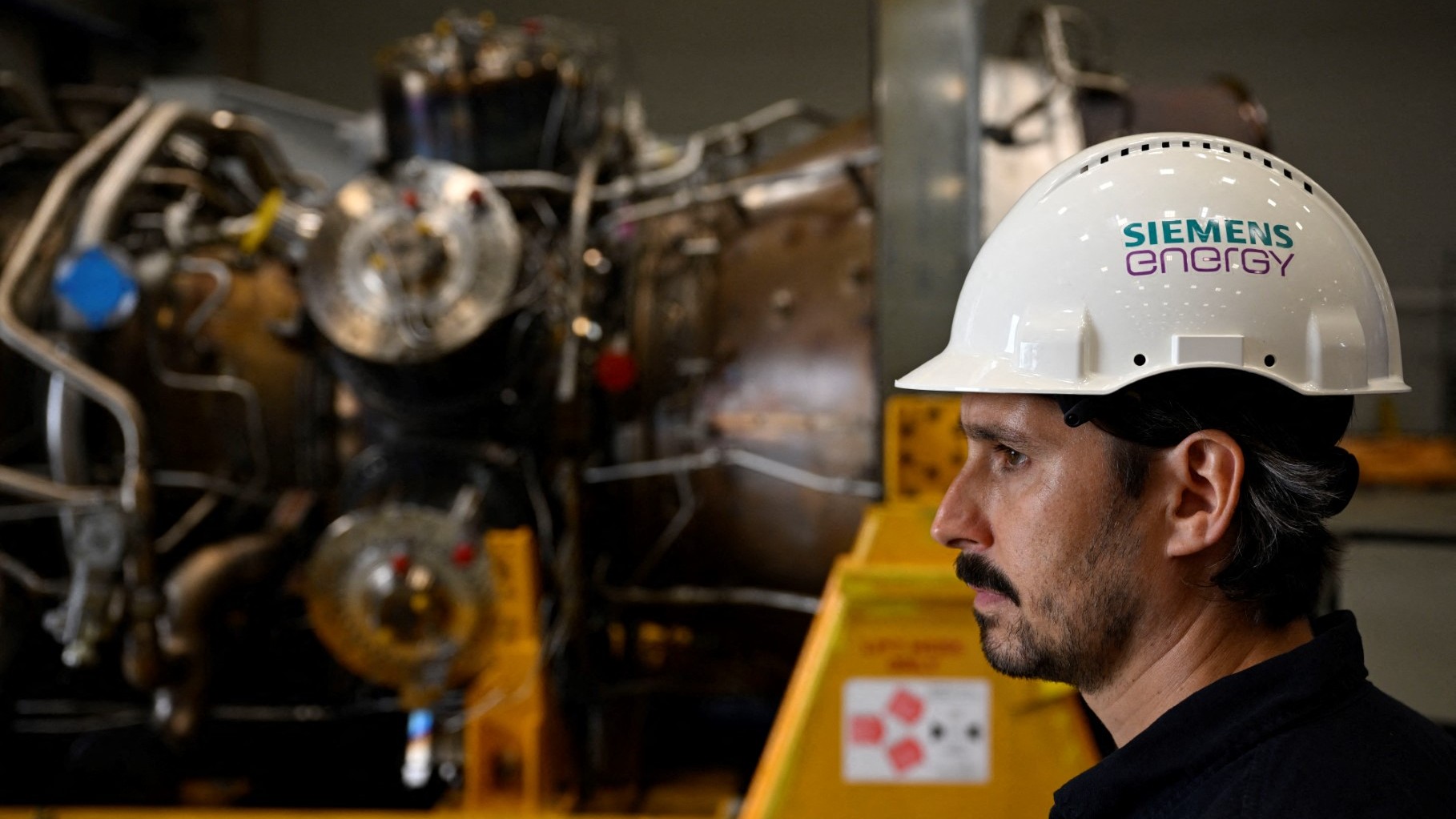
An employee of Siemens Energy stands on August 3, 2022 in front of a turbine of the Nord Stream 1 pipeline at the plant of Siemens Energy in Mülheim an der Ruhr, western Germany, where the engine is stored after maintenance work in Canada.
SASCHA SCHÜRMANN / AFP
The escalation in the Middle East and the blockade of the Strait of Hormuz have triggered a new global energy crisis that, according to the International Energy Agency (IEA), surpasses in severity the oil shocks of the 1970s.
The warning is not trivial: those crises caused recessions, inflation and a profound shift in Western economic policy, and the international agency believes the current scenario could have an even greater impact.
IEA Executive Director Fatih Birol described the situation as “very serious” and said the world is facing something comparable to “two oil crises and a gas collapse combined.”
The comparison refers to the 1973 and 1979 embargoes, which paralysed entire economies and forced a rethink of the Western energy model.
Birol also warned that “no country will be immune if the situation continues in this direction,”after serious damage was confirmed to dozens of energy infrastructures across the Middle East.
The impact is already visible on the markets, with oil above 100 dollars per barrel and a sharp rise in gas prices in Europe.
The IEA considers that the full reopening of the strait is the only quick way to ease tensions, but the political scenario remains uncertain. The United States has demanded guarantees of free transit, while Iran has warned it will respond if its energy infrastructure is attacked.
Each day the corridor remains unstable, prices rise around the world. However, the effect is particularly severe in Europe.
Brussels officially maintains the goal of completely eliminating Russian gas before 2027, but at the same time it depends more and more on distant suppliers and on maritime routes that can be blocked at any moment.
That contradiction, which for months was presented as a necessary sacrifice to gain strategic autonomy, is now becoming visible again with full clarity.
Experts agree that, for now, there is no immediate risk of general blackouts if storage levels remain high and consumption stays contained.
However, a term that seemed forgotten since the 2022 crisis has once again gone viral on social media: the so-called “energy lockdowns.”
This does not mean planned power cuts, rather emergency plans to reduce demand if supply worsens: limits on industrial consumption, restrictions on heating and air conditioning, mandatory saving targets or even temporary shutdowns in energy-intensive sectors.
These are tools the European Union created during the previous crisis and that remain in place, ready to be activated if the market tightens again.
The fact that they are being mentioned again shows how fragile the system still is. Europe managed to avoid collapse four years ago, but it did so at the cost of accepting a more expensive and more externally dependent energy model.
The first signs are already visible in the major industrial economies.
In Germany, where energy costs have become a structural problem since the end of cheap Russian gas, the new price surge is once again putting heavy industry on alert.
Sectors such as chemicals, metallurgy and automotive manufacturing have been warning for months that competing with the United States or Asia is increasingly difficult if energy costs several times more.
Italy has reacted with fiscal measures to contain fuel prices, aware that every rise in oil is quickly reflected in the cost of living. The concern in Rome is not only economic but political: another energy crisis could mean inflation, protests and electoral backlash, as happened in several European countries after 2022.
In Central and Eastern Europe the situation is even more complex. Part of the energy infrastructure is still linked to supply systems designed in the Soviet era, and replacing them completely requires time and money.
For those countries, the European strategy of breaking with Russia without fully stable alternatives is increasingly seen as a risk taken too quickly.
Europe thus enters this crisis in a more fragile position than it was decades ago. It has reduced its dependence on Russia, but it has done so by moving into a global market that is more expensive, more volatile and shaped by conflicts it does not control.