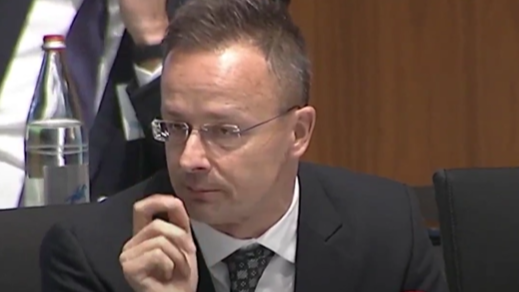
Screenshot of a video of Hungarian Prime Minister Péter Szijjártó speaking in Brussels on October 20, 2025
@FM_Szijjarto on X, October 20, 2025
The Hungarian government has issued a direct warning to Brussels: if the European Commission enforces the ban on Russian gas, Budapest will take the matter to court. For Viktor Orbán’s administration, the decision constitutes a blatant violation of EU treaties and a direct assault on the energy sovereignty of member states.
Foreign Minister Péter Szijjártó described the ban as an “unprecedented scandal” and declared that Hungary “will not accept Brussels making decisions over national interests.” Szijjártó said the EU executive is using the pretext of energy security to impose, in practice, a political sanction against Russia without the required consensus among member states.
With RePowerEU, our safe energy supply is being killed. They call it diversification, but in reality, it cuts one of our vital oil routes. @EU_Commission completely ignores that this regulation destroys the energy security of EU Member States. Energy should not be about politics! pic.twitter.com/dI7JC1rKXZ
— Péter Szijjártó (@FM_Szijjarto) October 20, 2025
The proposal, pushed by the Commission and backed by most of the Western bloc’s governments, aims to sever energy ties with Moscow before 2027. But for countries like Hungary and Slovakia, this move is not only reckless but also illegal, as foreign policy sanctions must be approved unanimously, not by qualified majority voting. As Szijjártó remarked in Luxembourg,
This is not a commercial issue—it’s a disguised sanction. And the European treaties are clear: decisions of this kind require unanimity.
Hungary has a long-term contract with Gazprom running until 2036, which guarantees stable prices and secure supply. If Brussels forces a rupture of that agreement, the Hungarian economy would suffer an immediate blow: halted factories, increased energy costs, and a loss of industrial competitiveness.
Local analysts warn that energy prices in the country could double if it is forced to import liquefied gas from European terminals that rely on international markets. Such a decision would benefit major Western suppliers but suffocate Central European families and businesses.
Orbán’s government has already pledged to defend its people’s interests. The prime minister declared last week
We will not allow ideological decisions made in Brussels to wreck the Hungarian economy and punish our population.
Despite the criticism, the European Commission insists the ban “is entirely legal” and “responds to the need to reduce dependency on an unreliable partner.” Energy Commissioner Dan Jørgensen claimed “the legal basis is solid,” and the Danish presidency of the Council added that countries “are free to take the matter to court if they deem it necessary.”
Overwhelming support for our ban on Russian gas in @EUCouncil!
— Dan Jørgensen (@DanJoergensen) October 20, 2025
The EU will be able to gain its energy independence.
To ensure security of supply to its citizens.
And not least to support Ukraine.
Thanks @eu2025dk for all your work and steer! https://t.co/XQejmrwN9w
However, Brussels’ stance reveals a worrying drift towards centralism, where strategic decisions are made without regard for national realities. For many observers, this trend confirms what Orbán has been warning about for years: the EU is turning into an ideological superstate imposing policies that run counter to sovereignty and common sense—and even against the welfare of its own citizens.
Hungary has the option of challenging the decision before the Court of Justice of the European Union, though the legal process could take years. Still, Budapest’s defiance goes beyond legal arguments—it symbolizes a defense of the Europe of nations, against a bureaucratic Europe striving to homogenize its members.