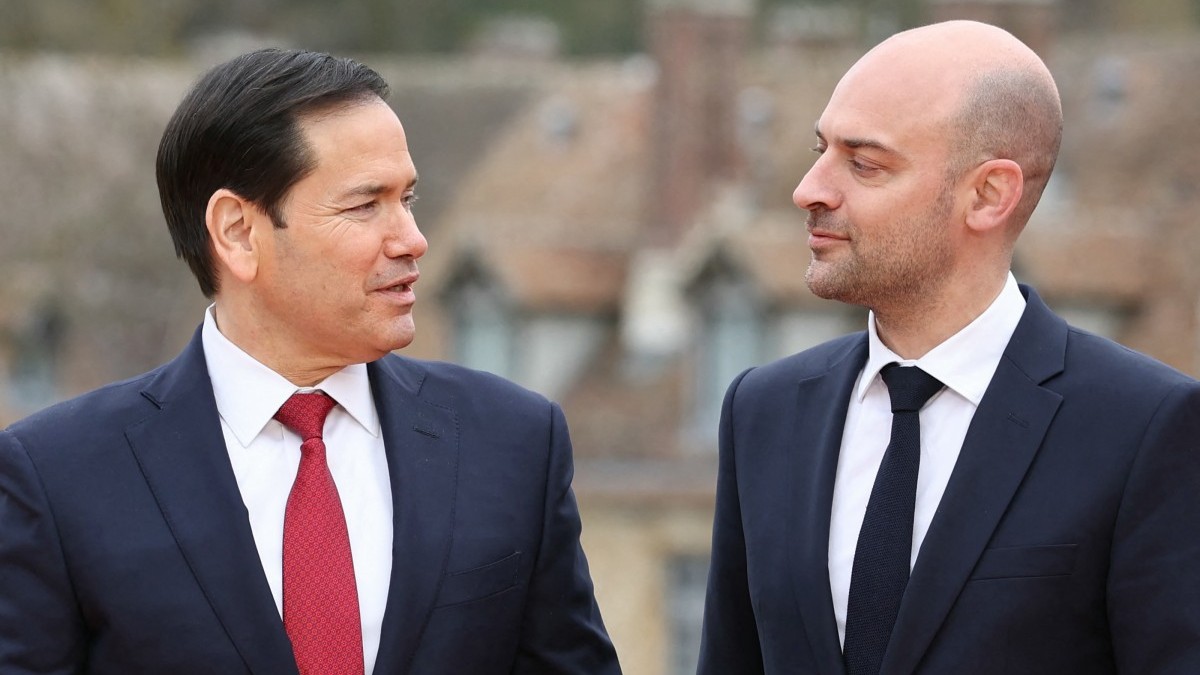
France’s Foreign Affairs Minister Jean-Noël Barrot (R) welcomes U.S. Secretary of State Marco Rubio during a G7 Foreign Ministers’ meeting at the Vaux-de-Cernay Abbey in Cernay-la-Ville on March 27, 2026.
ALAIN JOCARD / AFP
The war against Iran has opened a rift that had been growing for years beneath the surface of the transatlantic relationship. Emmanuel Macron accuses Donald Trump of pushing the Middle East toward another regime-change war. Marco Rubio responds by questioning the very purpose of NATO if Europe refuses to support the United States.
For the first time since Iraq in 2003, Washington and the European capitals are not arguing only about a military operation. They are arguing about the rules of the alliance.
Europe sees the war as illegal, dangerous and strategically absurd. The United States sees Europe as wanting to remain under the American military umbrella while reserving the right to block the operations it dislikes.
Europe’s refusal to take part in the war seems justified. France, Spain, Italy, and even the United Kingdom have refused to provide bases or airspace for an operation they regard as lacking an international mandate and increasingly aimed at regime change.
🚨 WATCH: Keir Starmer's full address to the nation
— Politics UK (@PolitlcsUK) April 1, 2026
"It is now clear the impact of this war will affect the future of our country. So today I want to reassure the British people: no matter how fierce this storm, we are well placed to weather it" pic.twitter.com/VQWdTr1vKT
Macron described the action as “dangerous.” Spain closed its airspace to U.S. aircraft involved in the operation. Italy refused the use of a base in Sicily. The United Kingdom says it is not prepared for war. Behind that caution lies the memory of Iraq, Afghanistan, Libya and Syria.
Europe knows that Iran is not Libya. It is a regional power with missiles, allies, and a real capacity to close the Strait of Hormuz. It also knows that Tehran has warned that any country facilitating attacks will be considered a legitimate target.
But Europe being right does not mean it has the capacity to impose that position. The EU has gone from being one of the architects of the Iran nuclear deal to an irrelevant actor. It has sanctions, diplomacy and statements. It does not have military capability or political unity.
The Union spent around €343 billion on defence in 2024, 1.9% of GDP. Even so, Europe is still unable to secure the Strait of Hormuz, protect its energy routes, or sustain a major operation without American logistical and military support.
On the American side, Trump and Rubio are not entirely wrong when they say NATO cannot function as a one-way street. From Washington’s perspective, Europe wants protection against Russia (a conflict fuelled by the previous U.S. administration), American bases on its territory and automatic guarantees, but then denies the use of those same bases when the United States wants to act elsewhere.
Rubio’s question—what does the United States gain from keeping troops and bases in Europe if its allies then block operations—is not illegitimate. The problem is that Washington seems to forget what NATO is.
The Alliance was created as a pact of collective defence, not as a permanent obligation to support every preventive war or regime-change operation launched from the White House. When Trump calls Europeans “cowards” or Rubio threatens to “reexamine” NATO over Iran, both are trying to redefine the rules of the pact.
Moreover, Washington helped create this crisis. It was the Trump administration that destroyed the Iran nuclear agreement and replaced diplomacy with the policy of maximum pressure. To blame Europe now for refusing to follow that strategy is convenient, but insufficient.
The United States is right to demand more capable allies. What it cannot demand is that greater capability should mean automatic obedience.
The war against Iran has revealed that the United States and Europe no longer share the same idea of alliance.
Washington believes Europe behaves like a security client: it demands protection but refuses to bear the costs. Europe believes the United States uses NATO to drag the continent into wars that do not serve European interests.
Both diagnoses are in fact correct.
Europe wants to veto wars it considers illegal, but without paying the price of genuine strategic autonomy. The United States wants stronger allies, but still treats them as subordinates when they disagree.
If this crisis ends with a weaker NATO, a Europe that is just as dependent and a more divided West, Russia, China and Iran will have achieved a strategic victory without firing another shot.