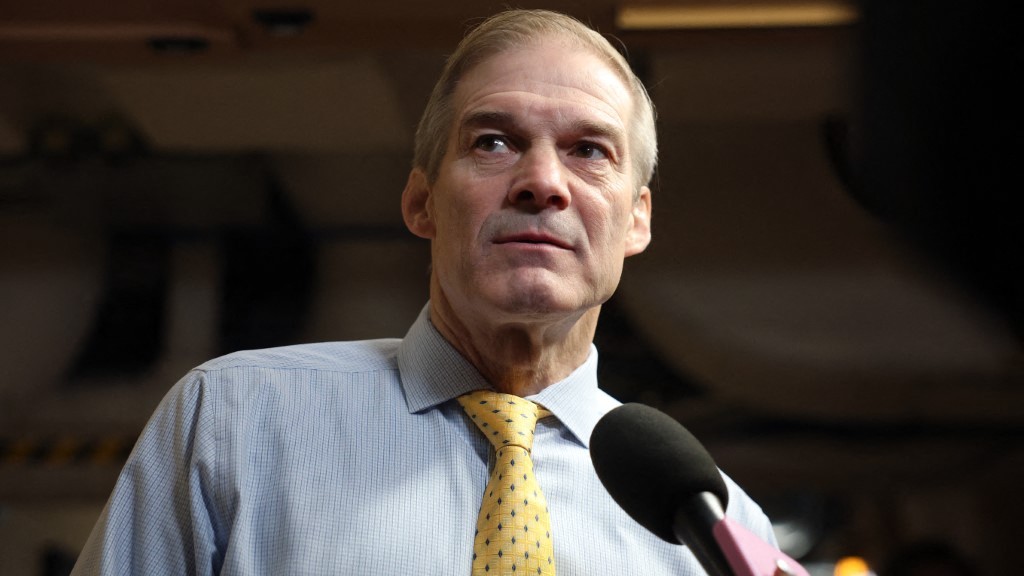
Republican Congressman Jim Jordan (R-OH) speaks to members of the media as he arrives for a House Republican Conference meeting at the U.S. Capitol on February 03, 2026 in Washington, D.C.
KEVIN DIETSCH / GETTY IMAGES NORTH AMERICA / GETTY IMAGES VIA AFP
Republican chairman of the U.S. House Judiciary Committee Jim Jordan, on February 5th issued one of the strongest warnings to date against what he describes as an expanding European censorship regime with global consequences.
Speaking in response to the committee’s report on EU content regulation to a select group of media outlets, including europeanconservative.com, in an online press conference on Thursday, Jordan framed Brussels’ policies not as an internal European matter, but as a direct challenge to freedom of expression, democratic accountability, and the constitutional rights of American citizens and companies.
At the center of the controversy is the EU’s Digital Services Act (DSA), a regulatory framework that, while formally European, operates in practice as a global moderation standard due to the dominance of U.S.-based technology companies in the digital public square.
According to Jordan, the DSA affects the United States precisely because it imposes speech rules on platforms headquartered in America but operating worldwide. “This is not just about Europe,” he stressed. “It is about how a global moderation policy ends up shaping what Americans can say, read, or publish online.”
The Judiciary Committee report concludes that EU regulators, including authorities in Brussels and Ireland, interfered in Irish electoral processes in 2024 and 2025 by pressuring platforms to restrict political content.
When asked whether Washington had contacted the Irish government, Jordan confirmed that congressional delegations travelled to Brussels, London, and Dublin in the summer of 2024, echoing concerns previously raised by the Trump administration about the DSA’s impact on free speech and U.S. businesses.
Letters of concern were sent to senior EU figures, including then–Internal Market Commissioner Thierry Breton, shortly after his controversial letter to Elon Musk in 2024. Jordan described that intervention as “ridiculous” and outside the EU’s legitimate authority—adding pointedly that Breton’s subsequent departure from office spoke for itself.
Jordan repeatedly drew parallels between European pressure and what the committee has documented at home. A key reference was a 2024 message from Mark Zuckerberg, confirming that the Biden administration had pressured platforms to censor content related to COVID-19, immigration, and gender ideology.
For Jordan, the pattern is unmistakable: governments using informal pressure and regulatory threats to achieve censorship they cannot lawfully impose. He recalled the now-defunct “misinformation board” proposed within the U.S. Department of Homeland Security as emblematic of this mindset. “It made no sense then, and it makes no sense now,” he said.
Questions were also raised about redactions in the committee’s published exhibits. While names of company representatives and some diplomats were withheld, EU Commission officials were not. Jordan defended the approach as a basic matter of privacy and proportionality. “We worked with the tech companies to obtain this information, and the minimum obligation is to protect personal data,” he explained.
As for next steps, Jordan signaled that the committee will now focus on consequences: what EU officials’ actions mean for American companies, and how policies adopted in Brussels can lawfully bind citizens who have no democratic representation there. “They have no authority over Americans,” he said. “Yet their policies impact Americans globally. That cannot be allowed.”
Asked whether the EU has responded and how he views initiatives such as the so-called “Democracy Shield,” Jordan was blunt. In his view, these mechanisms reveal the core irony of modern censorship: those most eager to suppress speech are political authorities themselves. He singled out COVID policy as the clearest example, arguing that much of what was aggressively censored later proved false.
Jordan also expressed particular concern about the role of Commission Vice-President Věra Jourová, whose portfolio included values and transparency. “Throughout history, it is always the bad actors who want to censor,” he said. “That lesson has not changed.”
Jordan closed by grounding the dispute in first principles. Without freedom of speech, he argued, there can be no free press, and without a free press, democracy itself collapses. For the House Judiciary Committee, the EU’s censorship apparatus is not merely a regulatory disagreement but a constitutional red line.
As Brussels continues to export its regulatory model, Washington is making clear that the debate over digital governance is no longer about moderation standards—it is about who gets to decide the limits of speech in the modern world.