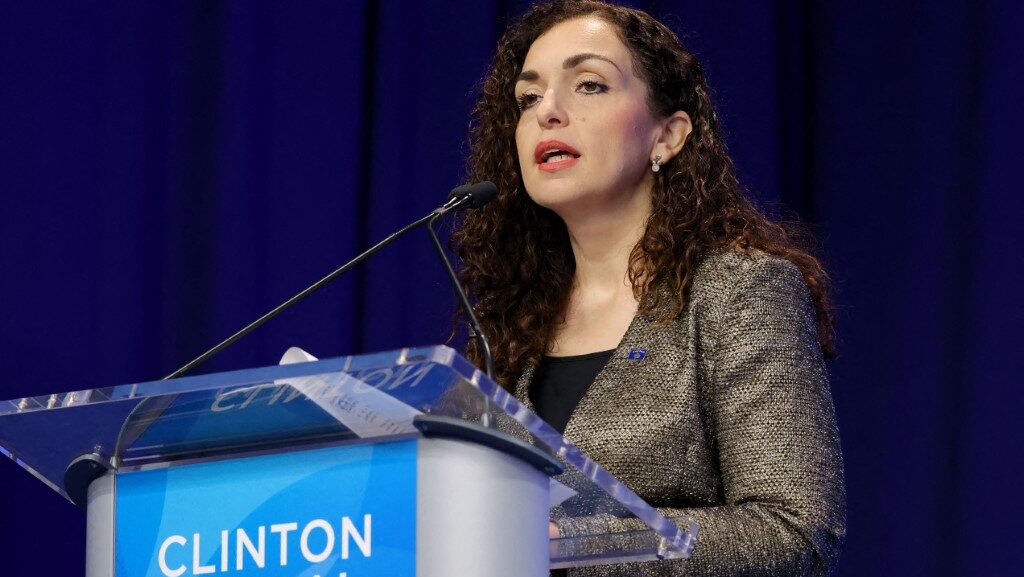
Vjosa Osmani speaks onstage during the Clinton Global Initiative 2025 Annual Meeting at New York Hilton Midtown on September 25, 2025 in New York City.
JP Yim / GETTY IMAGES NORTH AMERICA / Getty Images via AFP
Kosovo’s President, Vjosa Osmani-Sadriu, surprised many in Berlin on Thursday by declaring that her country would be willing to join the European Union even without full voting rights. The gesture, seemingly pragmatic, has been met in Brussels with a degree of sympathy.
Osmani-Sadriu justified her stance before students at Humboldt University, arguing that the accession process should not depend on “domestic political considerations” but rather on full alignment with the EU’s common foreign and security policy.
Kosovo, she emphasized, is already “100% aligned” with sanctions against Russia and promises to double its defense spending in the coming years. It is a discourse perfectly attuned to the tone of a Europe that, instead of consolidating internally, seeks to extend its borders to gain geopolitical weight. Russia is the excuse.
However, the problem is far from minor. Five EU member states—Spain, Greece, Slovakia, Romania, and Cyprus—do not even recognize Kosovo’s independence. Integrating a country under such circumstances would be an unprecedented diplomatic contortion: the Union would be forced to accept as a member a state that not all of its members acknowledge as such. Brussels would thus face a structural contradiction that threatens to further erode the legitimacy of its own legal framework.
The idea of a ‘gradual’ or ‘limited’ accession—that is, allowing entry without granting full voting or representation rights reflects a recent logic within the EU bubble: keeping the dream of enlargement alive without truly reforming the decision-making mechanisms. But this formula not only contradicts the still-unamended founding Treaties; it also undermines the principle of sovereign equality on which the Union was built.
In practice, admitting Kosovo under such conditions would institutionalize inequality and open the door to future exceptions for other candidates, from Ukraine to Moldova. It would mark the consecration of a ‘two-tier’ Europe, where integration is measured not by democratic maturity or compliance with objective criteria, but by the political convenience of the moment. Kosovo, thus, would become the shortcut to avoid the many legal hurdles Brussels currently faces.