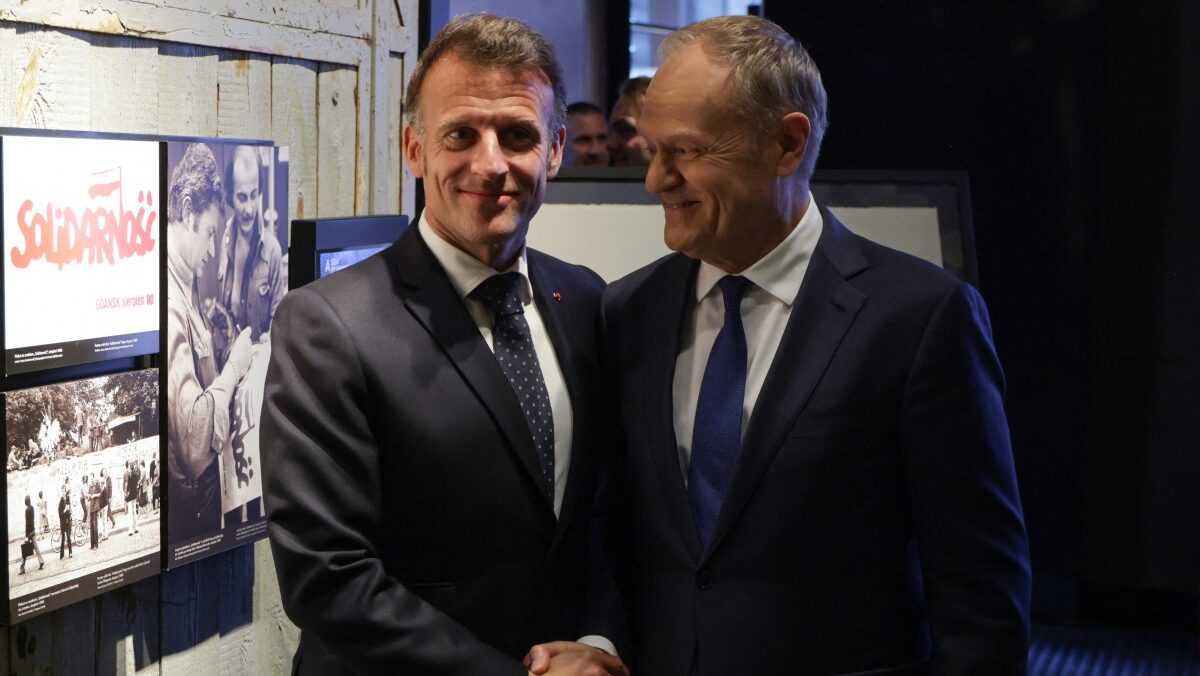
Macron and Tusk at the European Solidarity Centre in Gdańsk, April 20, 2026.
Ludovic MARIN / AFP
Almost two months ago, Emmanuel Macron announced his intention to establish a shared “advanced nuclear deterrent” with European partners. During a visit to Poland to meet Prime Minister Donald Tusk, the French president sought to move forward with one of the countries most committed to this initiative.
The meeting took place on Monday, April 20th during a summit in Gdańsk. It marks the first concrete follow-up of the Treaty of Friendship and Cooperation between France and Poland, signed in Nancy in May 2025, which elevated Poland to the rank of one of France’s closest European allies.
At a joint press conference, the French President referred to “the exchange of information,” “joint exercises,” and the possible deployment of French nuclear-capable aircraft in Poland. France, however, intends to retain full decision-making control of its nuclear arsenal.
To avoid the relationship from becoming entirely asymmetrical, the two leaders discussed possible support from Polish conventional forces for French deterrence in the areas of air defence, long-range capabilities, early warning systems, and space. The Polish Prime Minister stated that cooperation with France should have “no limits,” though he also cautioned that hosting nuclear-armed aircraft “is not my dream.”
An agreement on the development of a geostationary military telecommunications satellite for the Polish armed forces was also signed by the European groups Airbus and Thales, together with the Polish group Radmor.
The rapprochement reflects a broader convergence of interests in the face of the ongoing war in Ukraine and heightened concerns over Russia.
For France, strengthening ties with Poland is both a strategic and economic priority. Despite the professed Franco-Polish friendship, Poland has engaged in large-scale purchases of American military equipment that have not been well received in Paris, including F-35s, Apache attack helicopters, Patriot missiles, and Abrams tanks. At the press conference, Tusk also reiterated the importance of “preserving the transatlantic link,” even as uncertainty grows over President Donald Trump’s approach to European security. Poland’s defence spending currently stands at around 4.8% of its GDP, making it one of the NATO countries that devotes the largest share of its budget to defence.
Given this context, France faces a challenge in rebalancing the relationship. Poland remains closely tied to the United States, and President Nawrocki is reluctant to deepen involvement in certain EU defence initiatives, citing concerns over sovereignty. France is therefore making moves elsewhere, particularly in the nuclear energy sector. The French group EDF has entered the tender process for the construction of Poland’s second nuclear power station, with Tusk stating that “France will be considered one of our most important partners in all major projects.”