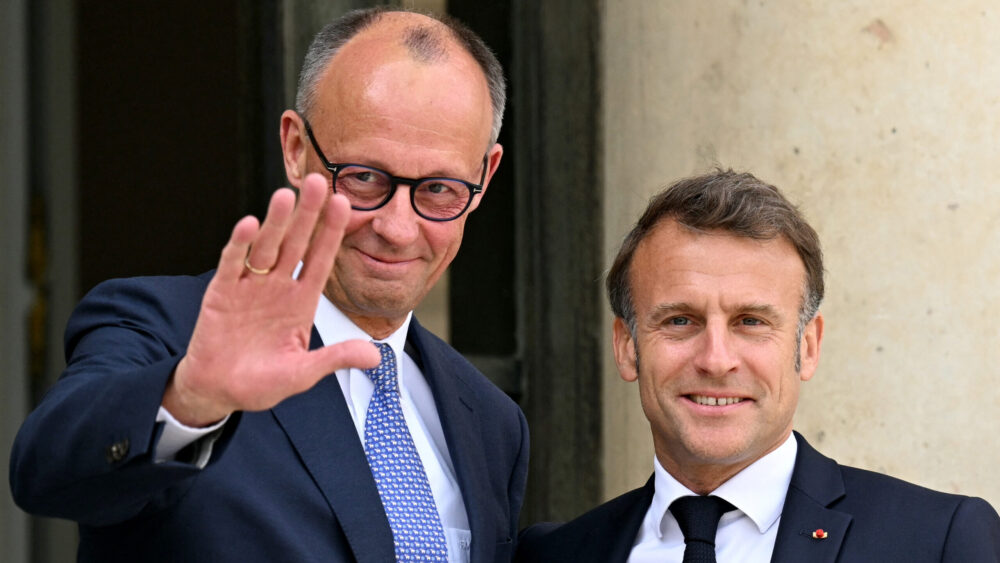
France’s President Emmanuel Macron (R) welcomes Germany’s newly elected Chancellor Friedrich Merz (L) at the Elysee presidential palace
Bertrand GUAY / AFP
French President Emmanuel Macron and newly inaugurated German Chancellor Friedrich Merz pledged a “Franco-German renaissance” during Merz’s first official visit to Paris—but behind the grand words lies a partnership forged out of political need, as both leaders grapple with fragile domestic standing and urgent calls for stronger leadership.
On May 7, Macron hosted Merz at the Élysée Palace. It was Merz’s first official visit abroad, in line with longstanding German diplomatic tradition. The two leaders hailed a “Franco-German renaissance for Europe” and declared a new era of cooperation, vowing to “resynchronize” the agendas of Paris and Berlin.
Yet behind the lofty rhetoric lies a clear political necessity: both leaders urgently need to boost their popularity. Macron is navigating one of the most difficult periods of his presidency, while Merz—inaugurated only two days earlier—has yet to convince the public. They need each other to shore up their respective leaderships.
Macron announced the creation of a Franco-German “Defense and Security Council,” set to meet this summer to deliver joint responses to Europe’s strategic challenges. He also spoke of a joint military innovation program and the ambition to reinforce European sovereignty and competitiveness. However, concrete commitments remained vague, particularly on sensitive issues like a joint European defense loan, the deployment of ground troops to Ukraine, or the provision of long-range missiles—areas where Merz continues to exercise calculated caution.
His predecessor, the socialist Olaf Scholz, followed a similar policy of prudence on security matters. After all, Germany is geographically closer to Moscow than Paris.
While Paris welcomes Berlin’s willingness to open discussions on sharing France’s nuclear deterrence with European partners, no one ignores the deep-rooted resistance within Germany. The transatlantic relationship remains a cornerstone for many in Berlin, and substantial decisions are unlikely to come quickly.
Beyond the renewed personal rapport between Macron and Merz, the deeper fractures within the European Union cast a shadow over any effort to relaunch the bilateral axis. Tensions between Poland and Germany, divisions between East and West over attitudes toward Russia, and the enduring economic rifts between North and South are open wounds that even a perfectly synchronized Franco-German duo cannot heal overnight. As Brussels insiders warn, the “Franco-German engine” risks stalling without wider European support—something unimaginable just years ago.
Even if Paris and Berlin manage to tighten their cooperation, the bigger question is whether Europe has the real capacity to shape global affairs. While the United States and China set the rules of the technological, military, and commercial game, the European Union remains bogged down in internal debates and bureaucratic infighting. The Franco-German axis may sound impressive in speeches, but on the international chessboard, the decisive moves are being made far from Brussels.
Meanwhile, the Brussels elite continues to pursue its policies regardless of the consequences. Hopes for a course correction increasingly rest on events outside Europe.
Merz’s profile is far from that of a consolidated leader. His swearing-in was turbulent—he unexpectedly lost a first vote in the Bundestag, marking the first such defeat since World War II—and his coalition is fragile. Many within his own party doubt his ability to sustain an ambitious agenda or provide clear direction. Gestures toward France may generate headlines, but whether Merz can turn them into policy remains unclear.
Macron, for his part, arrives at this phase politically weakened. Domestically, his administration is deeply worn down, social opposition is mounting, and his room for political maneuver is increasingly narrow. Betting on the European stage offers the French president a chance to regain oxygen and reclaim relevance. Yet at home, many citizens criticize that his international ambitions divert attention and resources from urgent national issues. Even after sidelining Marine Le Pen, Macron has failed to regain meaningful political breathing space.
What emerges from this summit is not a genuine rebirth of the Franco-German axis but rather an alliance born out of necessity. Macron needs Merz to avoid isolation in Europe; Merz needs Macron to project the leadership he has yet to build domestically. Behind the polished “European renaissance” lies more choreography than reinvention.
Meanwhile, Germany’s CDU maintains control over Europe on three levels: nationally—through Germany itself—and at the European level, both in Parliament with the EPP’s Manfred Weber and in the executive branch with Ursula von der Leyen.