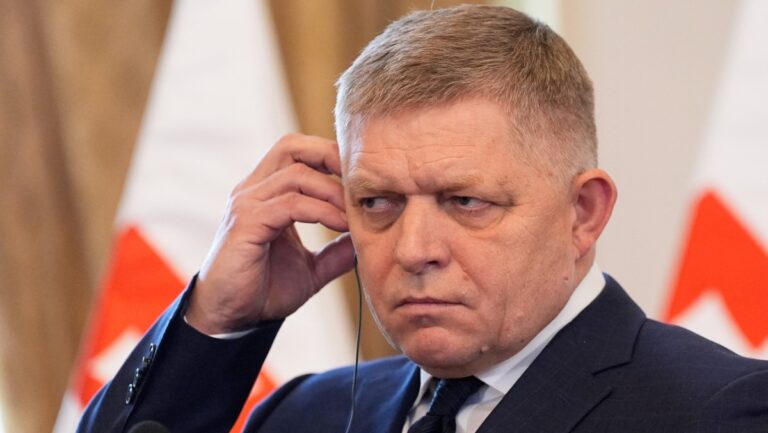
Spain’s Prime Minister Pedro Sánchez addresses journalists after a meeting with King Felipe VI of Spain at the Marivent Palace in Palma de Mallorca on July 29, 2025.
Jaime Reina / AFP
Tensions between Spain and the United States, intensified under Pedro Sánchez’s presidency and initiated under José Luis Rodríguez Zapatero in 2004, have resulted in trade and diplomatic frictions that threaten to place the Iberian country in a position of vulnerability vis-à-vis a traditional ally.
The disputes are around issues such as refusal to purchase F-35 fighter jets, a controversy over Huawei, and the recent loss of the Port of Algeciras to Morocco.
The cooling of bilateral relations dates back to disagreements with Donald Trump within NATO, when Sánchez refused to accelerate the increase in defense spending to 2% of GDP, the target set by the Alliance. The refusal to purchase the American F-35—chosen by several European allies to guarantee interoperability—added to the friction, interpreted in Washington as a political and military snub. The perception that Spain is reinforcing its technological and energy dependence on partners outside the Western bloc further aggravates the situation.
THE OBJECTIVE’s publication of contracts worth €12.3 million between the Spanish Government and Chinese Huawei, including for the police wiretapping system Sitel, triggered alarms in the U.S.-China Economic and Security Review Commission. The document warns that the Socialist PM’s decision breaks previous EU commitments to remove Chinese technology from critical infrastructures and could compromise the exchange of intelligence with NATO allies.
Although the controversy points at the PSOE, the truth is that the push for Chinese technological penetration in Europe has, for years, enjoyed the complicity of the main European political families—the Popular Party, Socialists, Liberals, and Greens—until pressure from Washington shifted the narrative. Today, no one takes responsibility for a dependence that Beijing has skillfully consolidated.
The recent U.S. decision, reported by ABC, to exclude Spain from a strategic maritime route at the Port of Algeciras and favor Morocco, is seen by analysts as a “tailor-made” punishment responding to the Huawei crisis and Spain’s refusal to align in defense matters. The move strengthens Morocco’s role as Washington’s preferred partner on the southern flank, to the detriment of a historic ally such as Spain.
While EU membership protects Spain from a generalized tariff like those Trump applied to India or Brazil (50% in key sectors), experts point out that Washington could apply surgical measures against specific Spanish products—as it did in 2018 with black olives, olive oil, and oranges—to maximize damage without triggering European retaliation. The agri-food sector and some export-oriented manufacturing industries would be in the crosshairs.
While Brussels prioritizes protecting the German and French industries, few in the EU expect a firm defense of Spanish interests should the U.S. decide to harden its stance. Meanwhile, Morocco continues to advance as Washington’s privileged partner in the Maghreb, consolidating a strategic advantage that could prove very costly for Spain in the immediate future.