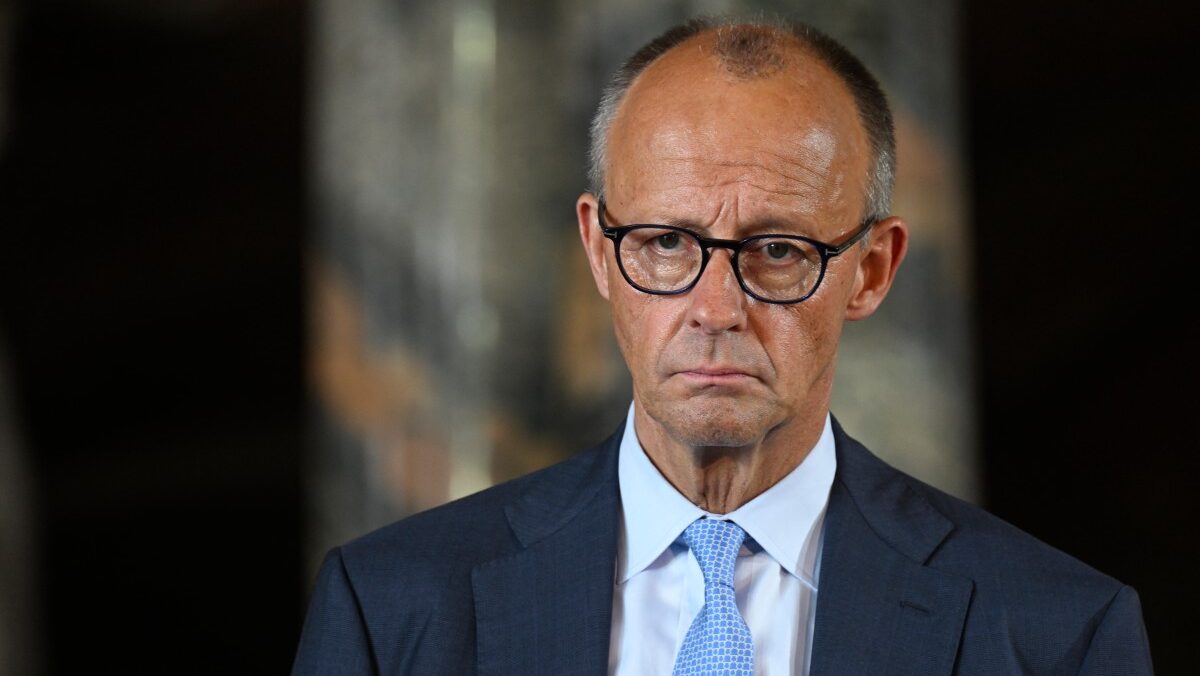
Friedrich Merz
INA FASSBENDER / AFP
German Chancellor Friedrich Merz acknowledged on Sunday that Germany is suffering from “a crisis of confidence in democracy.”
His admission comes as 68% of Germans disapprove of the government and 70% are unhappy with his performance. Alternative for Germany (AfD) has meanwhile emerged as the country’s most popular party, consistently polling at around 27%.
Merz, however, presented the problem largely as one of political tone and shared responsibility. In his summer interview with public broadcaster ZDF, he said he had left the latest session of the German parliament concerned by the aggression shown by AfD, The Left and even the Greens. The session, he said, had not been “good advertising for democracy”.
In effect, this turns a crisis caused by political failure into one of parliamentary manners, while shifting much of the responsibility onto other parties.
Merz did not mention that 71% of Germans believe cooperation between his centre-right CDU/CSU alliance and the centre-left Social Democrats is poor. Nor did he mention that 81% believe the costs of the government’s reforms are being distributed unfairly, while 79% doubt its healthcare measures will solve the system’s financial problems.
Trust is not lost because MPs raise their voices about the problems facing their country. It is lost when governments promise one policy and deliver another, when reforms increase costs without improving public services, and when elections appear unable to change the country’s direction.
Merz himself provides a clear example. Before the 2025 election, he promised not to weaken Germany’s constitutional limit on government borrowing, known as the debt brake. Just weeks later, he pushed through a €500 billion fund and exempted much military spending from the borrowing rules. The chancellor has since admitted that the reversal seriously damaged his credibility.
Less than 24 hours after winning the election, Merz also acknowledged that he would not introduce the immigration measures he had promised during the campaign in an attempt to win back voters from AfD.
Then there is the refusal of Germany’s other parties to cooperate with AfD. Although the party now leads the polls, its rivals continue to form alliances primarily designed to keep it out of power. Millions of Germans can therefore vote for the country’s most popular party but rarely see it gain any meaningful influence over government.
Germany’s crisis did not begin with bad-tempered parliamentary debates. It is the accumulated result of economic stagnation, high energy prices, mass immigration, deteriorating public services and a political class that has spent years describing opposition to its policies as a threat to democracy.
Merz has identified the symptom. What he still refuses to acknowledge is that democracy will not regain its credibility through appeals for better manners. It will recover only when voters believe that their decisions can produce genuine political change.
Germany is far from the only European country facing that problem.