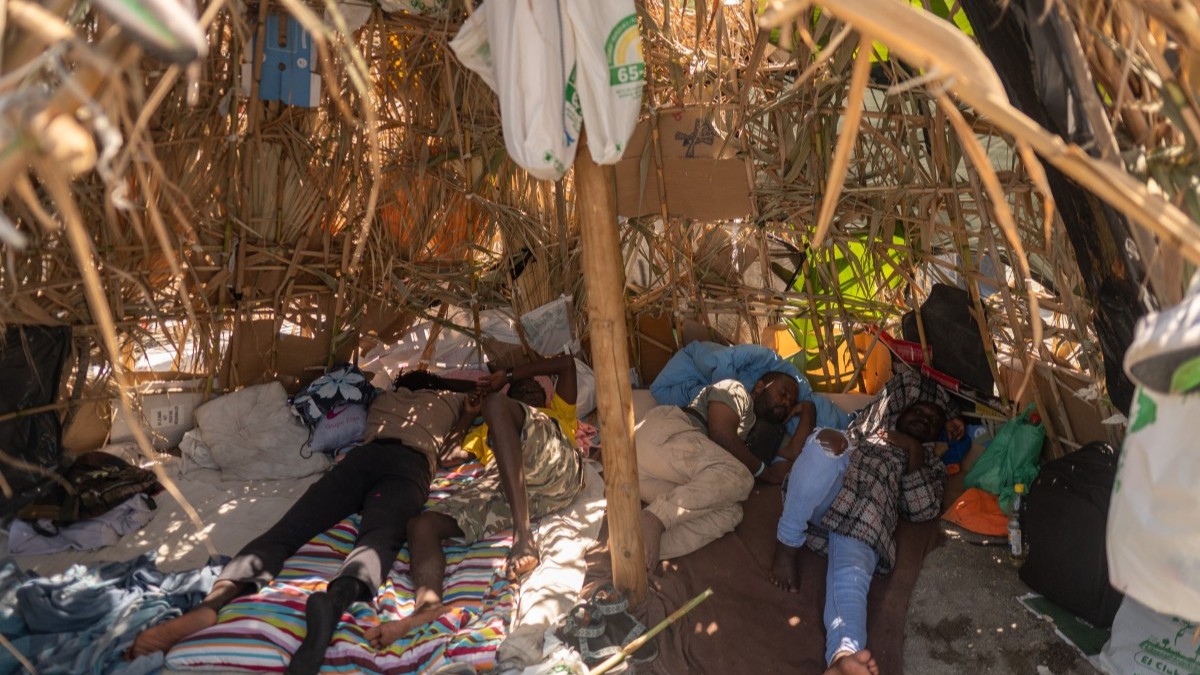
Spain’s National Police began clearing an improvised camp on the beaches of Ceuta on Thursday morning, where more than 4,000 migrants had remained since the mass crossing on July 30th.
Twenty days have passed since that border crisis, and the Spanish autonomous city is still struggling to return to a normality that remains distant.
The settlement had become one of Ceuta’s main security and public health problems. Thousands of people were sleeping outdoors, with inadequate sanitation facilities and an accumulation of waste that forced the authorities to deploy an extraordinary cleaning operation.
The health problems have also begun to affect the personnel deployed in the city: cases of scabies have been reported among police officers and military personnel.
More serious still has been the deterioration in security, particularly for women and minors. Since July 30th, at least 15 sexual assaults of varying severity have been reported, according to figures from the SUP police union.
Most of the victims are minors. No feminist association has condemned such acts by those who stormed the border.
Eleven Moroccan teenage girls have filed complaints with the National Police. As of August 17th, prosecutors had recorded 13 formally registered cases or complaints, while several cases have already reached the courts.
In one of them, a man is accused of raping a minor and subsequently forcing her to sell drugs. Five girls aged 14 or younger have also reportedly received hospital treatment following suspected rape.
As Ceuta attempts to dismantle the camp, the central government has maintained a far less clear position on what should happen to those who will remain in Spain.
Last week, Minister Félix Bolaños said the priority was to ensure that “each and every one” of the minors could be reunited with their families in Morocco. Interior Minister Fernando Grande-Marlaska likewise defended the return of those who could legally be sent back.
However, the Ministry of Youth and Children is now working on the urgent transfer of around 500 girls to facilities on the Spanish mainland.
Under the formula being considered, Ceuta would formally retain legal guardianship, while child-protection organisations would assume responsibility for their care in other regions, thereby preventing the transfers from depending directly on the approval of Spain’s autonomous communities.
The government is apparently attempting to pursue two policies at the same time that are difficult to reconcile: presenting returns to Morocco as the priority while simultaneously preparing to distribute hundreds of minors across Spain.
All this is happening while the European dimension of the crisis has virtually disappeared from Brussels’ agenda. Despite Ceuta being part of the European Union’s external border, and despite reports of sexual violence against minors, there has so far been no significant political intervention by the EU institutions.
European Commissioner Hadja Lahbib, whose portfolio covers both Equality and Preparedness and Crisis Management, has also made no specific public statement about the women and girls affected.
Astonishingly, no senior European Union official has travelled to Ceuta to assess the situation in what, so far, has been the largest assault on the European Union’s borders in its history.
Twenty days after the mass crossing, Ceuta is beginning to dismantle the camps. The crisis, however, is far from being dismantled with them.