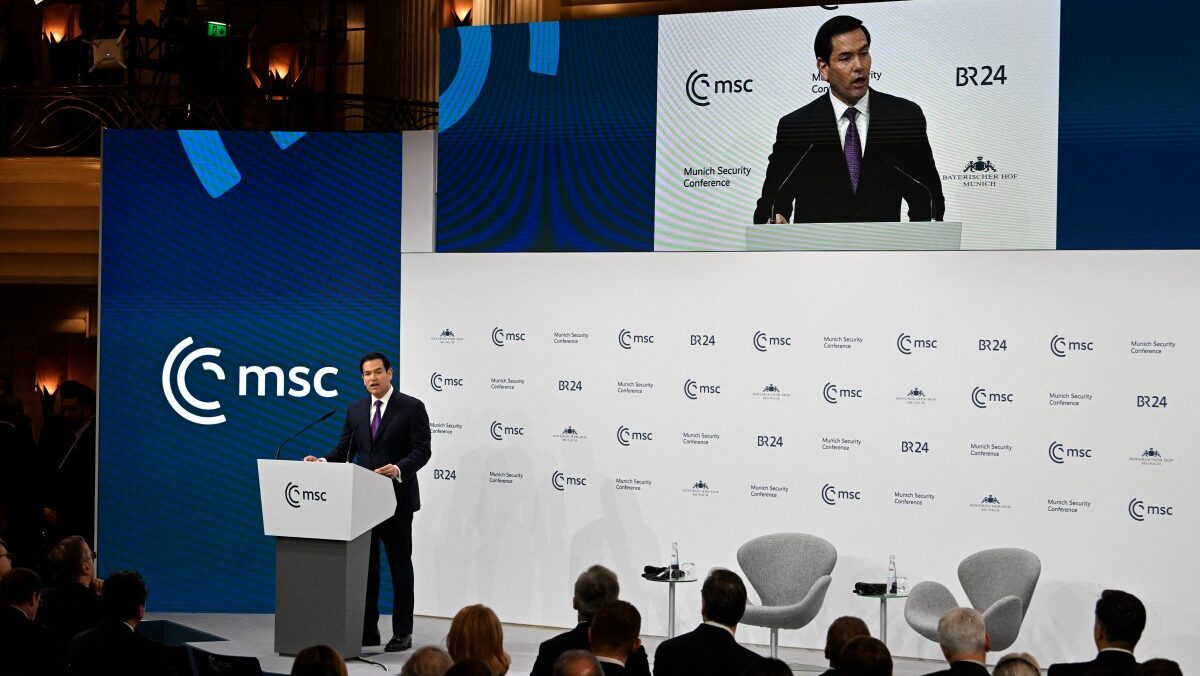
U.S. Secretary of State Marco Rubio speaks during the 62nd Munich Security Conference (MSC) on February 14, 2026 in Munich, southern Germany.
THOMAS KIENZLE / AFP
The Munich Security Conference has always been a barometer of the Atlantic mood. This year, it felt less like a ritual reaffirmation of unity and more like a carefully staged reset—one that left Europeans applauding, yet still deeply uneasy.
The defining image was the standing ovation for U.S. Secretary of State Marco Rubio after he declared that America “will always be a child of Europe.” The line was crafted to reassure. It landed well in the room. But once the applause faded, European officials began parsing what he did not say.
Many European leaders were looking for a reset in transatlantic ties. Vice President JD Vance—whose speech at last year’s conference unsettled European elites—was absent. Elbridge Colby struck a conciliatory tone toward NATO. Rubio’s delivery was smoother, less confrontational, more elegiac.
Yet several EU officials privately noted that Rubio did not explicitly address China or Russia—despite a war still raging on Europe’s eastern flank. To them, the speech was stylistically different but strategically aligned with last year’s more combative messaging.
Finnish President Alexander Stubb was blunt: “MAGA means anti-EU. It means anti-liberal world order.” German chancellor Friedrich Merz warned that the rules-based order “no longer exists in the way it once did.” Latvia’s prime minister suggested that the dynamic between Washington and Brussels had shifted irreversibly after disputes over Greenland.
The applause, in other words, did not signal restored trust. It reflected relief at tone—not clarity of alignment.
What surfaced in Munich was not simply policy divergence but a philosophical dispute over the meaning of the Western alliance.
At a panel discussion, Gladden Pappin of the Hungarian Institute of International Affairs framed the question with stark clarity. The NATO Treaty, he noted, speaks of safeguarding the “liberty, common heritage and civilization” of its peoples. Those words, he argued, are not decorative; they are foundational.
In his remarks, he suggested that the West’s freedom, common heritage and civilization “have also come under threat recently”—and that the threat has often been misdiagnosed. For years, he explained, conservative and nationally oriented voices were excluded from elite institutions. After the Cold War, decisions increasingly shifted to being made “less and less in national governments speaking for their citizens, and more and more in transnational bodies.”
The result, Pappin said, was a distortion of the postwar system: family structures weakened, borders blurred, industrial capacity eroded—developments that ultimately affect the ability to sustain NATO’s commitments.
The argument has a clear resonance. What Munich revealed is that Washington’s current leadership appears increasingly willing to articulate that critique—or at least to engage governments that share aspects of it.
Rubio’s itinerary underscored that shift. His stops in Slovakia and Hungary were not incidental diplomatic courtesy calls. They were signals.
For years, certain Central European governments have been treated in Brussels as outliers—too nationalist, too skeptical of supranational authority, too resistant to prevailing ideological trends. Yet from Washington’s perspective under the current administration, these governments represent interlocutors aligned on migration control, national sovereignty, and a more restrained approach to cultural transformation.
Hungary, in particular, has positioned itself as a defender of what it describes as Christian civilization, family policy, and border integrity. That framing has long irritated segments of the European Commission. But it now finds a more receptive audience in parts of Washington.
The emerging pattern suggests a recalibration: transatlantic ties may increasingly operate through bilateral relationships grounded in perceived value alignment rather than exclusively through Brussels-centered frameworks.
Meanwhile, discussions in Munich about a European nuclear deterrent—floated by Merz, Macron, and even voices in Warsaw—indicate a continent hedging against strategic uncertainty.
Against this backdrop, the clash between Czech Foreign Minister Petr Macinska and Former U.S. Secretary of State Hillary Clinton took on symbolic weight. Czech establishment media portrayed his performance as an embarrassment. Critics argued he lacked diplomatic finesse; supporters countered that he challenged prevailing orthodoxies.
“The actions of President Donald Trump in the United States are a reaction to the fact that some policies have gone too far,” Czech Macinska declared during a roundtable on Saturday evening. Hillary Clinton expressed firm disagreement with that assessment.
If such remarks are now considered a “national embarrassment,” some observers argue, it may say as much about the anxieties of the liberal establishment as about the tone of the exchange itself.
Whatever one’s judgment, the intensity of the reaction illustrates the broader tension. Leaders who question prevailing integrationist assumptions or progressive commitments are often framed not merely as dissenters, but as destabilizing actors.
Yet Munich itself demonstrated that these arguments are no longer peripheral. They are now central to the Western debate. Whether one views that development as overdue correction or dangerous regression depends largely on how one defines the purpose of the alliance.