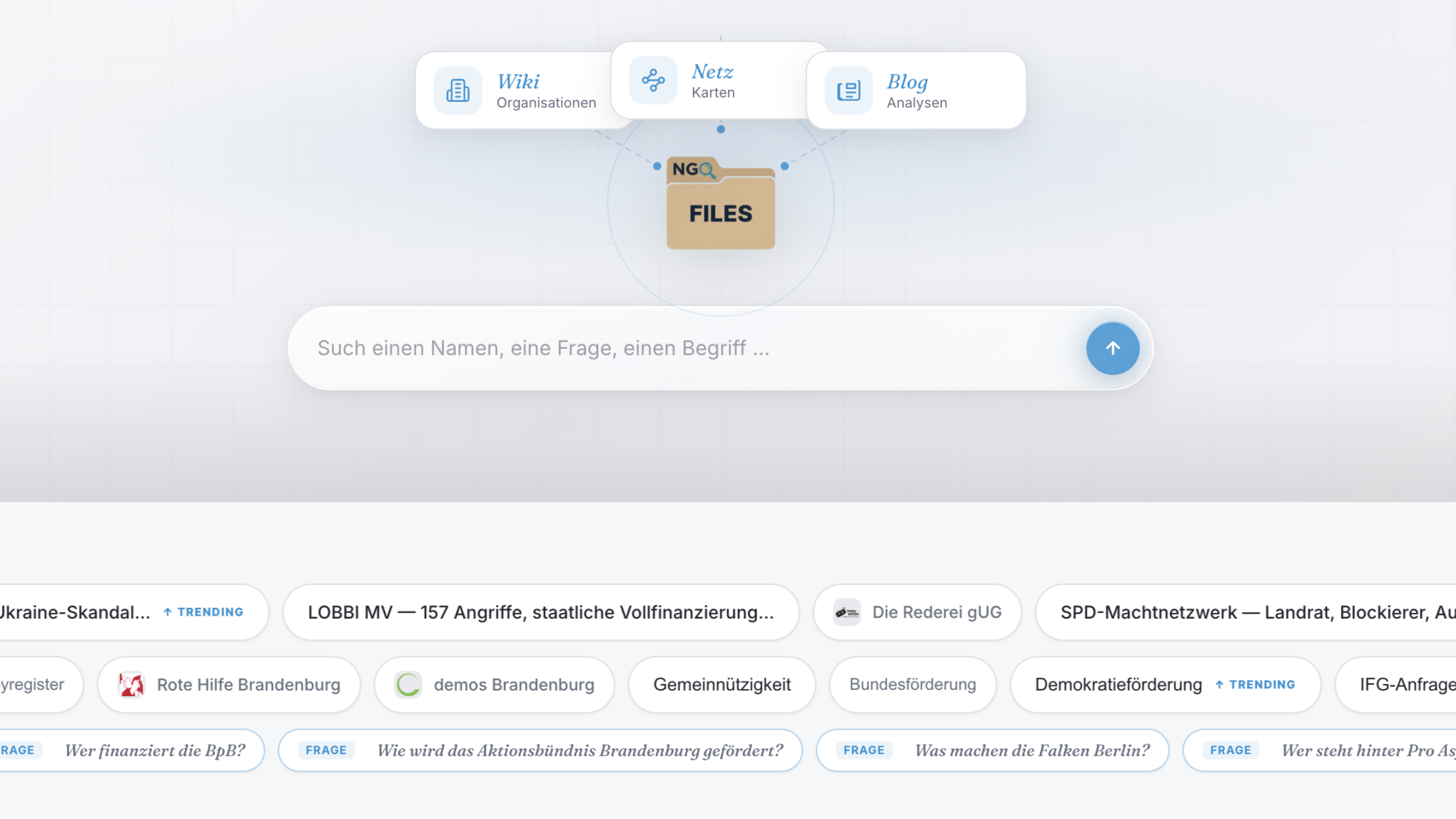
The NGO-Files website front page
Screenshot
A new website that tracks which NGOs receive German taxpayer money came under sustained cyberattacks within hours of launching, raising fresh questions about transparency, public funding, and political influence.
The NGO-Files website said it came under sustained cyberattacks just hours after going live, reporting more than 24 hours of continuous DDoS attacks, scanning, and attempted intrusions that it claims were successfully blocked.
🚨 JETZT WILL UNS DER NGO-KOMPLEX ZERSTÖREN
— NGO Files (@ngo_files) July 2, 2026
Seit gestern live, über 24 Stunden — und ununterbrochen Angriffe auf unsere Server: DDoS-Attacken, Scans, Einbruchsversuche. 🛡️ Alles abgewehrt.
👉 Folgt uns überall: https://t.co/PUSDgbc1K3
Macht uns lauter, als sie es aushalten. pic.twitter.com/PdtZbMpkxY
NGO-Files describes itself as a platform that reveals “the figures no one wants to reveal.” It says its purpose is to show which organisations receive taxpayer money, through which government programmes, how they are connected, and how they influence politics.
In Germany, as in Brussels, political influence does not only come through political parties, governments, or parliaments. It also comes through foundations, think tanks, “democracy” programmes, advisory bodies, publicly funded organisations, expert networks, and groups that present themselves as independent civil society while relying partly or entirely on state funding.
That is what gives NGO-Files its value. It brings together information that is already public and makes it easier to understand. When public money is involved, transparency is not an attack—it is a basic requirement.
German media have identified the person behind the project as Sebastian Maack, an Alternative für Deutschland (AfD) MP and spokesman for a parliamentary body investigating state funding for NGOs. The Frankfurter Rundschau described NGO-Files as an AfD-linked initiative.
That should be made clear. But it does not automatically make the project illegitimate or useless. If an AfD politician was the first to build such a tool, that may say more about the reluctance of other parties to do so than about the project itself.
For years, Germany’s main political parties have accepted a system in which some NGOs receive public funding while also taking part in political campaigns, lobbying, fact-checking, online reporting, and ideological education. The surprising part is not that someone has organised this information into one searchable database. The surprising part is that no one did it sooner.
One example is the federal programme “Demokratie leben!” (“Live Democracy”), which is due to receive €182 million a year between 2025 and 2032, according to earlier reports on AfD’s plans to examine state-funded NGOs. When governments spend large sums under broad labels such as democracy, diversity, and social cohesion, questions about political neutrality are unavoidable.
Some of the organisations listed have already responded. HateAid says NGO-Files contains false information, argues that its public funding is tightly controlled, and says it is considering legal action. If that is the case, it should present the evidence. That is how transparency is supposed to work.
If NGO-Files contains mistakes, they should be corrected. If its information is accurate, it should be debated. What should not happen is treating scrutiny of public spending as something dangerous.
The reported cyberattacks do not prove that everything on the platform is correct. But they do suggest that it has touched on an issue that many people in Germany consider politically sensitive.