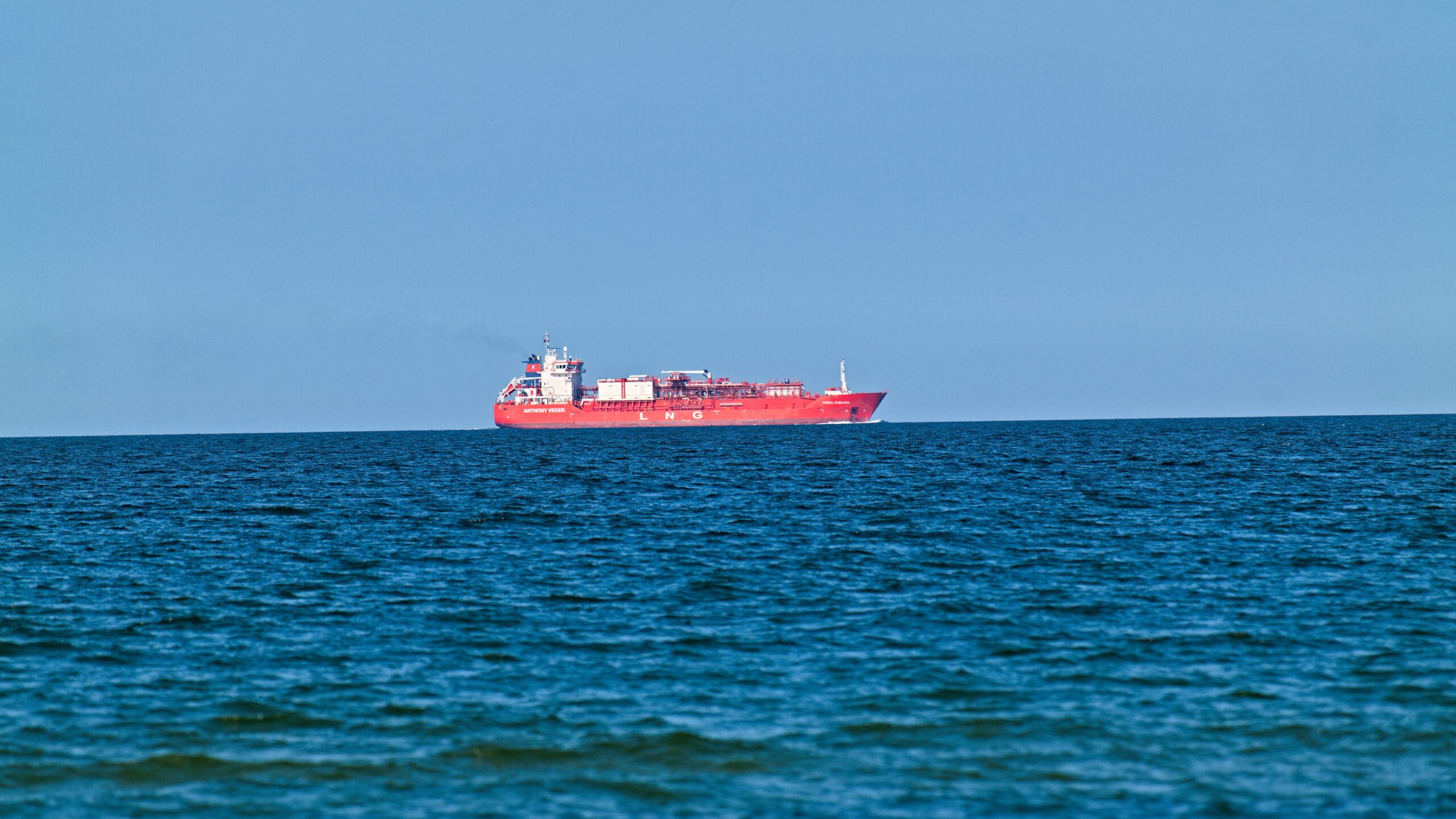
LNG tanker in the Bay of Pomerania seen from the Sellin beach in Germany in May 2023
By Leonhard Lenz – Own work, CC0, https://commons.wikimedia.org/w/index.php?curid=132571517
The latest statement made on January 26th by the European Commissioner for Energy, Dan Jørgensen, claiming that the European Union “does not want to replace one dependency with another”—referring to Russia and the United States—sounds reassuring, even comforting.
The problem is that it comes too late and, above all, stands in stark contradiction to the facts. Today, the EU has not only replaced its energy dependence on Moscow with a new one but has done so by accepting higher prices and conditions that are more rigid, making the Union strategically more vulnerable.
The commissioner made those remarks in Hamburg, during the North Sea Summit, against a backdrop of tensions with Washington stemming from the geopolitical ambitions of U.S. President Donald Trump, including his statements on Greenland. Jørgensen sought to project an image of balance: strong transatlantic relations, yes, but without slipping into energy subordination. Yet, that narrative clashes with an increasingly evident reality: Europe is now firmly in the hands of American gas.
Before Russia’s invasion of Ukraine in 2022, the EU imported around 45% of its energy from Russia. Today, that figure has fallen—according to the Commission—to around 13–19%, with the declared aim of reaching 0% by 2027. The political message to Moscow is that there will be no more ‘blackmail’ and no more indirect financing of the war. But the more relevant question is at what cost, and at whose expense?
The answer lies in U.S. liquefied natural gas (LNG). Washington has become the EU’s second-largest energy supplier, and Brussels is not only accepting this reality but actively promoting it. In September 2025, Jørgensen himself stated bluntly, “We need to import more gas from the United States.” This was not an isolated remark but confirmation of a strategy already underway.
Good meeting with @SecretaryWright in Brussels.
— Dan Jørgensen (@DanJoergensen) September 11, 2025
The EU and the US stand strong and united against Russia.
We are committed to strengthen our energy cooperation, support Ukraine and implement the Russian energy phaseout as fast as possible. pic.twitter.com/aUMIgvaDoU
That strategy was sealed in the recent EU–U.S. trade agreement, under which the 27 member states committed to importing up to €700 billion worth of American energy products.
More expensive gas—around 40% costlier than Russian gas on a comparable basis—is transported as LNG, with higher logistical and environmental costs, and tied to a trade deal that also includes accepting 15% tariffs. It is hard to see much ‘diversification’ in what the Commission describes as such.
Another key factor compounds this equation: the deliberate dismantling of a large share of Europe’s nuclear capacity. Germany is the most obvious example, but far from the only one. In the name of an accelerated, ideologised and poorly planned green transition, Europe has shut down perfectly operational nuclear plants, giving up a source of stable, affordable and sovereign energy.
The result is a situation that is difficult to explain to ordinary citizens: Russian gas is demonised for geopolitical reasons, nuclear energy is dismantled for ideological ones, and both are replaced by more expensive American gas imported under hard-to-modify contracts. All the while, the mantra of ‘reliable and affordable energy’ is endlessly repeated as a prerequisite for European competitiveness.
Even when the commissioner mentions nuclear energy, he does so by once again looking to Washington: cooperation on small modular reactors, joint projects, and business forums. European strategic autonomy, once again, is framed as a form of dependent collaboration.
Jørgensen insists that the solution lies in diversification, expanding European generation capacity, and exploiting the potential of the North Sea, especially in renewables. But these are medium- to long-term bets. In the short term, reality is stubborn: Europe has swapped one supplier for another, one dependency for another—and under worse economic conditions.