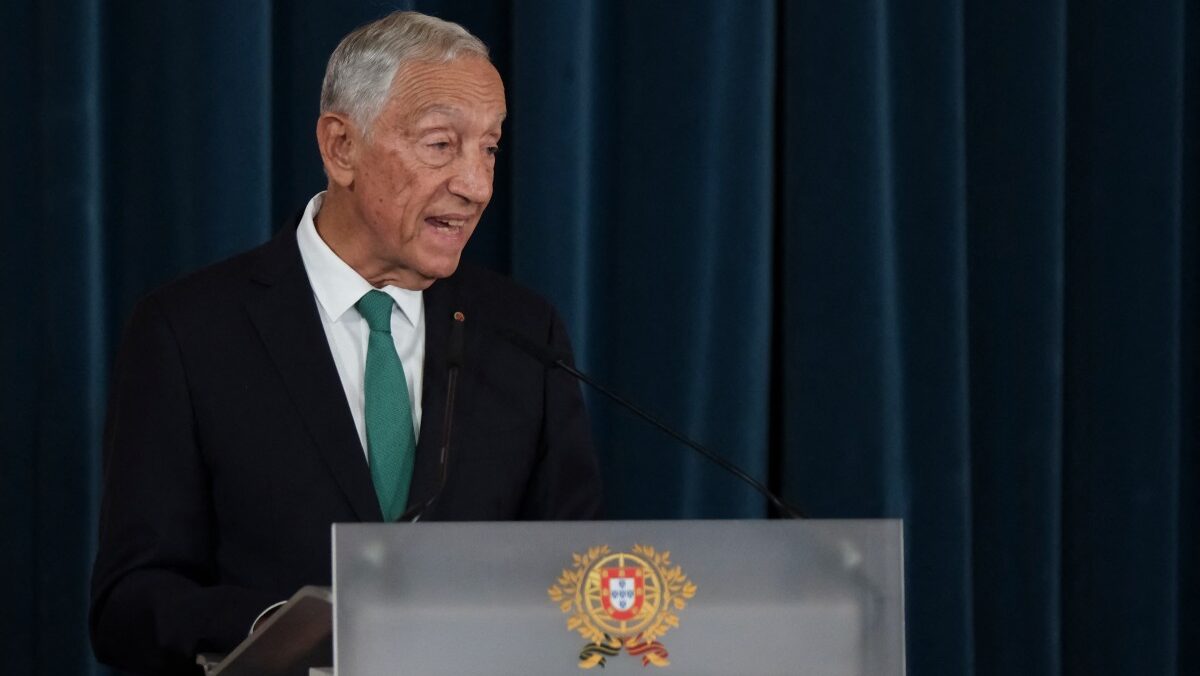
Portuguese President Marcelo Rebelo de Sousa delivers a speech during the XXV Constitutional Government swearing-in ceremony at Ajuda Palace in Lisbon on June 5, 2025.
Mario Cruz / AFP
The President of Portugal, Marcelo Rebelo de Sousa, has decided to appeal to the Constitutional Court to review the migration reform approved by Parliament. The reform introduces restrictions on the family reunification of immigrants.
The measure, promoted by conservative Prime Minister Luís Montenegro’s government and backed by Chega, the party led by André Ventura, aims to reduce the pull factor and contain the growing migratory pressure in the country, in line with other European nations that have already begun implementing stricter policies.
Rebelo de Sousa, however, has requested the Constitutional Court urgently examine several articles, arguing that they may violate constitutional principles such as family unity and non-discrimination. In an extensive statement, the president expressed concern over the measure’s proportionality, claiming that limiting reunification—for example, by requiring two years of legal residence before family members can be brought over—could represent a disproportionate restriction on the right to family life.
Even though a parliamentary majority approved the law, the president, who occupies an institutionally ambiguous position, is seeking a way to delay its implementation or even avoid signing it into law. As president, he is constitutionally obliged to do so, unless the court deems it unconstitutional. The strategy is not new in Europe. In Italy, Giorgia Meloni’s government has faced similar situations, where the judiciary—not the legislature—has blocked or delayed reforms aimed at curbing illegal immigration. Portugal now appears to follow the same pattern: with a parliamentary majority favoring tighter controls, the courts are used as the final barrier.
Chega, the main driving force behind this reform, has defended it as a necessary measure to safeguard social security, economic balance, and meaningful integration. According to its leader, André Ventura, restricting family reunification is essential to reducing the impact of a growing and increasingly difficult-to-manage migratory phenomenon.
By contrast, left-leaning sectors and the president himself argue that such measures may exacerbate exclusion, foster irregular immigration, and undermine the principle of equality before the law. The institutional tug-of-war in Europe is once again evident—between those who seek to preserve national sovereignty and curb mass immigration, and those who prioritize a broader interpretation of international human rights.