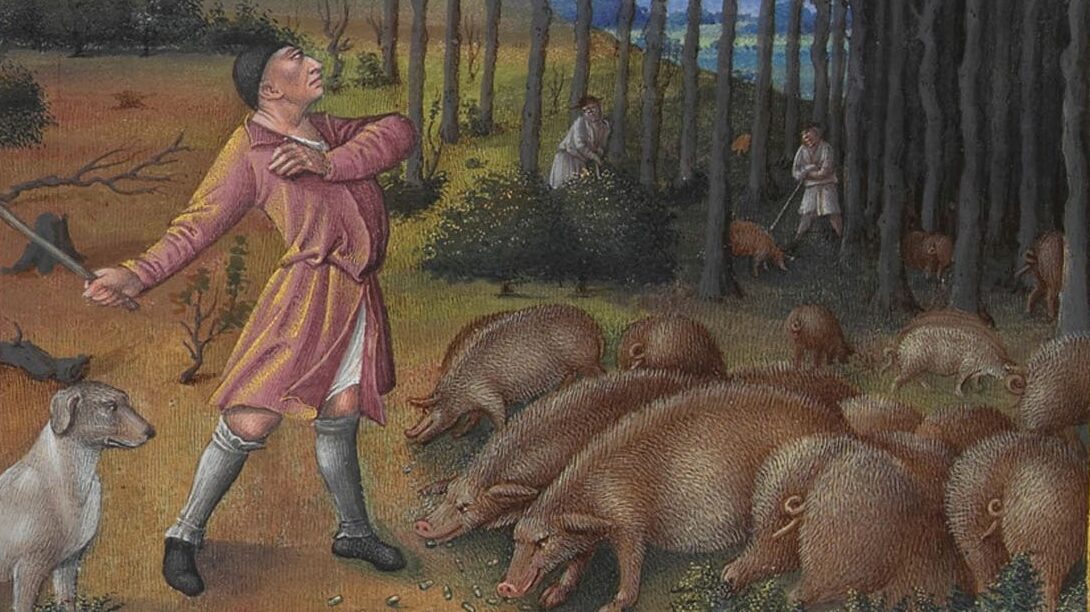
Detail from Très Riches Heures du duc de Berry (between 1485 and 1486), a 22.5 x 13.6 cm painting on vellum by Jean Colombe (1430–1493), located in the Condé Museum in Chantilly, Oise, France.
Jean Colombe, Public domain, via Wikimedia Commons
The controversy surrounding the banquets organised by Le Canon français shows no sign of abating. The initiative, launched by two young entrepreneurs to revive traditional banquets centred on culinary specialities from across France, has come under fire from the press and the Left on the grounds that it perpetuates an ideology of exclusion and promotes far-right ideas. The rector of the Paris Mosque has spoken out publicly to, in turn, attack these festive gatherings which bring together several thousand enthusiastic guests in towns and cities across France.
In a video dated April 29th, Chems-Eddine Haffiz, rector of the Paris Mosque—who, given his official position, is regarded as a kind of spokesman for Islam in France—lashed out at the Canon français and its banquets: the fact that it celebrates a cuisine featuring pork, he claimed, is proof of a logic of exclusion. He condemns the “4,000 guests gathered around a spit-roasted pig” and accuses them of “symbolically” excluding those who do not share this cuisine—that is to say, Muslims.
His statement was met with outraged reactions from right-wing politicians, as well as from ordinary “canonniers”, as the participants in these popular feasts are known.
The conservative mayor of Chalon-sur-Saône, Gilles Platret, took offence at Haffiz’s statement, describing the rector’s outburst as “delusional.” “We have the right to celebrate without being accused of exclusion,” he pointed out, whilst announcing his intention to host a banquet in his Burgundy town soon. On social media, Platret accuses Haffiz of being “a mouthpiece for the dictator Tebboune” and questions the rector’s true motives:
What is he after? To ban banquets where the food served isn’t halal? This is a dangerous trend that I would describe as seditious, as it is likely to accelerate the process of communal conflict. Which, incidentally, would not be unwelcome in Algiers.
On May 5th, MEP Marion Maréchal also reacted on X, pointing out that there is nothing exclusive about eating pork, but that it is one of the oldest and most fundamental ingredients in French cuisine, throughout the country:
We are in France: here, we eat pork in all its forms, always and everywhere. If that doesn’t suit you, you’re free to go and live elsewhere, for example, in a country that applies Sharia law.
Much to the chagrin of the organisers, who refuse to be politicised against their will, the banquets are now at the heart of an intense political battle—not to say a clash of civilisations.
It is a fact that French cuisine has celebrated pork in all its forms for centuries: sausages and saucissons, boudin, sauerkraut, terrines and pâtés have reigned supreme on French tables since time immemorial and are an integral part of the national consciousness. A saying well known to gourmets and peasants alike proudly declares that “everything in the pig is good” (tout est bon dans le cochon). Not a single region, from north to south, from Brittany to Alsace, lacks a pork-based recipe among its specialities. Since the Middle Ages, the motif of the pig has been omnipresent in both sacred and secular iconography, proof of the royal status it holds in the French imagination. We see it being reared in oak forests; we delight in the folk festival honouring its slaughter, a promise of culinary delights once the animal has been prepared.
It is not just in cinema that it takes centre stage in plots, as in a masterpiece such as La Traversée de Paris, whose story revolves around the perilous transport of a freshly slaughtered pig through the German-occupied city.
With all due respect to the rector of the Paris Mosque, a ‘pig-themed’ festival excludes no one. Those who do not eat it are simply not obliged to come, just as no one is obliged to attend a rock concert if they only like baroque music (or the reverse). The fact that the consumption of pork is now perceived as a factor of exclusion speaks volumes about the mental confusion and the militancy of some.