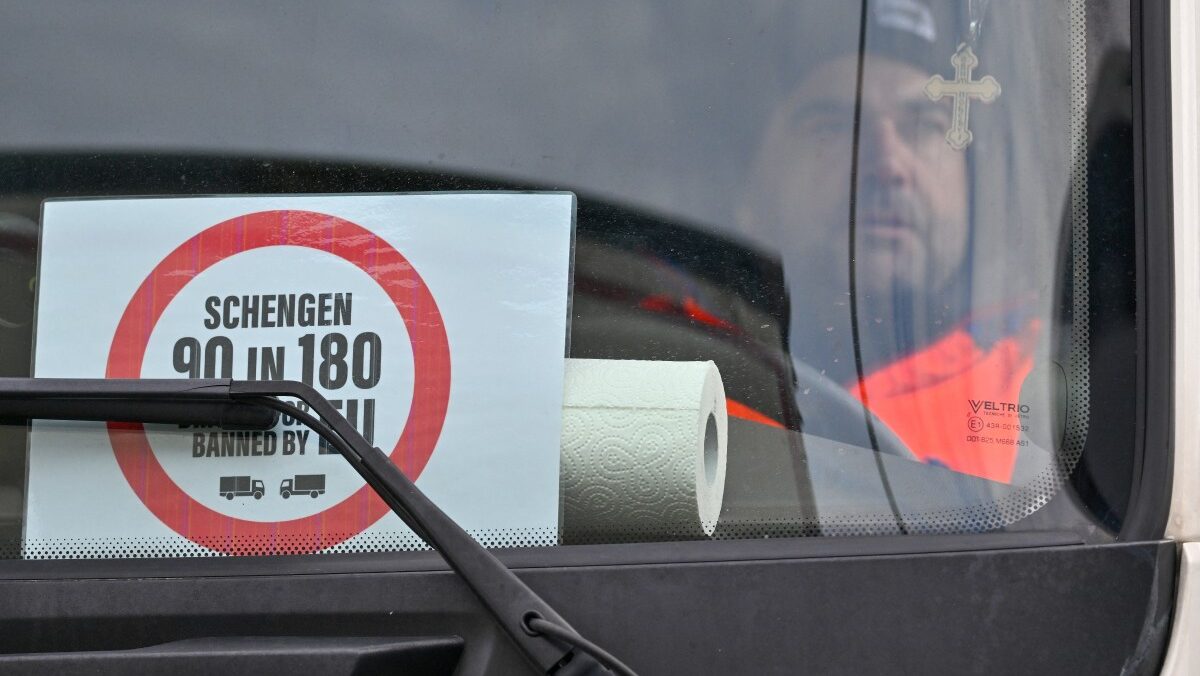
A Serbian truck driver waits in his truck at the Batrovci border crossing between Serbia and Croatia on January 26, 2026, as hundreds of truck drivers began blockading freight border crossings several Balkan countries, demanding changes to the European Union visa system that restricts their time in the EU.
ANDREJ ISAKOVIC / AFP
In Brussels, the word of the moment is ‘competitiveness.’ It is repeated in corridors, speeches, and strategic documents. But the reality—whether one likes it or not—is that the much-vaunted single market does not truly exist. Europe speaks of a single market, yet, in practice, it still operates as 27 different markets.
Matthias Bauer, economist at the European Centre for International Political Economy (ECIPE), made this point on Tuesday during an event focused on intellectual property and the need to strengthen transatlantic cooperation, organised by the International Property Rights Alliance.
Bauer did not merely question Brussels’ political slogans. He went further: “Europe cannot afford strong research—including public academic research—but weak commercial innovation.”
Europe conducts strong research. Its universities produce talent and knowledge. The problem arises when it comes to turning that research into companies capable of growing, exporting, and competing on a global scale.
In the United States, he explained, a startup can operate within a relatively coherent federal framework. In Europe, expanding from one country to another means navigating different tax systems, distinct labour regulations, and uneven judicial procedures. “We don’t have a single market as compared to what we have in China or the United States,” he insisted.
This is not just about bureaucracy. It is about scale. And without being able to expand, innovation remains small.
Italian MEP Stefano Cavedagna (ECR), who hosted the event, opened the discussion with a reflection that went beyond legal technicalities. “We have to treat IP [intellectual property] not just as a technical matter,” he said. Intellectual property, he argued, is “directly linked to industrial policy, economic security, and international competition.”
At a time when the United States is reassessing its global role and China is consolidating its technological weight, Cavedagna maintained that Europe must “keep together the West.” But that unity, he suggested, cannot rest solely on shared values; it requires a solid economic foundation.
Philip Thompson, from the Property Rights Alliance, added another piece to the puzzle. After reviewing recent trade agreements, he issued a clear warning: “It looks like there’s a lot that Europe is leaving on the table.”
While the United States has negotiated more ambitious standards in certain areas of regulatory data protection and patents, the European Union—according to his analysis—has been more cautious. In an international context marked by trade tensions and a reassessment of alliances, that unused margin is concerning.
“I don’t think we should let tariffs get in the way of negotiating higher standards,” he added, urging policymakers not to turn commercial frictions into a structural obstacle.
Experts also expressed concern about the impact on parts of the business community. Michael Jäger, CEO of the European Economic Senate, put it bluntly: “I’m really afraid if it’s regulated on a European level.”
His concern is not European cooperation itself, but that harmonisation could translate into additional layers of regulation rather than simplification. “We need less regulation,” he said, reminding the audience that for many companies, the problem is not a lack of rules but their accumulation.
The exchange reflected a real tension within the European project: how to advance toward greater coherence without suffocating private initiative. Much of what is being done in the name of European homogenisation does not necessarily make life easier for citizens at the regulatory level.
What began as a discussion about intellectual property ended as a broader conversation about the European model—about its ability, or inability, to act as a genuine economic bloc.
The single market functions reasonably well for physical goods. But when it comes to services, technology, or digital companies, the cracks become visible. And those cracks have political consequences.
At a moment when transatlantic relations are entering a new phase, Europe needs more than declarations of intent. According to the experts, it must prove that it can act as a truly integrated economic space.
Bauer’s remark was not a slogan or an attack. It was, rather, a wake-up call.
If Europe does not complete its own market, it will struggle to negotiate on equal terms with Washington or compete with Beijing—especially considering that access to the so-called single market has historically been one of the main attractions of EU membership.
And in that gap—between discourse and reality—lies a significant part of the continent’s economic future.