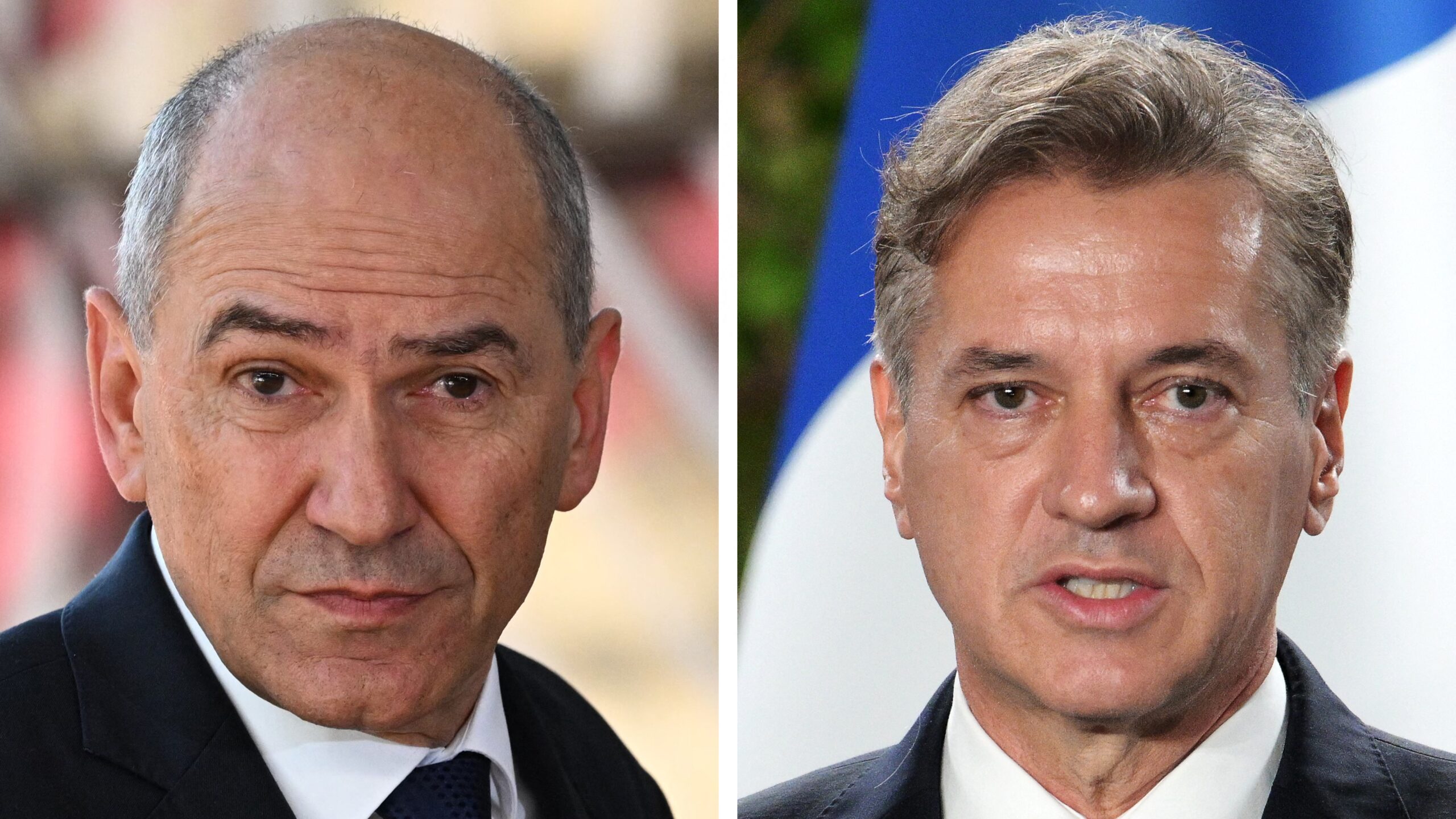
Slovenia’s Prime Minister Janez Janša in Brussels, on May 31, 2022 (L); and Slovenia’s Prime Minister Robert Golob in Portorož on October 20, 2025
EMMANUEL DUNAND / AFP
Slovenia heads into a closely contested parliamentary election this Sunday amid fresh corruption allegations involving the left-wing government that have shaken confidence in the country’s democratic institutions.
The vote pits the conservative opposition, led by former prime minister Janez Janša, against the left-liberal government of Prime Minister Robert Golob. While Janša’s Slovenian Democratic Party (SDS) has long maintained a lead in opinion polls, the gap has narrowed in recent weeks.
Janša, a veteran politician, three-time prime minister, and an ally of Hungarian Prime Minister Viktor Orbán, has campaigned on a platform of restoring Slovenian values, emphasising traditional family structures and pledging to curb state funding for politically active NGOs.
In the Central European country of two million people, his message has resonated with voters frustrated by economic mismanagement and mounting bureaucratic pressure under the current administration.
That discontent has intensified following the emergence of secretly recorded videos exposing corruption among figures linked to the ruling coalition.
In one recording, for example, the Secretary General of PM Robert Golob’s party states that Infrastructure Minister Alenka Bratušek siphoned around €2.5 million from a railway project. In another, prominent lawyer Nina Zidar Klemenčič explains how the construction of a hotel in Ljubljana secured permits by paying a 10% commission to the son of the mayor.
BREAKING:
— Visegrád 24 (@visegrad24) March 17, 2026
Major corruption scandal hits Slovenia’s government & its left-wing prime minister Robert Golob just days before the parliamentary election
Top members of his party have been recorded on tapes in which they allegedly discuss the corruption schemes of a minister and… pic.twitter.com/2Lo7KVXlgT
Instead of addressing the substance of the allegations, the government has focused on claims of foreign interference. Foreign Minister Tanja Fajon described the affair as a “direct attack” on the country’s sovereignty, while Golob called on the European Union to investigate “for an immediate threat assessment.”
Left-wing Slovenian rights groups and journalists have suggested the Israeli private intelligence firm Black Cube may have been behind the release of the recordings, and accused Janez Janša and his party of involvement. The opposition has dismissed the accusations as politically motivated.
Speaking to europeanconservative.com, Slovenian journalist Bogdan Sajovic argued that the tapes are “quite damaging to the government,” and that efforts are underway to shift public attention away from them.
“They are trying to shift the focus of attention away from the government on Janša,” he said, adding that claims the opposition leader orchestrated the scandal were “totally absurd.” Sajovic also emphasised that the government has “the bulk of the media on their side,” who are amplifying the government’s narrative while downplaying the content of the recordings.
The scandal has also revived long-standing concerns among conservatives about left-wing political influence over institutions and the media. According to Sajovic,
The Left is worried that if Janša wins the election, he could start breaking this system, because a lot of people live off this system. The core of left-wing voters are employed in the deep state, or they are related to someone who is in the deep state, or working for non-governmental organisations who are financed by the deep state. This is a closed network.
In an earlier interview with europeanconservative.com, SDS MEP Branko Grims accused Slovenia’s deep state of systematically abusing the judiciary to weaken the opposition. PM Golob has also been cracking down on conservative media and intimidating journalists with unjustified police raids.
Janša is also accusing the government of reckless spending and ideological policymaking. He has warned that Slovenia risks falling behind regional competitors if current policies continue.
Despite Golob’s initial popularity following his 2022 election victory—when his Freedom Movement secured more than a third of the vote—recent polling suggests a much tighter race. The outcome may ultimately depend on turnout and the performance of smaller parties, including a new centre-right grouping that could play a decisive role in coalition talks.
Slovenia, Mediana poll:
— Europe Elects (@EuropeElects) March 17, 2026
SDS-EPP: 31% (+4)
GS-RE: 25%
L/Vesna-LEFT|G/EFA: 8% (-2)
Demokrati~EPP: 8% (+1)
NSi/SLS/Fokus-EPP|EPP|*: 7% (-1)
SD-S&D: 7%
Resnica→NI: 5% (+1)
PSS-G/EFA: 2% (-2)
SNS→PfE: 2%
Prerod-G/EFA: 2% (+1)
Mi, socialisti-*: 2%
Stranka generacij/ZS-*|~RE: 1% (+1)… pic.twitter.com/bFcFP4CRh1
The most recent surveys suggest that both the Freedom Movement and SDS are on course to receive around 25-30% of the vote.
A coalition government led by Janez Janša would align Slovenia more closely with the group of Central European countries that promote conservative social values, adopt a firm stance against illegal migration, oppose progressive “woke” policies, and maintain strong support for Israel.