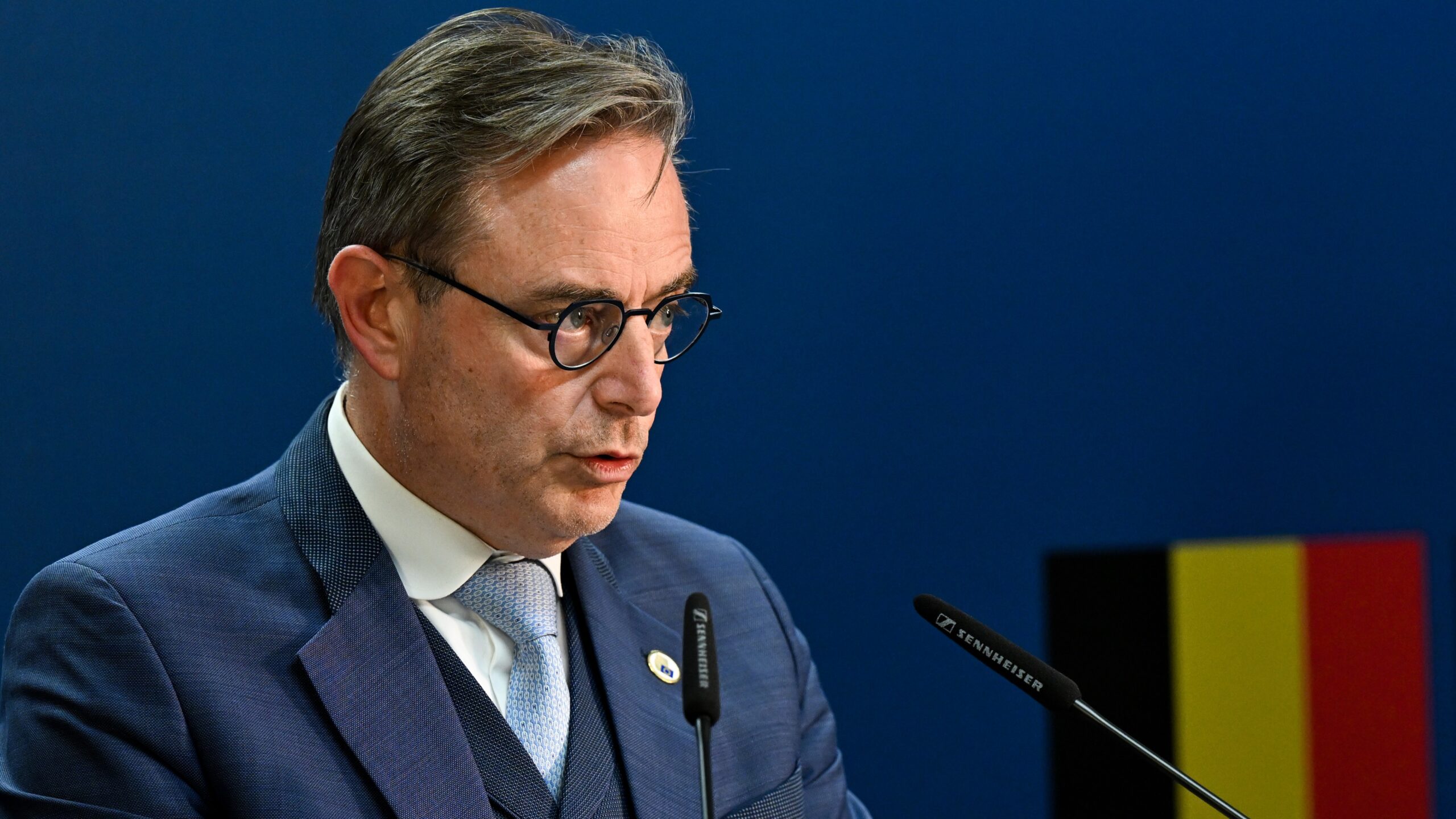
Belgium’s Prime Minister Bart De Wever
By © European Union, 1998 – 2026, Attribution, https://commons.wikimedia.org/w/index.php?curid=174974706
“There is no money.” Belgian Prime Minister Bart De Wever’s remark this week captured, more clearly than any European Commission report, the dilemma now facing much of Europe.
Belgium, one of the European Union’s most energy-import-dependent countries, has been hit hard by the new spike in fuel and gas prices caused by the war with Iran and the disruption of shipping through the Strait of Hormuz. Yet despite mounting political pressure, De Wever has ruled out any new broad support package for households and businesses.
“I did not say that people should not be helped. I said there is no money,” he told the Belgian parliament.
The Belgian government has approved only a limited emergency package of around €60 million, financed through the extra tax revenues generated by higher energy prices. The money will go to vulnerable households and to workers who depend on their cars to commute. But De Wever rejected larger measures such as across-the-board fuel tax cuts or new universal energy subsidies.
Belgium’s problem is not simply political. It is fiscal. The country is expected to run a budget deficit of 5.3% of GDP this year, rising to nearly 6% by 2027, while economic growth is projected to remain around 1%.
After years of crisis spending, Belgium no longer has the fiscal room it once had. The COVID-19 pandemic, the energy shock after Russia’s invasion of Ukraine, and the subsequent increase in defence spending have left public finances severely weakened. Now another geopolitical crisis has arrived before European governments have had time to rebuild their budgets.
Belgium is not alone. In reality, it is merely the first European government willing to say publicly what many others now admit privately: Europe has largely exhausted its capacity to spend.
The current energy shock comes after three consecutive crises that have drained public finances across the continent.
First came the pandemic, when European governments spent hundreds of billions of euros on furlough schemes, business support, and emergency welfare programmes. Then came the war in Ukraine, which forced governments to subsidise electricity and gas bills, reduce fuel taxes, and increase military spending. Now the conflict with Iran and the disruption of one of the world’s most important oil routes have triggered a new surge in energy prices.
Brent crude has returned above $100 per barrel, while European gas prices have climbed sharply again. But unlike in 2022, governments no longer have the financial capacity to absorb the shock through massive public spending.
Several European countries are now approaching what economists sometimes describe as technical fiscal exhaustion: the state can still function, but it no longer has enough budgetary space to finance another major emergency without significantly increasing debt or risking a market reaction.
France offers one of the clearest examples. Paris has already signalled that it cannot repeat the expensive “tariff shield” that kept electricity prices artificially low during the previous energy crisis. France’s public debt is above 110% of GDP, and the cost of financing that debt continues to rise.
Italy faces a similar problem. Rome spent more than €90 billion on energy support between 2022 and 2024. With debt close to 140% of GDP, Prime Minister Giorgia Meloni’s government has ruled out another round of universal subsidies and is considering only limited aid for specific industries.
Spain is also quietly retreating from broad support measures. Fuel discounts have disappeared, while new assistance is increasingly restricted to low-income and energy-vulnerable households. Madrid argues that the return of EU fiscal rules leaves little room for another large-scale intervention.
Even Germany, traditionally Europe’s strongest economy, is beginning to hit financial limits. Berlin faces rising defence costs, higher energy bills, and economic stagnation at the same time. Interest payments on public debt are growing rapidly and are starting to consume a larger share of the budget.
Embed:https://europeanconservative.com/articles/news/war-triggers-e2000-spike-in-european-energy-bills/
The European Commission itself now appears aware that the era of massive state support is over. Brussels is preparing a new emergency framework based not on large rescue packages, but on “temporary”, “targeted,” and “limited” aid directed only at the sectors most exposed to the crisis, such as agriculture, transport, and fisheries.
This marks a major change in Europe’s political narrative. For years, governments promised that every crisis could be solved with another public spending package. COVID-19, Ukraine, and the energy crisis all reinforced the idea that the state could always intervene, always compensate, and always protect.
Now that assumption is colliding with fiscal reality.