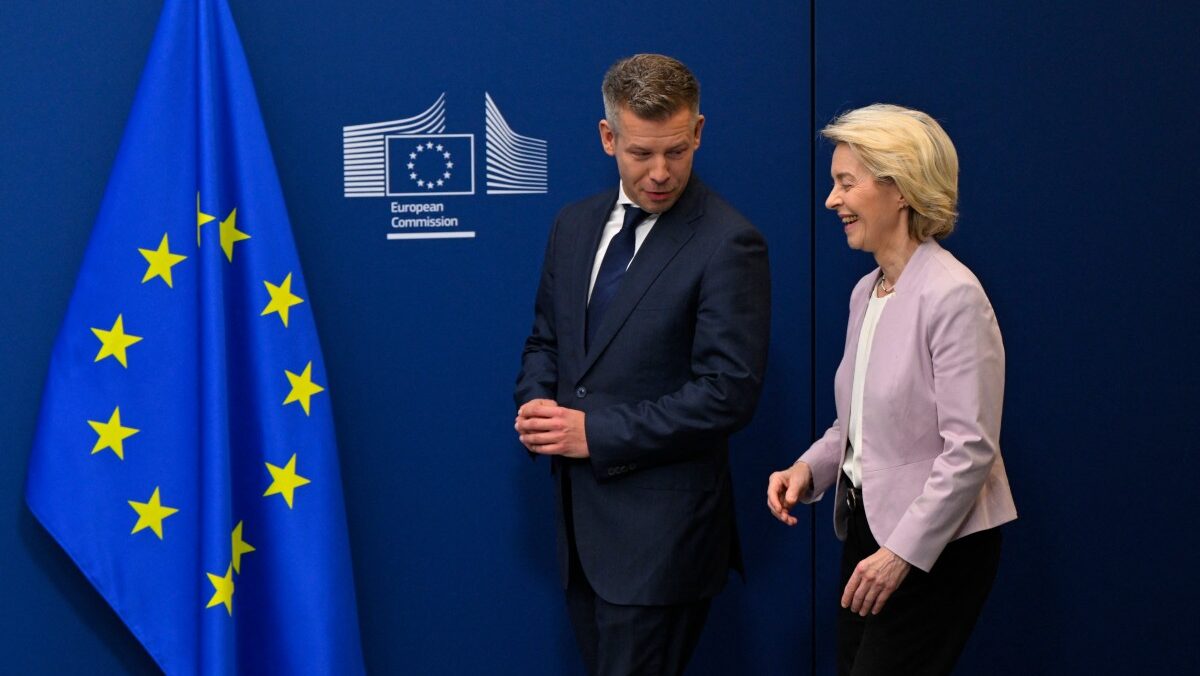
Péter Magyar and Ursula von der Leyen
JOHN THYS / AFP
European Commission President Ursula von der Leyen announced on Friday, May 29th, that Brussels would move to unlock €16.4 billion in frozen EU funds for Hungary after Prime Minister Péter Magyar’s new government committed itself to political and legal reforms aimed at restoring relations with the European Union.
Speaking alongside Magyar in Brussels following talks on Friday afternoon, von der Leyen praised the “strong wind of change” in Hungary since the centrist leader’s election victory over longtime conservative prime minister Viktor Orbán in April.
Dear @magyarpeterMP, it has only been a few weeks.
— Ursula von der Leyen (@vonderleyen) May 29, 2026
But we can feel a strong wind of change across Hungary.
To fight corruption.
Kickstart economic recovery.
And restore the rule of law.
Today we share the progress made ↓ https://t.co/juMDTzy6pD
“They chose Europe, they chose democracy,” von der Leyen added—a bizarre choice of words, since Orbán had also previously won democratically.
“In only a few weeks, you have driven forward long overdue reforms,” von der Leyen said, citing anti-corruption measures, changes to public procurement procedures, and Budapest’s planned accession to the European Public Prosecutor’s Office.
The European Commission said it would propose releasing €10 billion from Hungary’s frozen COVID recovery fund, alongside an additional €6.4 billion from cohesion funds. The recovery money had been at risk of expiring at the end of August unless Budapest submitted a revised reform plan.
Magyar hailed the agreement as a “historic day” and said his government had “fought for every euro cent” during negotiations with Brussels.
The Hungarian prime minister said the money would be used for transport, healthcare and social investments, housing projects, railway modernisation, education, research and development, and expansion of the country’s electricity grid and renewable energy infrastructure.
The Commission stressed that the release of funds remains conditional on Hungary implementing the promised reforms and agreed investments in full.
The announcement marks a reversal in relations between Brussels and Budapest after years of confrontation under Orbán’s conservative-nationalist Fidesz governments.
The EU had frozen around €18 billion over supposed ‘rule-of-law’ concerns during a period when Hungary resisted the EU’s liberal-progressive agenda, including the implementation of pro-migration and pro-LGBT policies.
Since taking office earlier this month, Magyar’s government has moved rapidly to signal a new political direction. Foreign Minister Anita Orbán declared that Hungary would no longer act as a “disruptive” force within the EU, while Justice Minister Márta Görög confirmed plans to revise Hungary’s 2021 child protection law restricting LGBT content in schools.
Brussels will most likely expect major concessions from Budapest on migration policy, Ukraine, and LGBT legislation before frozen funds are released.
The Magyar government has already pledged closer cooperation with EU institutions, support for deeper European integration, and a more constructive stance on Ukraine. Brussels also welcomed Budapest’s decision to join the European Public Prosecutor’s Office, something Orbán had long rejected.
The former prime minister sharply criticised the agreement on Friday, demanding that Magyar immediately publish the full details of what he called the “von der Leyen–Magyar pact.”
In a post on social media, Orbán questioned what concessions Hungary had made in exchange for the release of the funds. The former premier said his previous government had spent years resisting Brussels’ demands on migration, LGBT issues, taxation, utility price caps, and pensions, and claimed that any political agreement with the European Commission could only have been reached if Magyar had accepted conditions previously rejected by Fidesz governments.
In another symbolic shift, Hungarian police have announced they would not ban next month’s Pride march in Budapest, reversing restrictions imposed under the previous government last year.