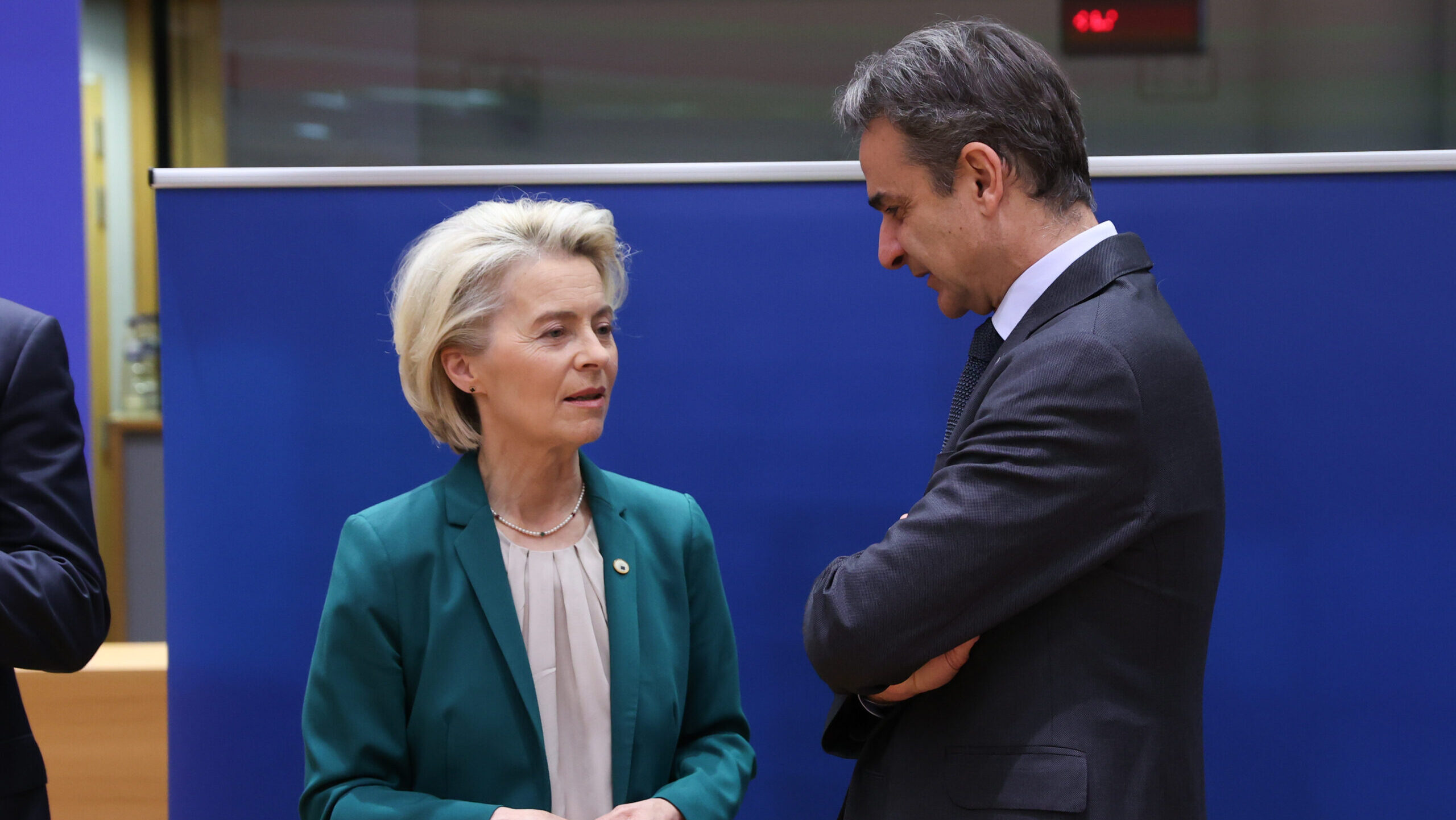
EU Commission President Ursula von der Leyen and Greek PM Kyriakos Mitsotakis.
European Council, April 2024
Despite the expectations that the departure of the national conservative Hungarian government of former PM Viktor Orbán would foster instant unity in the European Council behind Ukraine, the opposite seems to be happening.
After missing their first deadline and now fast approaching the second, member states are still divided on the question of the 21st EU sanctions package against Russia, widely advertised by the Commission as the most ambitious to date.
Now that they can no longer hide behind Orbán’s veto and let him draw the Commission’s anger alone, member states suddenly have to stand up for themselves and draw their own red lines during negotiations.
The biggest issue with the 21st sanctions package is the proposed ban on EU-based companies transporting Russian LNG (liquefied natural gas) to third countries.
Greece—home to the EU’s largest shipping sector and one particular company that would be severely affected by the measure—so far has maintained a firm ‘no,’ resulting in the current deadlock.
Athens’ EU ambassador warned that such a move would only prompt major companies to reflag their vessels and move them out of EU jurisdiction, meaning Russian LNG shipping remains at the current level while EU countries also lose out on significant tax revenue.
Greece, along with Cyprus and Malta, also oppose the extension of the EU’s price cap on Russian oil, currently set at $44.10 per barrel, which prohibits EU-based service operators from transporting or ensuring Russian oil shipments unless it’s sold below this threshold.
If no deal is reached later on Wednesday, the package would likely remain stalled until mid-fall, which Brussels wants to avoid in order not to hurt the “public perception” that the EU was standing with Ukraine, whatever it takes.
“Orbán was difficult,” one EU diplomat told Politico, “but he never actually blocked whole packages.” Yet, none of these countries are labeled ‘pro-Russian’ as Hungary had been for the past four years.
Furthermore, other proposals have already been removed from the text during negotiations in the past weeks, including a planned phaseout of Russian fish imports, after multiple countries with advanced seafood-processing industries protested it.
Austria also threatened to blow up the negotiations over the grievance of Raiffeisen Bank, which has been unsuccessfully lobbying Brussels for compensation for its loss during the expropriation of nearly €2.5 billion worth of financial assets held by a Russian oligarch.
The Commission finally promised Vienna to address the issue in a future sanctions package, which reportedly was enough for the Austrian government to drop its opposition for now.
France and Italy had their own problems too. Since both of them issue a large number of visas to Russians, they were the strongest to oppose the Commission’s proposed blanket ban on EU travel for ex-Russian combatants, which has also been removed as a result.
Italy also teamed up with Bulgaria against sanctioning Russian Orthodox Patriarch Kirill, which Pope Leo XIV also opposed, successfully forcing Rome’s hand. The planned sanctions have eventually been dropped.
What remains is still an ambitious, but significantly watered-down version of the Commission’s initial proposal. If it passes, dozens of Russian banks will also be cut off from the Western SWIFT processing system, as well as over 250 individuals who have played a hand in Russia’s war will be banned from entering the EU.