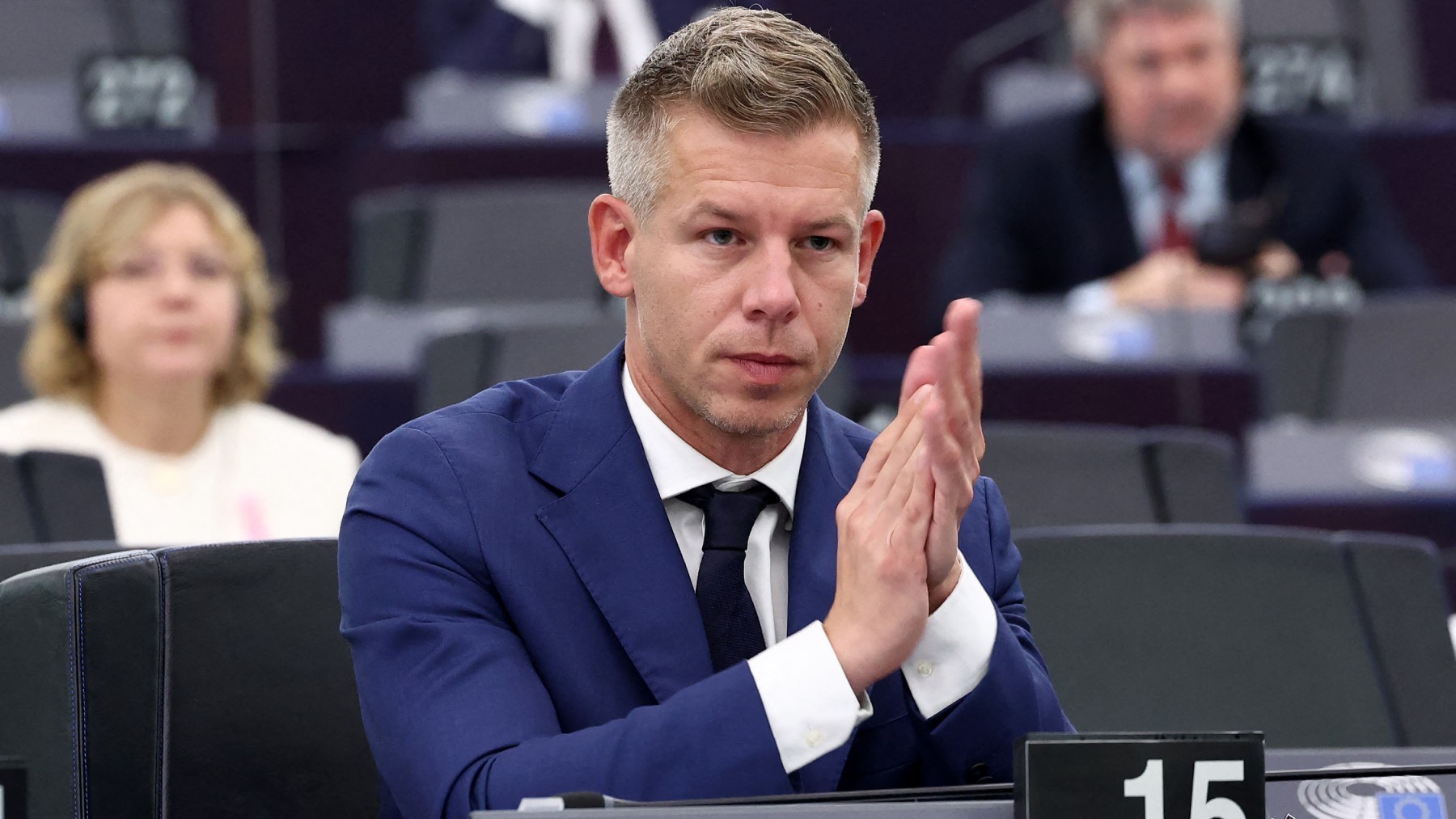
Hungarian MEP Péter Magyar attends the debate regarding the presentation of the programme for Hungary’s six-month Council Presidency, as part of a plenary session at the European Parliament in Strasbourg, eastern France, on October 9, 2024.
FREDERICK FLORIN / AFP
Those who think Hungary’s incoming prime minister Péter Magyar is some sort of an Orbán 2.0 are likely to be disappointed. His apparently conservative background and some of his symbolic posturing to appeal to right-wing voters say little about his true intentions, especially as he has hardly ever articulated those. Magyar’ victory was a blank check handed to him by a very diverse electorate that projected its hopes onto Orbán’s only viable challenger.
But we should make no mistake: Magyar may or may not have convictions or a vision regarding the future of Hungary, what he will do will be largely dictated in Brussels. He will be in Brussels today, and meet with Ursula von der Leyen behind closed doors, followed by talks with European Council President António Costa.
Europeanconservative.com has spoken with EU officials and politicians wishing to remain anonymous who say von der Leyen will present Magyar with the conditions that must be met by the new government in order to gain access to the EU funds that have been withheld from Hungary for years.
“These are not request, these are ultimatums,” one official said. “Magyar will no longer be able to have his cake and eat it too. He either delivers, or the money will not start flowing,” they added.
According to our sources, Brussels is focusing on three issues in particular on their list of demands: migration, Ukraine, and the LGBT community. The goal of the Brussels executive is to make sure Hungary complies with an EU Court ruling on accepting asylum seekers and will no longer obstruct the implementation of the Migration Pact; will align itself with the majority position in the EU about Ukraine’s accession and financing; and relax legislation that for now has shielded Hungary from the LGBT lobby’s agenda.
While, according to Politico sources, the meeting with von der Leyen on Wednesday “will ‘send a signal’ of goodwill toward Magyar as he moves to unwind Orbán-era policies,” this publication’s sources say this goodwill may be very short-lived if the PM-elect does not comply with the Commission President’s wishes.
Magyar may believe he can continue to play the double game he pulled during the elections campaign. But the reckoning may come soon: “unless he delivers, there will be no funds to prop him up,” another source told this publication.
And deliver Magyar will, it seems.
As Politico also reported, the Tisza Party plans to submit a new recovery plan to the European Commission by the end of May, replacing the exiting government’s 2021 proposal, which has been blocked based on the so-called rule-of-law conditionality ever since. Hungary would be entitled to a total of 10.4 billion euros from the 650 billion euro framework of the Recovery and Resilience Facility (RRF). Of this, 6.5 billion euros are non-refundable and 3.9 billion are loans. In order to have that funding unlocked, the government would have to fulfill 21 conditions. The Orbán government has already met around half of those. The 920 million euros that Hungary did received in advance have to be repaid if the related investments are not completed by August 31.
The Tisza team began talks with Brussels right after the party’s election victory, with key future officials including Anita Orbán, András Kármán, and István Kapitány recently travelling to the EU headquarters and a meeting in Budapest on April 19.
While we have no information about what Magyar or his aides have promised to their Brussels allies behind the scenes, there are plenty of indications that suggest the PM-elect will largely give in on the demands he is to be presented with.
As far as Ukraine is concerned, Magyar’s defense minister nominee says it all. Romulusz Szendi-Ruszin, when serving under the Orbán government in the same position, is known for having ended his remarks during NATO meetings with the “Slava Ukraini” slogan, and he reportedly took a clearly pro-Ukraine stance in official meetings (which is largely why he was replaced back then.) Also, Tisza MEPs wore pro-Ukraine T-shirts in the European Parliament for a while, until word came from Magyar that might harm the party’s chances in the Hungarian elections. It is fair to presume therefore that the new government will be willing to support Ukraine’s EU accession and, as unnamed sources told this publication, even ready to contribute financially to Kyiv’s war efforts.
When it comes to gender-related matters, as we reported, Hungary will have a new 24-hour LGBT TV channel, announced a few days after the April 12 vote. Not incidentally, the ECJ ruling that said the Orbán government had breached EU rules with its anti-gender ideology child protection laws also came out right after Fidesz’s defeat. Also, Magyar has nominated LGBT-friendly figures to serve in his administration. Judit Lannert will lead the Ministry for Children and Education. Aside from degrees in economics and social policy, she also holds a PhD in sociology but has never served in public education. She may have been selected because she displayed the Pride rainbow around her profile photo on Facebook during the protests against Fidesz’s Child Protection Law.
In addition, Péter Magyar has chosen LGBT activist and author, newly elected MP Kriszta Bódis to work in the Prime Minister’s Office, led by Bálint Ruff, to coordinate health care, education, and social policy. Bódis, who served as a socio-political consultant for Tisza during its campaign, is well-known as the author of a children’s homosexual-themed tale.
What Magyar will do on the migration question is less obvious, as he has until now vehemently asserted that he would not compromise on that. But he is likely to be required to change Hungary’s immigration policy and allow asylum seekers to apply for asylum within the country, which the Orbán government did not, resulting in a 1 million euro EU fine per day for Hungary. If Magyar wants that fine to go away, and bring home the frozen funding, he will need to make concession on that front, too. Which will mean asylum shelters opened in Hungary and migrants flowing in in large numbers. And that is definitely not what the overwhelming majority of Hungarians voted for.