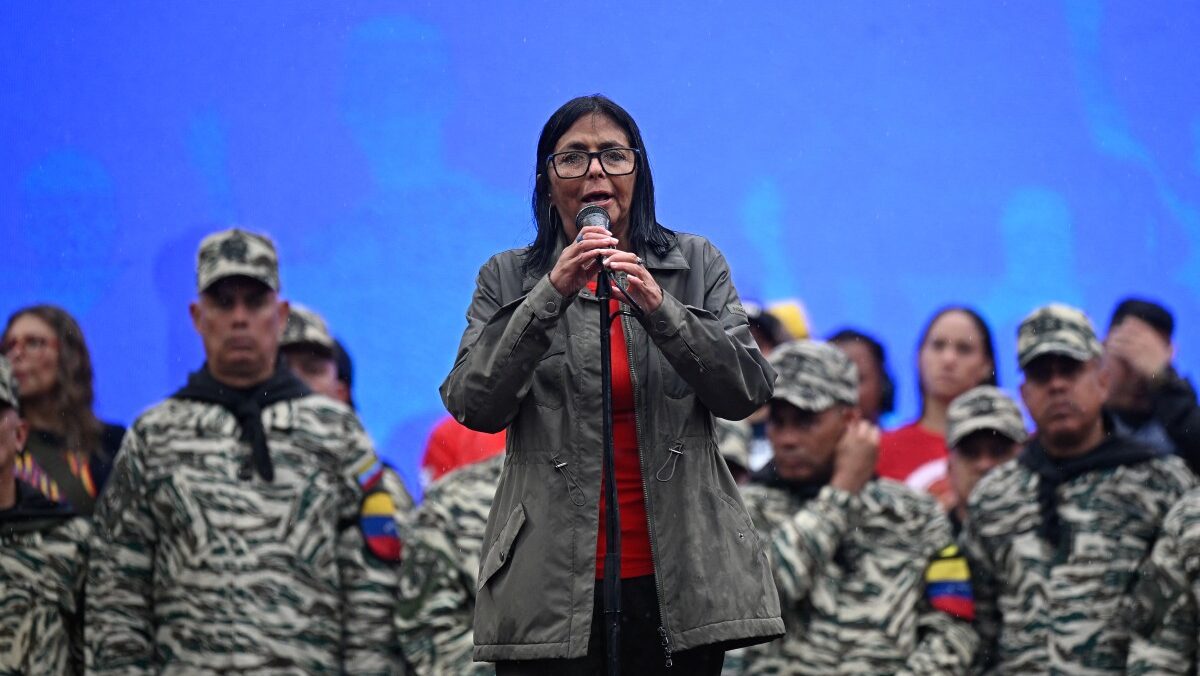
Delcy Rodriguez
Federico PARRA / AFP
Three months after the U.S. operation that removed Nicolás Maduro from power, Venezuela has not descended into chaos. There has been no civil war, no split within the armed forces, and no vacuum of power. Chavismo still governs—without Maduro and now under Washington’s close supervision.
Delcy Rodríguez took over with the support of the military and the main figures of the regime. Diosdado Cabello still controls the political apparatus, and Defense Minister Vladimir Padrino López remains in charge of the armed forces. The structure survives. What has changed is where the strategic decisions are made.
Donald Trump has repeatedly described the January operation as “the perfect scenario.” From the White House’s perspective, there are reasons for that. Venezuela has not become another Iraq. The United States has avoided a large occupation and has not financed a reconstruction plan.
In return, Washington has achieved something it had sought for years: removing Venezuela from the orbit of Russia, China, and Iran.
Iranian and Russian contractors are leaving the country. Cuba no longer receives free Venezuelan oil. Chinese and Russian companies formally remain in some oil fields, but, in practice, those assets are now managed by the Venezuelan government under U.S. oversight.
That is the real geopolitical shift. Venezuela has moved firmly into the American sphere of influence.
The Trump administration speaks about elections within 18 to 24 months. Marco Rubio argues that holding a vote now would be too risky because the Chavista apparatus remains intact and the country still lacks minimum guarantees for a credible election.
In practice, Washington is prioritising political and economic control.
Delcy Rodríguez has released several hundred political prisoners and promised a future “road map” toward elections, but no date has been fixed. María Corina Machado argues that credible elections could take place by late 2026 if there were political will. There is little sign of that.
The regime wants time. The opposition fears that if it waits too long, the economic opening will consolidate a new balance of power. Washington is in no hurry either. Its priority is not immediate democratization but a stable and aligned Venezuela.
Meanwhile, the economy is beginning to recover.
Venezuela is again selling oil and minerals at market prices instead of through opaque networks and deep discounts. The United States now buys part of Venezuela’s oil and some of its gold, while Washington has brokered deals between Caracas and Western commodity traders.
The result is higher state revenue—but the main beneficiaries so far are not U.S. oil companies but traders such as Vitol and Trafigura. India, not the United States, was the largest buyer of Venezuelan oil last month.
Trump promised privileged access for American companies, but major investors remain cautious. Venezuela has expropriated assets, broken contracts, and rewritten the rules too often. Although some sanctions have been eased, most remain in place.
The recovery is also uneven. Caracas is more active than it was a year ago, and the currency has stabilized temporarily. Outside the capital, little has changed. The electricity grid remains fragile, and the oil industry requires billions of dollars and perhaps a decade to recover.
Venezuela still has the world’s largest proven oil reserves, as well as major deposits of gas, gold, and strategic minerals. Resources are not the problem. Political certainty is.
For now, the country appears calmer than it did three months ago. But that calm rests on a fragile balance between the Chavista apparatus, the armed forces, and U.S. pressure.
If elections are delayed, the opposition may return to the streets. If Washington restores harsher sanctions, the recovery could stall. And if Delcy Rodríguez succeeds in pairing economic opening with political control, Venezuela may come to resemble a familiar model: a hybrid regime open for business, aligned with Washington, and stable enough to survive without ever truly changing.