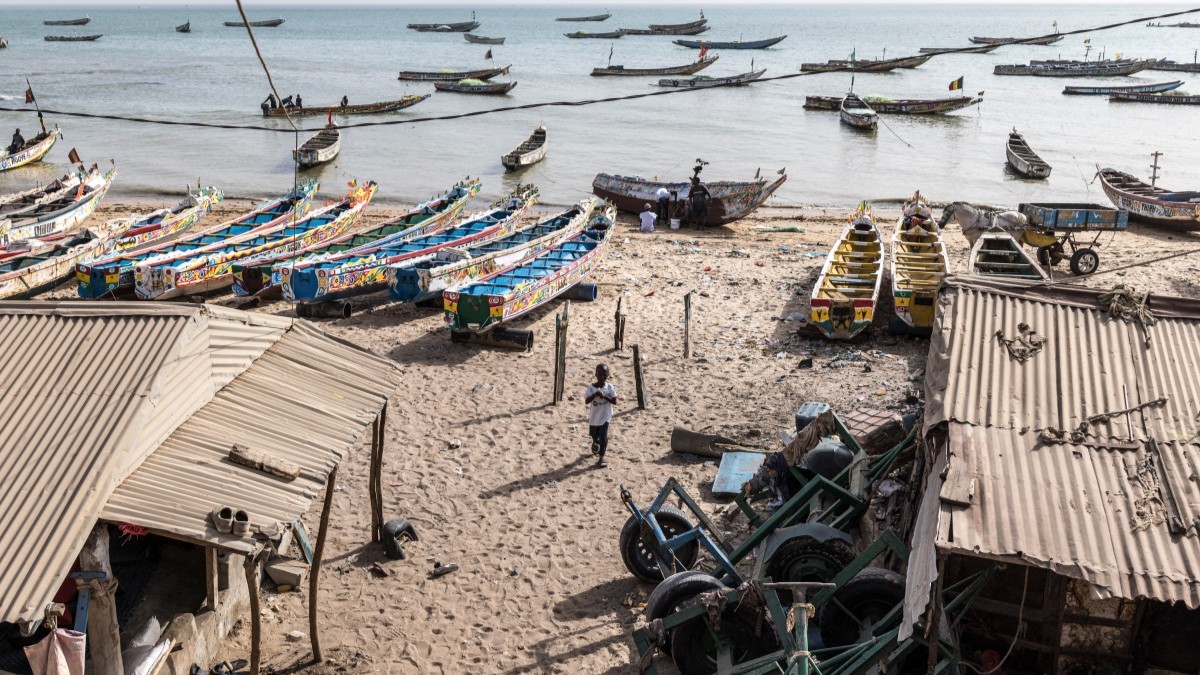
A boy walks on a beach known as “the airport”, a departure point used by migrants trying to reach Europe through the Atlantic route in Mbour, on March 9, 2026.
PATRICK MEINHARDT / AFP
Illegal immigration detected at the European Union’s external borders fell by 40% between January and April 2026. On the West African route, which connects with the Canary Islands, the decline reached 78%.
On paper, the figure appears to point to a significant shift after years of growing migratory pressure, but Frontex data only measures irregular crossings detected at specific border points. It does not measure the total immigration to Europe.
The distinction is more important than it may seem. Frontex counts interceptions or detected crossings. The agency itself notes that the same person may appear multiple times in different records and that the figures only concern external borders and specific routes. The decline therefore indicates that fewer entries are being detected on those corridors, not that Europe is receiving fewer foreign arrivals overall.
The Canary Islands case illustrates the issue well. Mauritania, Senegal, and The Gambia have intensified controls and cooperation with Spain and the EU, reducing departures along that Atlantic route. Frontex acknowledges that human smuggling networks are highly adaptable and rapidly shift their activity when one pathway becomes more difficult.
In fact, the Western Mediterranean was the only major route to record an increase. Detections rose by 50%, driven mainly by departures from Algeria. The European agency itself links this increase to a rerouting of migration paths caused by stricter controls elsewhere. In other words, less pressure in one location may simply mean more pressure somewhere else.
The broader European picture is even more striking. While detected illegal entries are declining, legal channels continue to move far larger volumes. Member states recently issued record numbers of residence permits, and millions of people continue entering through work, family, academic, or international protection pathways. The population born outside the EU continues to rise year after year.
This introduces a politically sensitive variable. Brussels has spent years hardening its border rhetoric and multiplying agreements with third countries to contain specific routes. At the same time, it continues to maintain migration policies, labour programmes, and resettlement mechanisms that expand other pathways of entry. The EU reduces visible pressure at certain borders while opening other channels of arrival.
Officials in Brussels also know the issue is not linear. The Middle East remains under severe strain, Libya continues to be an unstable space, and Frontex warns of possible new movements from Lebanon and other sensitive areas.
So a quieter border does not always mean a Europe receiving less immigration. Sometimes it only means the flow has learned to enter through another door. And the question is who opened that door, why, and in whose interests.