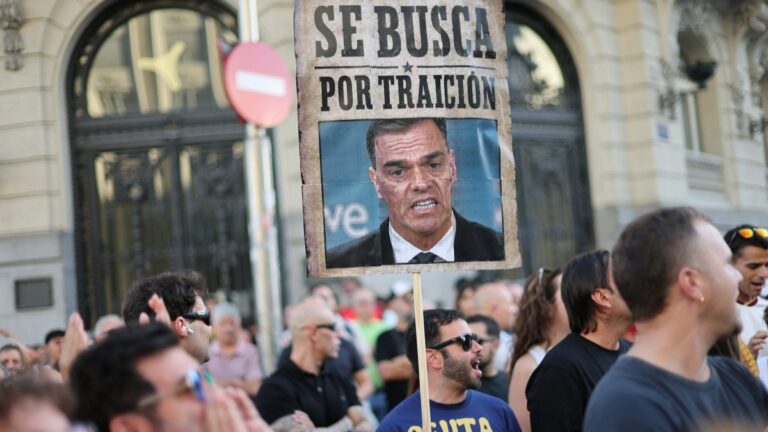
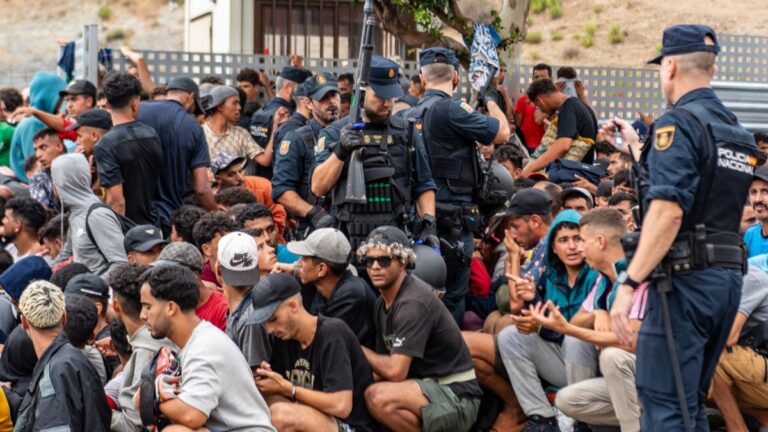
The European Commission has declined to comment on the recently leaked Spanish police report pointing to Rabat’s involvement in the Ceuta mass incursion, declaring the investigation “a matter for the national authorities.”
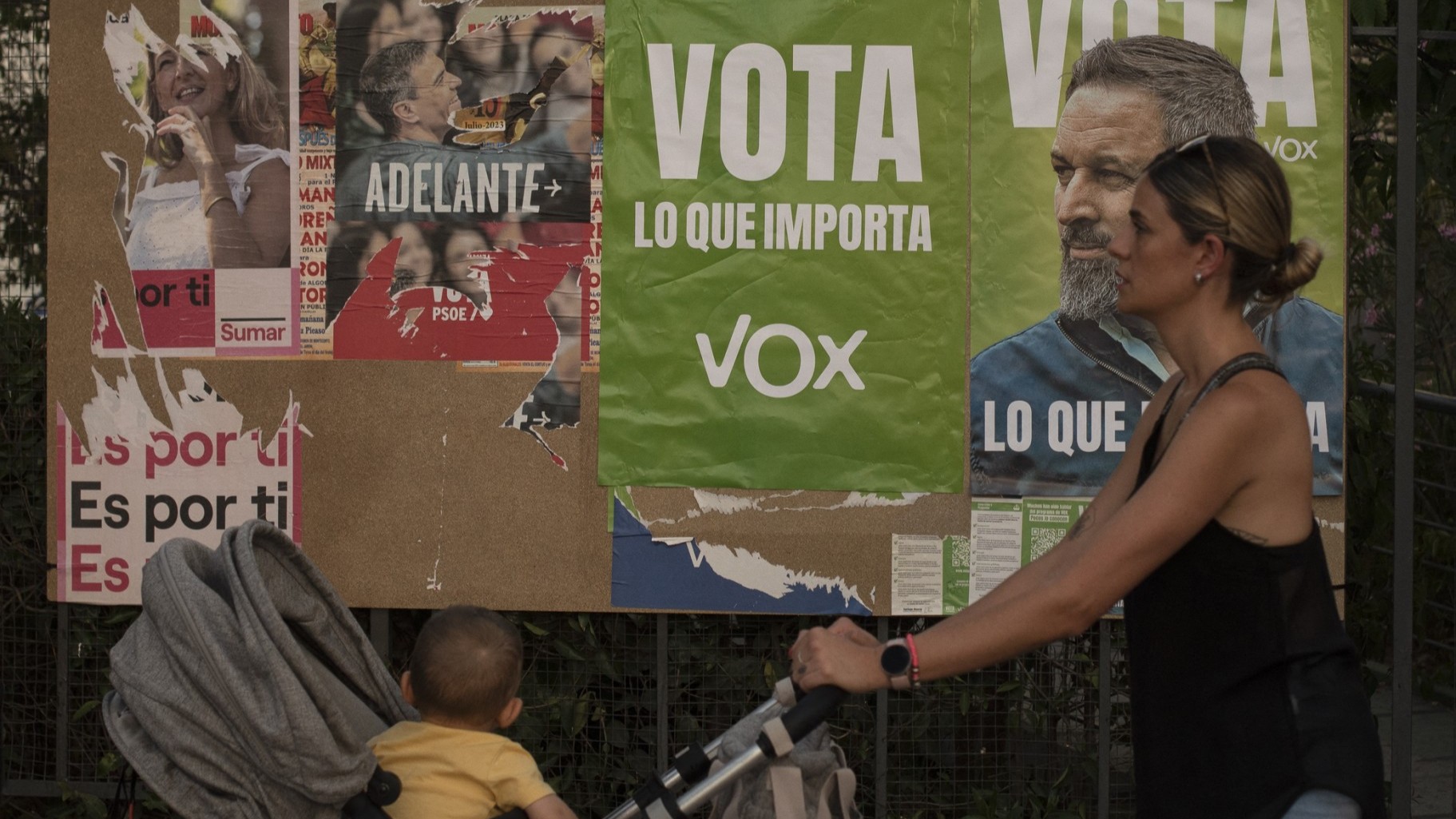
A woman pushes a baby stroller as she walks past electoral posters in Ronda, in Spain’s southern Andalusia region, on July 17, 2023 ahead of July 23 general elections.
JORGE GUERRERO / AFP
Spain’s Andalusia region votes this Sunday on whether the PP can continue governing from the sociological centre-left inherited from old Andalusian socialism or whether VOX manages to break that comfort zone and become the arbiter of the Right.
More than six million voters are called to the polls in a region that for almost four decades was the PSOE’s great territorial stronghold.
The favourite is once again Juanma Moreno. In 2022, his PP won 58 seats and 43.13% of the vote, compared with the PSOE’s 30 seats and VOX’s 14. That absolute majority ended Abascal’s right-wing VOX’s parliamentary leverage and consolidated a formula of its own: management without major changes, low ideological tension compared with national politics, and occupation of the space that for years allowed the PSOE to govern Andalusia almost by inertia.
That is precisely the political core of these elections. Moreno does not represent the hardest PP but its version most adapted to the old Andalusian regime: institutional, regionalist, left-wing on social issues, and very careful not to frighten disenchanted Socialist voters.
His success lies in having turned the PP into Andalusia’s new party of order. The risk is that this operation may end up looking too much like the system it claimed to replace.
The PSOE arrives weakened and with María Jesús Montero as a high-profile candidate whose campaign, however, is proving to be a disaster. Sánchez has bet on his deputy prime minister and finance minister to avoid another symbolic collapse in a key region, but the Socialist campaign has failed to alter the main framework: Moreno’s continuity or his eventual dependence on VOX.
The Left has tried to place public healthcare at the centre, after a controversy over delays in oncology diagnoses, and to accuse the PP of covert privatisation. Moreno, for now, appears to have withstood the blow. The erosion exists, but it has not been enough to rebuild a credible Socialist alternative.
For VOX, Andalusia is an uncomfortable yardstick. The party has grown in several recent elections and has consolidated a more robust national vote; however, in Andalusia it remains trapped in a dynamic in which it can rise but not necessarily displace the PP. Its real objective is not to win but to prevent Moreno from governing alone.
On the other hand, Andalusia is also the region where Abascal’s political force first entered the political arena in 2018.
That is where the decisive battle is being fought. If the PP renews its absolute majority, party leader Feijóo will be able to sell Andalusia as proof that the conservative ‘useful vote’ works even with a national leadership that does little to mobilise. If Moreno falls short, VOX will be able to claim that absorbing discontent against Sánchez is no longer enough: the PP must negotiate with the populist right that it would prefer to keep out of government.
Andalusia will not decide the general elections, but it may anticipate their climate. Sánchez arrives in political decline, the PSOE is territorially reduced, and the PP is benefiting from the protest vote.
On Sunday, voters will not only choose a regional government; they will vote on which Right commands.