PVV leader Geert Wilders has called on Dutch municipalities to take legal action against the asylum distribution law, known in the Netherlands as the Spreidingswet. He made the appeal during a parliamentary debate with Christian Democratic Asylum and Migration Minister Bart van den Brink, which arose after several protests against asylum centres across the country, including unrest in Loosdrecht, Aalsmeer, IJsselstein, Den Bosch, and Apeldoorn.
Wilders said he rejects violence at demonstrations. At the same time, he defended the broader resistance to the law. According to him, the Spreidingswet forces municipalities to provide asylum centres in places where people do not want them, and he called on the minister to withdraw the law.
“Chairman, the use of violence is always and everywhere wrong and must be condemned. But I would like to ask the minister to stop and withdraw that Spreidingswet,” Wilders said.
Wilders: The Netherlands is becoming one large asylum centre
Wilders strongly criticised the law, saying The Hague is imposing asylum accommodation on local authorities. According to him, many Dutch citizens are resisting that policy—most without the use of violence.
“With your Spreidingswet, you are turning the Netherlands into one large asylum centre. And it is right that people strongly resist that. And 99% of the Dutch people who resist and demonstrate, thank God, do not use violence. So can you now promise to stop with the Spreidingswet?” he said.
Wilders then addressed municipal authorities directly, urging them to resist the law as strongly as possible. He said they should also consider going to court:
I also call on all municipalities in the Netherlands to go to the utmost to resist the Spreidingswet. If necessary, as municipal authorities, take you and your cabinet to court. Try to make sure that the judge ensures that the Spreidingswet does not have to be implemented.
He ended his contribution with another appeal to the minister. “I hope, Chairman, finally, that more people will demonstrate. Always without violence. That municipalities resist, all the way to court, against that terrible law of yours. And finally I ask you: withdraw that terrible Spreidingswet and listen to the Netherlands for once.”
Minister rejects Wilders’ appeal
Minister Bart van den Brink rejected Wilders’ call. He said the Spreidingswet had been adopted by a parliamentary majority and that any attempt to abolish the law should also go through Parliament.
“Yes, it is a remarkable way to do this when something does not succeed in parliament, because this is the place where legislation in the Netherlands is made. A majority decided to adopt a Spreidingswet,” Van den Brink said.
The minister said Wilders’ appeal contributes to polarisation. According to Van den Brink, the cabinet and parliament should solve problems together. He also noted that the law had not been withdrawn in previous years. “But that is exactly the polarisation that causes us to stand opposite each other, while we have a number of things to solve together,” he said.
Fire during protest in Loosdrecht
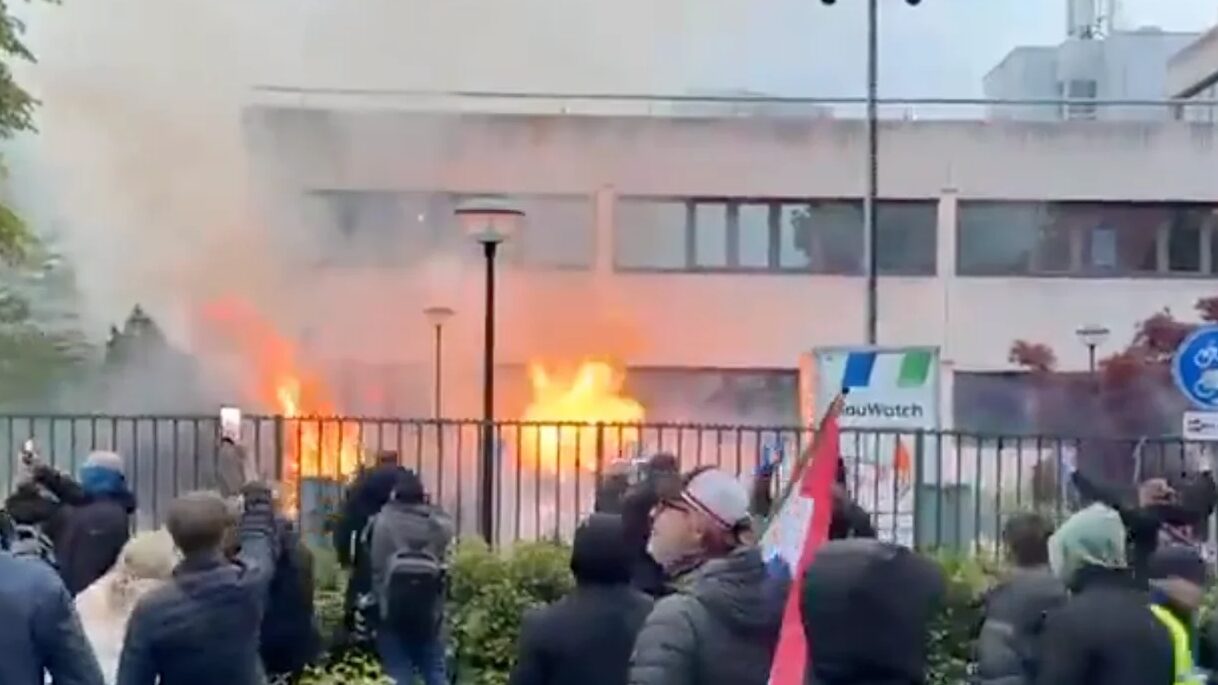
The debate followed growing unrest around asylum accommodation in several Dutch towns. In Loosdrecht, a Tuesday protest against temporary emergency accommodation for asylum seekers escalated. The accommodation is located in part of the former town hall of Wijdemeren.
During the demonstration, a fire broke out in bushes in front of the building. According to reports, fireworks and torches were thrown by demonstrators. Police later deployed riot police to bring the situation under control.
Journalist Jaïr Ferwerda reported from Loosdrecht, saying, initially, the demonstration was calm. “What I heard here from people around me was that it was quite a calm demonstration.”
Ferwerda said the situation escalated after asylum seekers allegedly appeared behind the windows of the building: “[A]pparently asylum seekers are now sitting behind there. They have come to Loosdrecht,” he said.
He said he had spoken to residents and a municipal enforcement officer about the number of asylum seekers in the building. “I heard from residents, and also from the BOA, that there are 19, four of whom have already left again because they did not feel safe,” Ferwerda said.
According to his account, fireworks were then shot off towards the building. “And then that caught fire in those bushes,” Ferwerda said.
Riot police deployed in Apeldoorn
There was also unrest in Apeldoorn for the third evening in a row after people earlier this week protested against the planned arrival of an asylum centre. The protest took place near the roundabout on Laan van Maten.
The municipality had allowed the demonstration but set conditions. The protest had to end at 8 p.m. and remain inside the designated area. A separate protest on the Markt had been banned. After 8 p.m., riot police cleared the area near the roundabout. Groups of demonstrators later returned, and the situation remained tense. At least two people were arrested on Sunday evening. On Friday six people were arrested, and on Saturday there were 26 arrests.
Fireworks were used during the protests. On Saturday evening, fireworks were also thrown at riot police. The municipality of Apeldoorn said it understands the concerns of demonstrators but also said residents have reported feeling unsafe because of the unrest.
Pressure on municipalities
The Spreidingswet is meant to distribute asylum accommodation more evenly across the Netherlands and applies to long-term asylum reception in asylum centres, not temporary emergency accommodation.
Wouter Kolff, the King’s Commissioner in South Holland, said municipalities that do not act to provide the required accommodations may face government intervention later this year. According to him, Minister Van den Brink could take steps within months if municipalities fail to carry out their task under the law.
Kolff said national politicians should create calm around the issue. “I would like to call on politicians in The Hague to create some calm on this dossier. Not to score points against each other or fail to support legislation that already exists,” he said.
He said politicians are free to try to change a law, but as long as a law is in force, local authorities must carry it out. “You can certainly want to change a law; that is very legitimate as a representative of the people,” Kolff said.
“But laws that apply simply apply. If they are implemented by local administrators, then it is important that politicians in The Hague also support those local administrators in that,” he added.
Kolff said municipalities must show in the coming months that they are seriously working on asylum accommodation. He expects autumn to be an important time. If municipalities do not act, he expects the minister to take further steps. Meanwhile, opposition to the Spreidingswet shows no sign of slowing down.