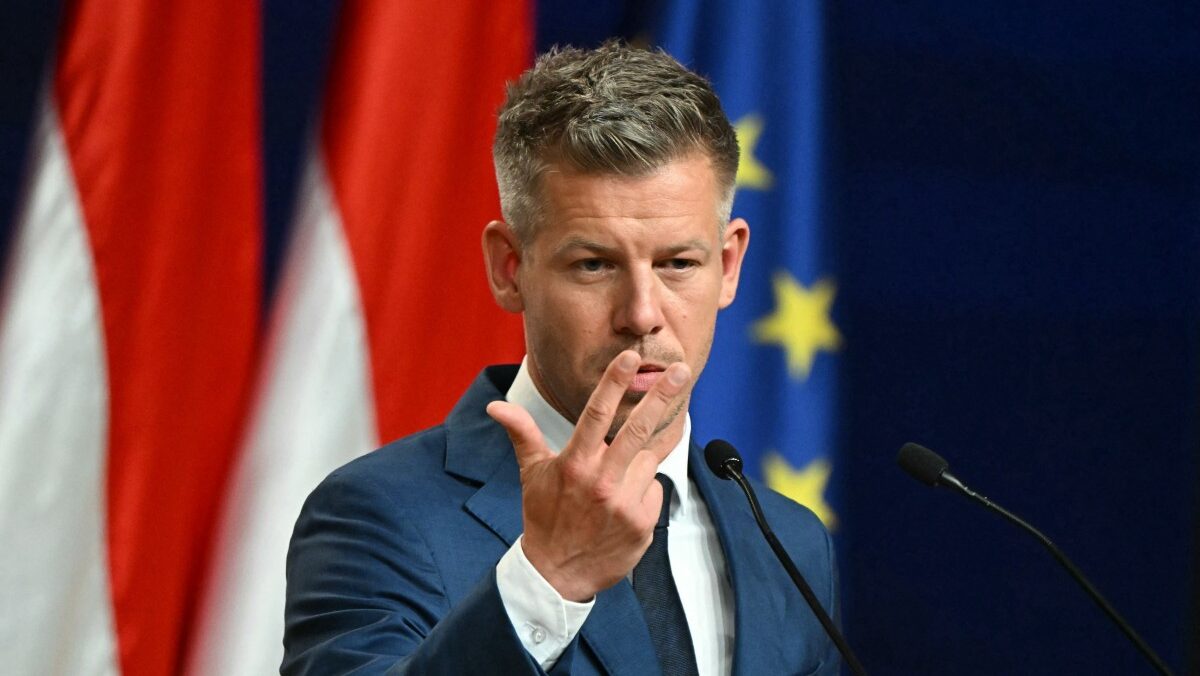
Hungarians who care about sovereignty, a strong economy, controlled borders, and the protection of the family unit will have looked unfavourably on those celebrating the election win of Péter Magyar’s Tisza Party.
Those hailing the result stand in stark contrast to the supporters across Europe—and beyond—that backed Viktor Orbán’s Fidesz government for 16 years and are now vowing to carry that project forward.
Responding to the result on Sunday, Alex Soros, son of George and now the chair of the ‘Open Society Foundations,’ said it was “a resounding rejection of entrenched corruption and foreign interference.” Shortly before this, an NGO funded by his foundation—as well as, significantly, by the European Commission—attacked Orbán’s Hungary as a “dismantler” who is actively weakening the rule of law.
Commission president Ursula von der Leyen also celebrated after polls closed that “Europe’s heart is beating stronger in Hungary tonight.”
Over in the U.S., Hillary Clinton congratulated Magyar and said “the end of Viktor Orbán’s autocratic regime is a victory not just for Hungary, but for people who value democracy around the world”—a standard that, in the eyes of the international liberal elite, Orbán’s previous election victories never seemed to meet.
Other officials were mindful to congratulate Magyar, while at the same time expressing their “deep appreciation”—as Israel’s Benjamin Netanyahu put it—to Orbán for his leadership over the past decade-and-a-half.
I want to express my deep appreciation to my dear friend @PM_ViktorOrban , a true friend of Israel, who stood firmly by Israel's side in the face of unjust international vilification and who supported Israel's soldiers in our just war of self-defense against brutal terrorists.…
— Benjamin Netanyahu – בנימין נתניהו (@netanyahu) April 13, 2026
In Germany, Welt Editor Ulf Poschardt also thanked the outgoing PM for playing a “commendable role in Europe as a perennial nuisance, repeatedly questioning the supposed unity of the EU instead of simply accepting its largely disastrous development.”
This applies to his views on the harmful migration policy, from which he wisely distanced himself; to the Green Deal, which has put considerable pressure on the German automotive industry—and thus also on Hungary’s economic standing; and to the bureaucratic absurdity and the expansion of an opaque and not particularly democratic power center in Brussels, where ever more regulations and decrees are changing the daily lives of people in Europe without genuine legitimacy from the electorate.
France’s Jordan Bardella also rather significantly highlighted that Magyar’s win, “respectfully welcomed by Viktor Orbán, demonstrates that the incessant accusations from European institutions in recent years against Hungarian democracy were unfounded.”