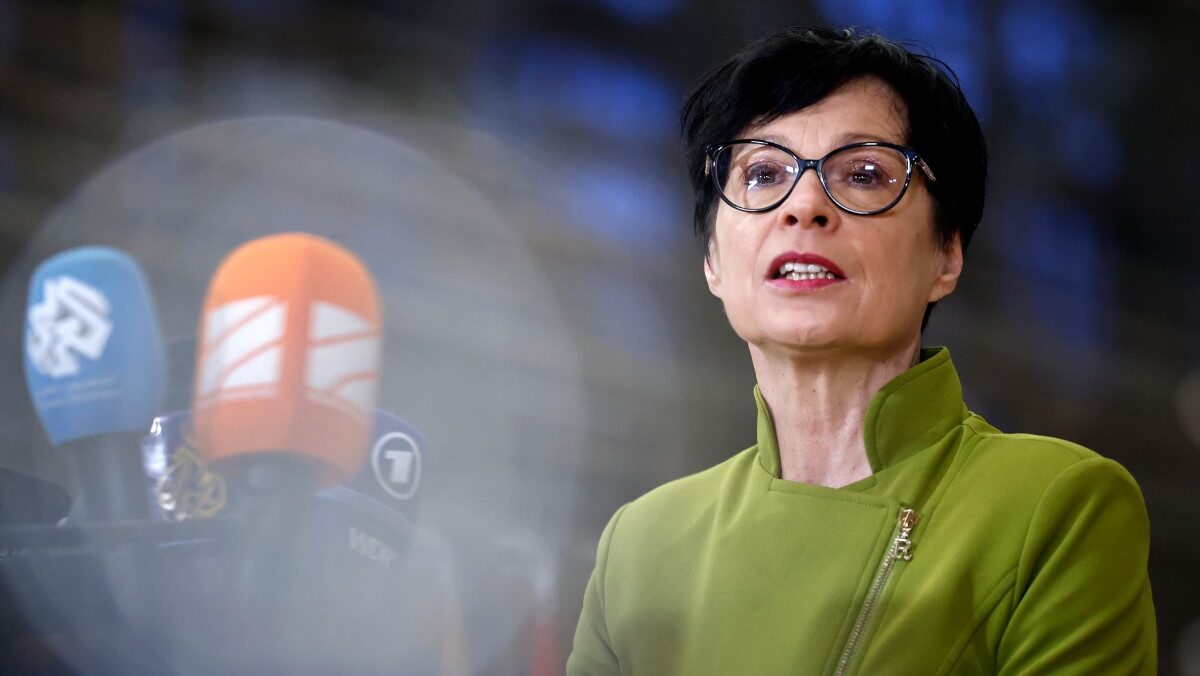
EU Commissioner for Enlargement Marta Kos talks to journalists ahead of a EU Foreign Affairs Council meeting at the EU headquarters in Brussels on January 29, 2026.
SIMON WOHLFAHRT / AFP
The European Commission had been waiting for this moment for years. Just days after Viktor Orbán’s defeat in Hungary, Brussels has begun openly talking about accelerating Ukraine’s accession to the European Union.
The clearest signal came this Tuesday from enlargement commissioner Marta Kos during her visit to Washington. There, she confirmed that the Commission wants to “very soon” open all negotiation clusters with Ukraine and Moldova, the indispensable step for a future entry into the EU.
This is no coincidence. Over the last few years, Orbán had been the main internal barrier against that process. Hungary repeatedly blocked decisions on Ukraine, delayed financial aid, vetoed progress in the accession talks, and turned every European Council meeting into a last-minute negotiation.
With Orbán out of power, Brussels believes that resistance has disappeared. And it wants to take advantage of it.
Kos announced that the Commission expects to disburse between €2.5 and €2.7 billion in additional funding for Ukraine after Kyiv fulfills the reforms required under the so-called Ukraine Facility. But the money was only part of the plan. The important part came afterwards: the Commission wants to open all accession chapters as soon as possible.
Translated into the language of European politics: Ukraine’s entry is no longer a distant possibility but is beginning to become a real strategic project.
A surprise? None.
Until now, Orbán had used Hungary’s veto right to stop it. His argument was twofold. On the one hand, he argued that Ukraine still does not meet the minimum conditions required of any candidate country as it is still displaying endemic corruption, institutional weakness, oligarchic control over part of the economy, and restrictions on national minorities. In addition, the country is in the middle of an open war on its territory.
On the other hand, he warned that Ukraine’s entry would completely transform the European Union itself.
And that is the real issue.
Ukraine is not Serbia, Montenegro, or Albania. It is a country of more than 30 million people, with one of the largest agricultural sectors on the continent, an economy still heavily dependent on subsidies and a reconstruction bill that will cost hundreds of billions of euros. If Ukraine enters the EU, it will alter the distribution of European funds, the institutional balance, and the political weight inside the Council and the Parliament.
Countries such as Poland, France, and Spain would have to renegotiate the distribution of the Common Agricultural Policy because Ukraine would immediately become one of the largest recipients of aid. Cohesion funds would also have to be redistributed. Several eastern member states would cease to be net beneficiaries and become contributors.
Moreover, Ukraine’s accession would almost inevitably force a reform of the Union’s internal functioning. An EU of more than 35 states—if all the nine countries formally accepted as candidates were to join—would be far more difficult to manage while maintaining unanimity in foreign policy, enlargements, or budgets.
That is why, in Brussels, many consider Ukraine and the end of the national veto to be part of the same battle.
Orbán’s defeat has reopened precisely that debate. Ursula von der Leyen and several European governments have long argued that the EU should move toward qualified majority voting in more areas. Officially, to avoid blockages. In practice, to prevent a single state from being able to stop the bloc’s strategic decisions.
Ukraine’s entry accelerates that logic. A larger, more centralized Union with less room for national vetoes.
Marta Kos herself acknowledged in Washington that the negotiations will not be completed before January 2027. But she made it clear that the direction has already been decided.
She even sent a message to Péter Magyar’s future Hungarian government. She said that Budapest will be subjected to the same level of scrutiny as candidate countries on issues such as corruption, the rule of law, and freedom of the press. It was a barely disguised warning: post-Orbán Hungary may change governments, but Brussels has no intention of giving up political control over Budapest.