“Nobody wants to see a conventional telling of Tristan,” Metropolitan Opera general manager Peter Gelb told The New York Times shortly before the company’s March 9 premiere of its new production of Richard Wagner’s Tristan und Isolde. “I think their expectations are more to the abstract rather than the realistic,” he continued, before adding, “I can assure you that this production will be unlike anything anyone has seen at the Met or anywhere.”
There is no evidence that Gelb—who has unpromisingly said, “It is impossible to predict hits”—actually asked what anybody might want in a new Wagner production. Nor did he clarify who the “they” of “their expectations” might be. In an operatic universe where abstract productions of Tristan are the grindingly monotonous norm, it might have occurred to him that the most radical thing a director could now do is stage a perfectly traditional production—complete with the sailing ship that brings the title characters to Cornwall, an enchanted garden where their rendezvous is interrupted, and the ancestral castle where they meet their transcendental end. It is odd that a general manager who claims to have reduced his audience’s average age from 65 to 44 seems unaware of the pervasive medievalism in our popular culture, especially in works that strongly appeal to young people. But after a steady two-decade-long stream of flops under his leadership, nobody should be surprised.
Gelb has staked a great deal on this production by Yuval Sharon, the closest thing American theater has to an enfant terrible—though, now pushing 50, one could be forgiven for simply calling him “terrible.” Is his Tristan “unlike anything anyone has seen at the Met or anywhere?” Not really. The Met’s last two productions were abstract affairs. Dieter Dorn’s 1999 production had an appealing minimalism and geometric simplicity that artfully drew attention to the characters and their psychological predicaments. Mariusz Treliński’s tepidly received effort, which opened the Met’s 2016-2017 season and was never revived, gave the opera modern naval stylings.
Sharon reimagines the opera as a tale of “rebirth,” a trope he applied to opera in general in his tediously self-referential book A New Philosophy of Opera (2024). His argument is that, in every new performance, “The past is made contemporary again.” That assertion is highly debatable, but Sharon’s most striking innovation to Tristan comes at the finale, when Isolde sings the opera’s famous “Liebestod” (“love-death”) while a silent double actress portraying her character downstage gives birth to a child. The effect is certainly original but the philosophy behind it departs from what makes Tristan original: Wagner’s idea that impossible love leads not to prosaic reality or even cathartic renewal, but to a transcendence of phenomenal reality. Indeed, this was his own bitter experience in composing the opera, which he did while suffering through a tortured romance with Mathilde Wesendonck, the wife of his then-patron. Their affair may or may not have been consummated, but Wagner’s wife uncovered and exposed it, causing the composer’s flight to complete the opera in maniacal isolation.
Tristan’s searing passions are the affliction of a man in immense pain. Here they are simply replaced by Sharon’s personal theory of opera. Curiously, Paul Thomason’s erudite program note contradicts him with a solid discussion of Wagner’s true inspiration, quoting what the composer called his “sincere and heartfelt yearning for death: total unconsciousness, complete annihilation, the end of all dreams – the only ultimate redemption.” It is Sharon alone who is birthing babies.
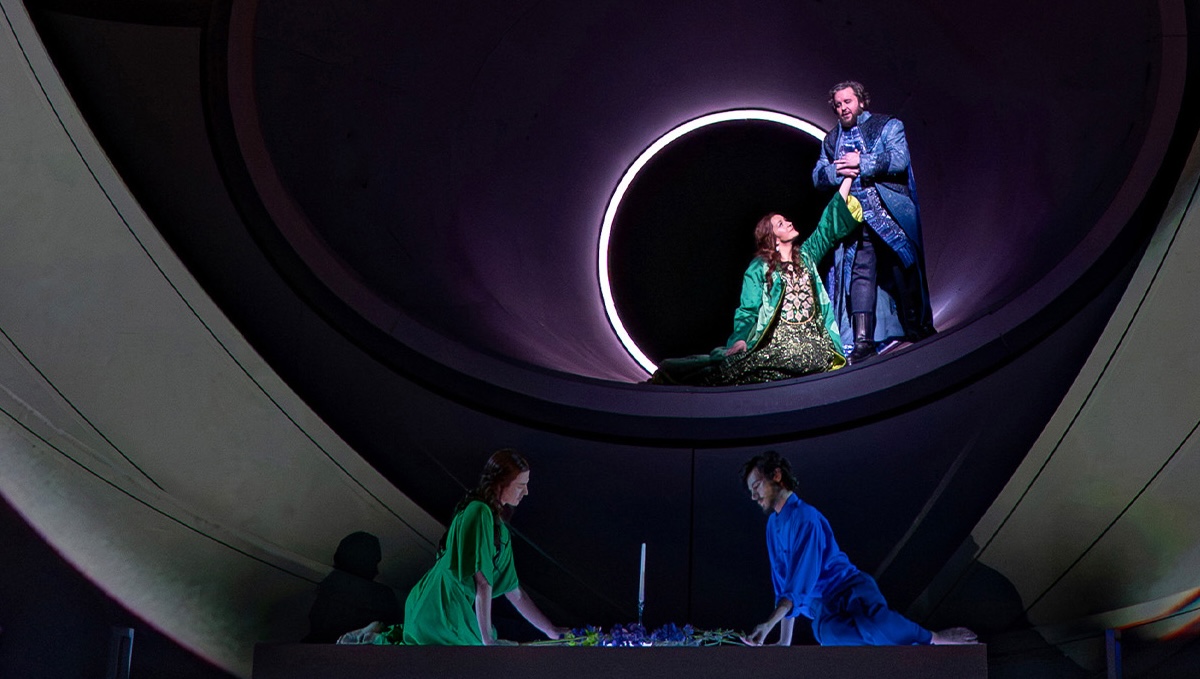
Es Devlin’s sets are sleek and bathed in attractive, cool colors. Nevertheless, Sharon remarkably adheres to the new convention of abstraction. As in most contemporary productions of Tristan, the lead characters barely have any physical contact, leaving any hint of romantic passion to their awkward doubles, who spend much of the performance blankly staring at each other. The singers are mostly positioned inside a giant tunnel suspended above the stage. Its main trick is that it can separate into two halves, which then pivot to separate the singers from each other as they perform the Act II love scene. Gelb may imagine this to be “unlike anything anyone has seen,” but the tunnel design looks remarkably similar to the staging of the sexualized bacchanale scene in Pia Maier Schriever’s Berlin Staatsoper production of Wagner’s earlier opera, Tannhäuser, which premiered in 2014 and has remained in repertoire, including during Sharon’s time working in the German capital.
Likewise, immense video projections of a stormy sea—a main visual effect in Act III, as the grievously wounded Tristan deliriously awaits Isolde’s seaborn arrival—recalls the visual artist Bill Viola’s filmic seascapes for Peter Sellars’ production of the opera back in 2004, still in repertoire at the Paris Opéra. Sharon’s video designer Ruth Hogben’s sea is brighter and has better resolution than early-century technology allowed, but the image is essentially the same and serves a noticeably similar purpose. Clint Ramos’ costumes for the singing cast are exquisitely traditional, with lots of velour and brocade. They would have fit well in Joseph Urban’s storied traditional production, which graced the Old Met’s stage from 1920 to 1959. The main characters’ doubles are outfitted in the same colors, but their garments have been updated to flowy modern garb.
It may be a backhanded compliment to say that this was the most exciting Met premiere in the last 20 years, but it is hard to think of anything else that was as interesting. The sets’ sheer size and technical sophistication drew admiration, and the cast is probably one of the top two or three that could be assembled today. The Norwegian soprano Lise Davidsen has progressed through lighter Wagner roles and other parts in the German repertoire, mostly with success. Her refined technique, crystalline high notes, and expert acting could make Isolde her signature role. Her only impediment seemed to come from the cavernous set with the tunnel formation, which at times appeared to cover the voice.
As her Tristan, Michael Spyres, an American singer who classifies himself as a ‘baritenor’ due to his unusually broad vocal range, has the sturdy lower-register qualities that recall Ramon Vinay and Jon Vickers in the role. His high notes also soared atop what to me seemed supernatural breath control, even if some spectators heard less of it. From where I was, he marched through the first two acts with no sign of fatigue, and into the treacherous but beautifully delivered Act III monologues.
The supporting cast had hints of luxury. Best among them was the superb Polish baritone Tomasz Konieczny’s Kurwenal, Tristan’s loyal retainer. Konieczny, who sings the major Wagner baritone roles, including Wotan in full stagings of the Ring of the Nibelung, was in top stentorian form. Ekaterina Gubanova sang Brangäne, Isolde’s maid, with purring subtlety. Ryan Speedo Green’s voice sits too high for the deep bass that a convincing King Marke needs, but he at least conveyed the cuckolded character’s pain.
Met music director Yannick Nézet-Séguin captured the opera’s famous prelude with moving élan but seemed to move more slowly as the opera progressed. The second act love scene was reasonably well paced, but by the end of Act III the performance seemed to lag.
Could this landmark production turn around the beleaguered Met’s fortunes? In a rare feat for the company these days, the entire run sold out or came close. Citing “overwhelming demand,” the Met added one additional performance, a highly unusual step in the company’s modern history. Nevertheless, nothing nearly as energizing seems to be on the horizon, unless one counts Sharon’s prospective Met Ring, which will appear in installments culminating in 2030. Nor does Gelb, who will finally step down that year, seem to have realized that it might have been a bad idea to wait a decade to stage Tristan again.
Ticket sales so far this season lag at 72% of the house. Next season, the Met will offer the smallest number of productions in 60 years. Earlier this year, the company announced layoffs, pay cuts, a production postponement, and sale offers for naming rights to the theater and for its iconic pair of murals by Marc Chagall. A prospective high-value deal with Saudi Arabia to perform there during the house’s February break is off. A Times exposé published the day before Tristan’s premiere revealed bizarre additional details, including an understandably unanswered appeal from Gelb to Elon Musk to produce operas in outer space.
Over the past few years, Gelb has spent about one-third of the Met’s endowment, which once exceeded $340 million, to meet operating costs. He has committed the house to politicized stances over the war in Ukraine and in reaction to the #MeToo movement, both of which, along with other unwise policies and decisions, have cost the company star artists and millions of dollars in legal costs. A focus on ‘new’ operas has mostly resulted in critical and popular failures and has been scaled back. A recent New York Post analysis suggests that the house’s fiscal health may now depend on the charitable largesse of just nine families in a crime-ridden city notorious for imposing America’s highest tax burden.
Gelb has variously blamed the Met’s woes on residual effects of the COVID-19 pandemic, new immigration policies, hostile critics, disinterest among the super-rich, mainstream cultural trends, and, it seems, anything or anyone other than himself. Many other opera companies, however, are doing well despite those same factors. The main opera companies of Chicago, Dallas, and San Francisco all received pledges of new eight-figure donations this season. The Vienna State Opera has recently boasted full attendance. Next season, the Hungarian State Opera will present 56 productions, more than three times the Met’s repertoire, in a city with less than a quarter of the population. Tristan may count as a success, but to win the battle is not to win the war.