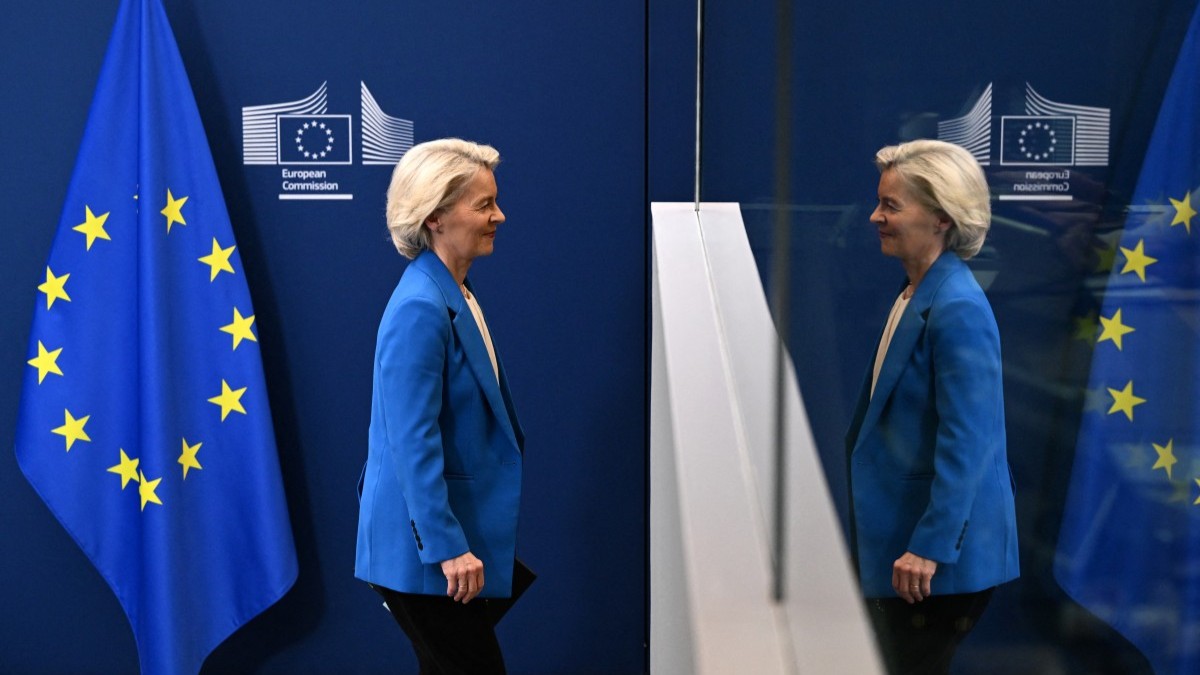
European Commission President Ursula von der Leyen leaves after a press conference at the EU Commission headquarters in Brussels on April 13, 2026.
NICOLAS TUCAT / AFP
Viktor Orbán has not even formally left power yet and Ursula von der Leyen has already used his defeat to advocate for one of the European Union’s fundamental rules: the right of member states to veto foreign policy decisions.
Just hours after Hungary voted for Péter Magyar and brought 16 years of Fidesz rule to an end, the Commission president appeared in Brussels to call on the EU to use the political “momentum” created by the Hungarian result and move to qualified majority voting in foreign affairs.
Translated: a group of large countries would be able to have sanctions, military aid or diplomatic positions adopted even if several national governments oppose them.
“Moving to qualified majority voting in foreign policy is an important way to avoid systemic blockages, as we have seen in the past,” von der Leyen said. The message was unmistakably directed at Hungary. In recent years, Budapest has blocked or delayed sanctions on Russia, funds for Ukraine and several joint EU statements.
But the speed with which the Commission reacted has caused unease even outside Hungary. Not so much because of the substance of the proposal—which Brussels has been pushing for years—but because it was presented immediately after the electoral defeat of the main government opposing it.
Even Politico, the main media outlet supporting the Brussels institutional establishment, noticed von der Leyen’s lack of tact (to put it mildly).
The scene was too obvious: as soon as the Hungarian obstacle disappeared, the Commission felt free to push once again an agenda that had been stalled for years.
It is important to stress and constantly remember that the veto is not an anomaly within the Union. It is one of the last mechanisms states still possess to prevent sensitive decisions from being adopted against their will. Foreign policy, sanctions, enlargement and certain fiscal matters still require unanimity precisely because they directly affect national sovereignty.
Removing that principle would alter the balance on which the EU was built. Smaller countries would lose the ability to stop decisions that the larger ones want to force on them. Hungary, Slovakia or even Italy could be strongarmed into accepting policies approved by a majority led by Germany, France or the Commission itself.
That risk explains why even traditionally pro-European governments have expressed reservations in the past. Denmark, Sweden and Ireland have repeatedly rejected the idea of completely surrendering control over foreign policy. They know that once the veto disappears, recovering that power becomes practically impossible.
Nevertheless, von der Leyen made clear that she sees the Hungarian result as a political opportunity. “It is a day to celebrate,” she said about Orbán’s defeat. She even added that Hungary was “returning to the European side.” The phrase was meant to sound conciliatory, but in Brussels many interpreted it differently: the idea that only a government that accepts without resistance the direction set by the European institutions is truly European.
Pressure on the new Hungarian government did not stop there. According to the Financial Times, Brussels is already preparing a list of 27 conditions to unfreeze around €35 billion in EU funds currently withheld from Hungary. Among them are approval of the €90 billion package for Ukraine, lifting the veto on new sanctions against Russia, changes to migration legislation and the repeal of several Orbán-era policies in cultural and social matters.
In other words, the money withheld for years would not simply be released because the government has changed, but in exchange for the new administration agreeing to align itself with Brussels’ political priorities.
The Commission argues that these demands are linked to the rule of law and the need to comply with European standards. But for Fidesz and for a large part of the Hungarian electorate, what happened confirms exactly what Orbán had been warning about for years: that behind the dispute with Brussels there was not merely a technical conflict over funds or judicial reforms, but a broader struggle over who really governs within the Union. An ideological battle.
For years, Orbán presented Hungary as the last wall against an increasingly centralized integration process. His opponents accused him of exaggeration. Yet less than a day after losing the election, the President of the Commission openly called for using that result to abolish the national veto.
What will follow from now on is a fierce struggle to impose a particular vision of the EU: one based on agreements between states, where each government retains the ability to decide on essential matters, or one that becomes increasingly centralized, in which the Commission and a majority of countries can impose their will on the rest.