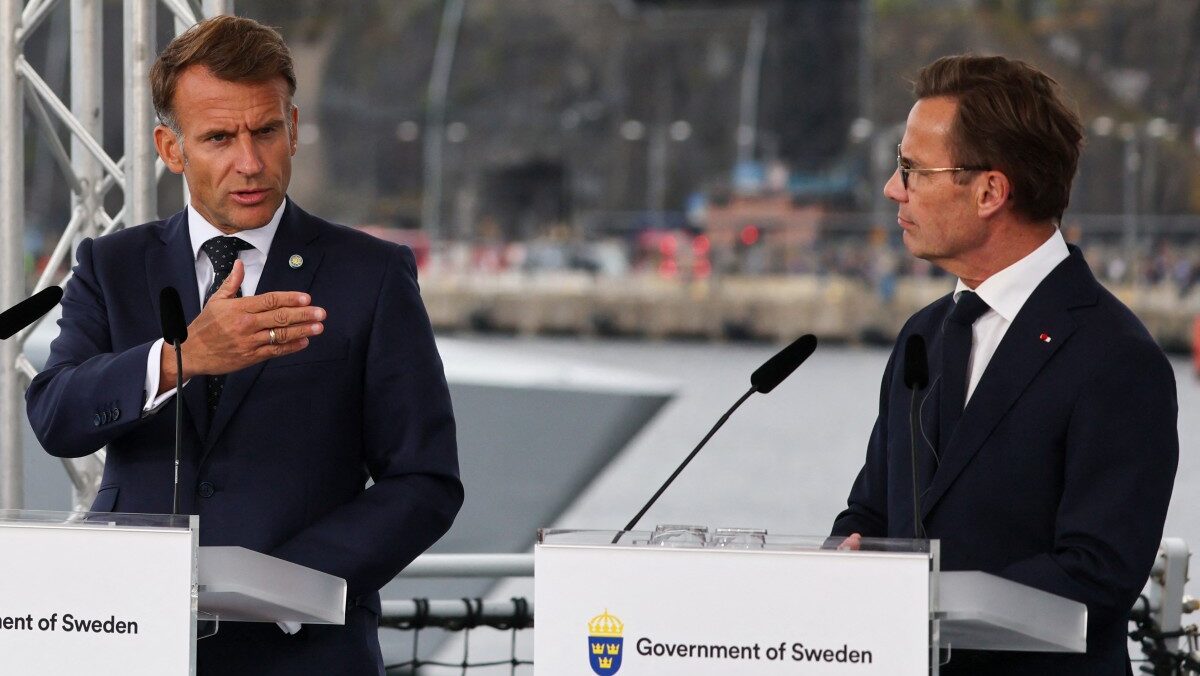
French President Emmanuel Macron speaks as Swedish Prime Minister Ulf Kristersson (R) looks on during a joint press conference aboard the French frigate Amiral Ronarc’h in Stockholm, Sweden, on August 31, 2026, following a bilateral meeting and the signing of a 4.3-billion-euro contract for Sweden’s acquisition of four French-built defence and intervention frigates (FDI).
Ludovic MARIN / AFP
Emmanuel Macron’s visit to Stockholm on Monday, August 31st, added a political dimension to a major contract for the French defence industry. The French president and Swedish Prime Minister Ulf Kristersson attended the signing of an agreement for Sweden to acquire four defence and intervention frigates (FDI) built by Naval Group in a contract worth €4.3 billion.
Beyond the commercial value of the order, Paris and Stockholm aim to make it the foundation of a broader defence partnership. A framework agreement has therefore been signed between the two defence ministries to strengthen their cooperation in the operational, capability, and industrial spheres. The stated aim is to build a long-term strategic relationship between two countries that are now allies within NATO.
For Stockholm, the primary focus is on capabilities. Sweden, which joined NATO in 2024 after abandoning its policy of military non-alignment, has significantly stepped up its defence investment since the Russian invasion of Ukraine. In particular, the four future frigates, adapted to the requirements of the Swedish standards known as Luleå-class, are set to triple the Swedish Navy’s current air defence capabilities. They will also be equipped with anti-submarine warfare and maritime route protection capabilities. The first frigate is due to be delivered in 2030, with the remaining three to follow progressively through to 2034.
The choice of French technology is also noteworthy because it is not an exclusively French system. The vessels will be adapted to Swedish requirements and will incorporate various components from local industry, notably systems from Saab and BAE Systems Bofors. This approach to industrial integration is essential for Stockholm, which seeks to preserve its own technological base whilst strengthening its interoperability with its allies.
The partnership is, moreover, reciprocal. In December 2025, France placed an order with Saab for two aircraft, worth approximately 12.3 billion Swedish kronor, or just over €1 billion. Deliveries are scheduled for between 2029 and 2032.
For French industry, the Swedish contract represents a particularly significant success. Naval Group is to build the four vessels at its Lorient site, where vessels for the French Navy and Greece are also constructed. The Swedish order thus helps to boost the shipyard’s visibility and ensure the long-term future of a production line that is particularly strategic for the French shipbuilding sector.
The stakes therefore extend beyond the jobs directly linked to shipbuilding. Major military contracts help to maintain rare industrial expertise, fund research and development, and spread fixed costs across a wider range of clients. They also contribute to the credibility of French equipment on international markets: the more a platform is used by different armed forces, the more attractive it becomes to future buyers.
The success in Sweden is all the more valuable given that Naval Group has recently suffered several setbacks in the export market, notably in naval tenders in Poland, Canada, and Norway.
This new closeness with Stockholm comes at a time when France’s strategy for industrial cooperation in Europe is being called into question. For nearly a decade, Paris had made its partnership with Berlin the main pillar for building a European defence industry. The Future Combat Aircraft System (FCAS) project, launched in 2017 with Germany and later joined by Spain, was intended to become the symbol of this ambition: a next-generation air combat system combining fighter aircraft, drones and communication networks.
The project was finally abandoned in June 2026, following years of disagreement over the allocation of industrial responsibilities and the sharing of technologies.
The failure of the FCAS does not signify the end of Franco-German cooperation on defence matters, but it sends a deeply negative political signal. This episode served as a reminder of the limitations of a strategy that relies too heavily on a single partner, whilst the industrial and military interests of different European countries can diverge significantly.
In this context, the relationship with Sweden takes on particular importance. Like Paris, Stockholm has an independent defence industry, notably Saab, a strong strategic culture, and recognised expertise in the aerospace, naval, and technological sectors. Franco-Swedish cooperation thus enables Paris to expand its network of partners without compromising its own industrial autonomy.
Having long placed the Franco-German partnership at the centre of its vision for European defence, Paris is now seeking to build a more diverse network of partnerships. Sweden, for its part, appears willing to play an increasingly significant role in this architecture.