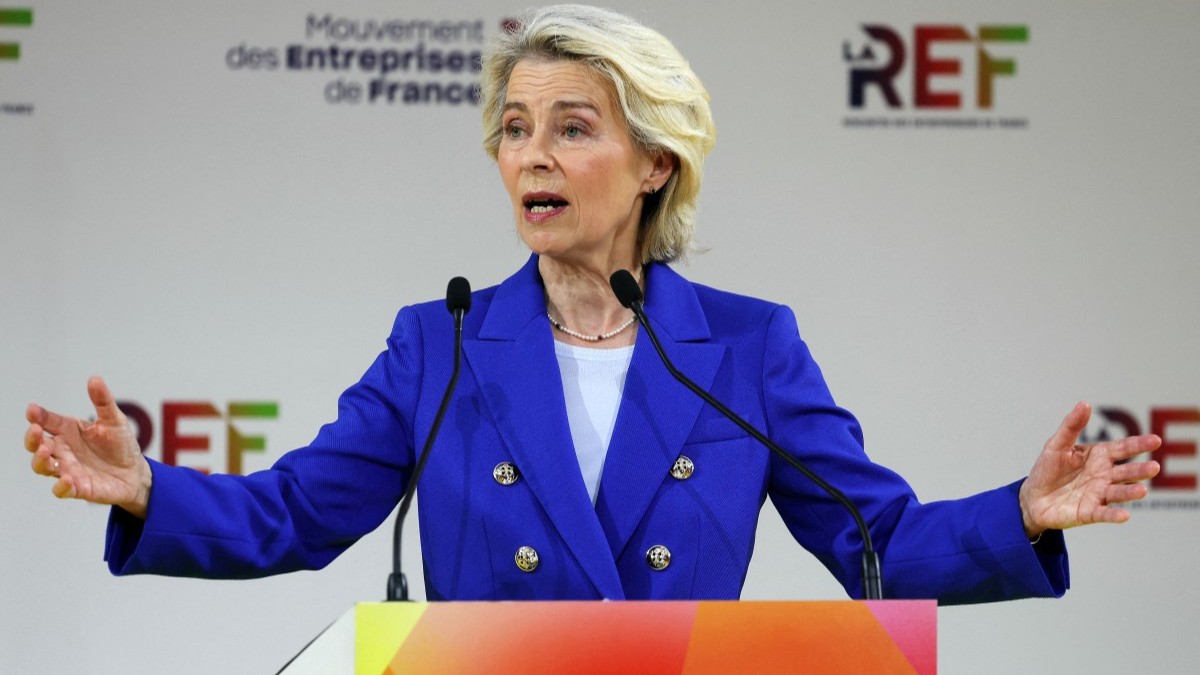
European Commission President Ursula von der Leyen gestures while addressing the audience during a special keynote session on the second day of La REF 2026 meeting of French entrepreneurs in Paris on August 27, 2026.
THOMAS SAMSON / AFP
Ursula von der Leyen has put a figure on Europe’s financial problem: €10 trillion.
Last week, speaking to French business leaders gathered by Medef (Mouvement des entreprises de France—France’s leading employers’ organisation) in Paris, the Commission president lamented that such a large share of European household savings remains in bank deposits. “Unfortunately, these savings are lazy,” she said, before arguing that Europe needs to put that money “at the service of its companies.”
For now, there is no plan to confiscate deposits or withdraw money from individual bank accounts. Brussels’ proposal is different and, precisely for that reason, more politically significant: to use tax incentives, new financial products, regulatory changes, and more integrated supervision to push a greater share of private savings towards European capital markets.
This is the so-called Savings and Investments Union, presented in March 2025. The Commission estimates that around 70% of EU household savings, roughly €10 trillion, remains in bank deposits. The measures under consideration include investment accounts with tax advantages, changes to securitisation rules and regulations intended to facilitate greater participation by banks, insurers and funds.
Von der Leyen argues that the package could unlock up to €470 billion in additional investment.
EU's von der Leyen:
— Clash Report (@clashreport) August 31, 2026
€10 trillion of household savings is currently sitting in bank deposits, and a significant part of European savings is invested outside our continent.
Europe must now put these savings to work for its companies, and that is the goal of the Savings and… pic.twitter.com/CATwQJWAW2
The question is why Brussels now needs to mobilise citizens’ money, and the answer can be found in Europe’s own figures, which have hardly delivered the results that were expected.
The Draghi report estimated that the EU needs an additional €750-800 billion every year to finance digitalisation, industry, energy, defence and infrastructure. That amounts to approximately 4.4%-4.7% of annual European GDP.
Member states simply do not have enough fiscal room to cover such a bill. Public debt reached 82.9% of EU GDP in the first quarter of 2026 and 88.9% in the eurozone. Greece stood at 143.5%, Italy at 138.9%, France at 117.6%, Belgium at 109.1% and Spain at 101.6%.
After years of extraordinary spending and public programmes designed to support successive European priorities with little or no effectiveness, Brussels is discovering that it cannot finance the next economic transformation through simple taxation. .
The Savings and Investments Union does not start from scratch. It is the new incarnation of the Capital Markets Union, launched in 2015. Christine Lagarde acknowledged in 2024 that more than 55 regulatory proposals and 50 non-legislative initiatives had been presented since then, yet progress had remained limited. The Eurogroup itself admitted that same year that the project had failed to achieve its original objective of building deep and integrated European capital markets. In other words, they acknowledged that they had failed, only in different words.
A decade later, the answer to that failure is once again more integration, more common supervision, and another regulatory package. Yes, exactly the same formula. In Brussels, a project that does not work rarely disappears: it normally comes back under a different name.
To be fair, that does not invalidate the Commission’s diagnosis. Europe needs deeper capital markets, companies capable of growing without relocating to the United States, and better alternatives for savers. None of that changes the fact that von der Leyen’s choice of words was deeply unfortunate. Private savings are increasingly being regarded by the European institutions as a strategic resource that should be channelled towards the Union’s economic priorities.
For now, the instrument for achieving this is tax incentives. Pension products, securitisation, and new ways of directing capital towards investments considered strategic are also being examined. The change of direction has already taken place: managing public money is no longer enough; Brussels also wants to influence where private money goes.