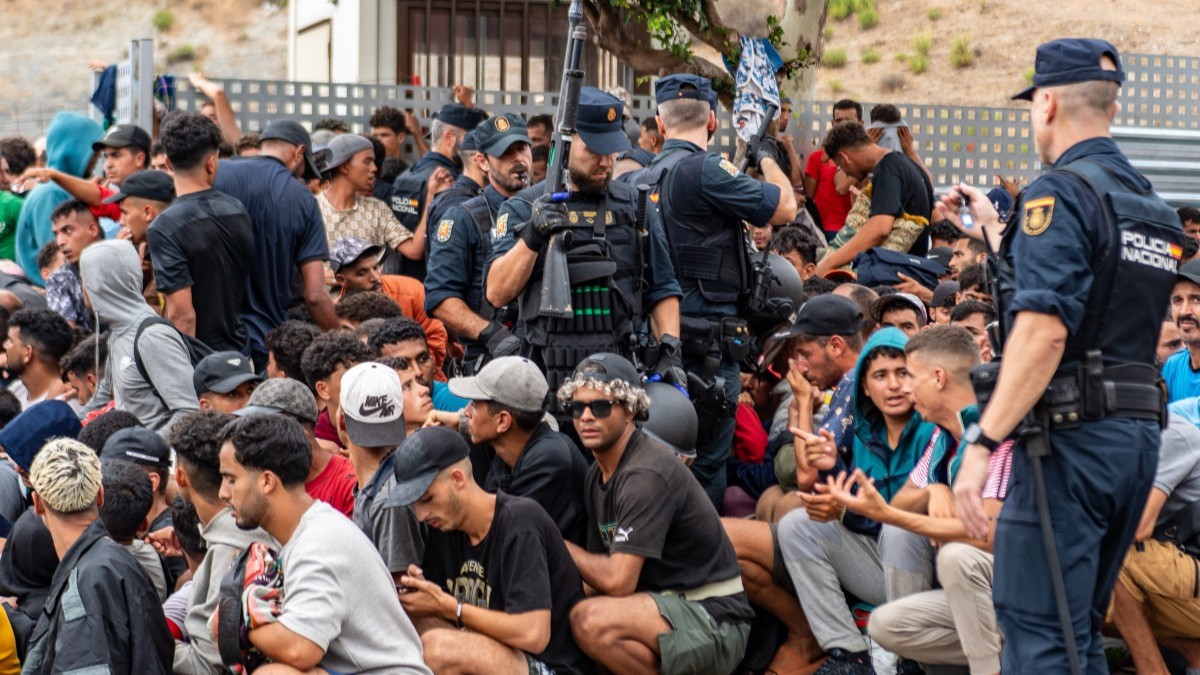
Police officers control a large group of migrants crowding outside the entrance of the Loma del Colmenar reception center, waiting for admission, in Ceuta on September 1, 2026.
ANTONIO SEMPERE / AFP
The official account of what happened in Ceuta on July 30th has just suffered its most serious blow from within the Spanish state itself.
A confidential report prepared by the National Police’s Centre for Immigration and Borders (CENIF) maintains that the mass entry was not a spontaneous phenomenon caused simply by traffickers, social media, or a temporary failure of Morocco’s border-control apparatus, as the government and media outlets aligned with it have argued for the past month.
According to the document, uniformed officers and members of Morocco’s security forces operating in plain clothes actively participated in organising and directing the groups that advanced towards Spanish territory.
The report has been submitted to Spain’s Audiencia Nacional in the National Police’s capacity as judicial police, according to reports published on Tuesday. The Interior Ministry says it learned of the document’s existence through the media, and Fernando Grande-Marlaska has demanded explanations from the senior leadership of the National Police.
The problem for the government is not merely a policing one. It is political.
Pedro Sánchez had publicly rejected the existence of intelligence information that would allow responsibility to be attributed to Morocco. The prime minister also praised Rabat’s subsequent cooperation and went so far as to describe accusations of Moroccan involvement as part of “disinformation campaigns.”
Now, a specialised unit within the National Police itself is describing a very different reality.
According to the details that have emerged, CENIF analysed photographs, videos, and the operational behaviour of Moroccan forces. Its officers identified gendarmes guiding groups from Castillejos towards specific border points and individuals believed to be plainclothes members of the Moroccan security services giving instructions on how to reach the El Tarajal breakwater.
The police’s conclusion therefore goes considerably further than Moroccan passivity. It describes coordination on the ground and an operation intended to overwhelm Spain’s border-control capacity within the framework of hybrid operations that are taking place not only on Europe’s eastern flank, but also along its immediate southern border. The report even examines the sequence of the crossings and the rapid subsequent return of many of those involved as factors incompatible with a conventional migration crisis.
With this report, reducing what happened to the work of criminal networks and messages spread online looks more like a government disinformation campaign than an accurate account of events.
What remains to be explained is why the government has shown such certainty in politically exonerating Morocco when its own security apparatus was reaching very different conclusions.
Relations between Madrid and Rabat have for years been characterised by concessions, silences, and decisions whose negotiations are rarely fully known– and Ceuta is once again demonstrating the price of that opacity.