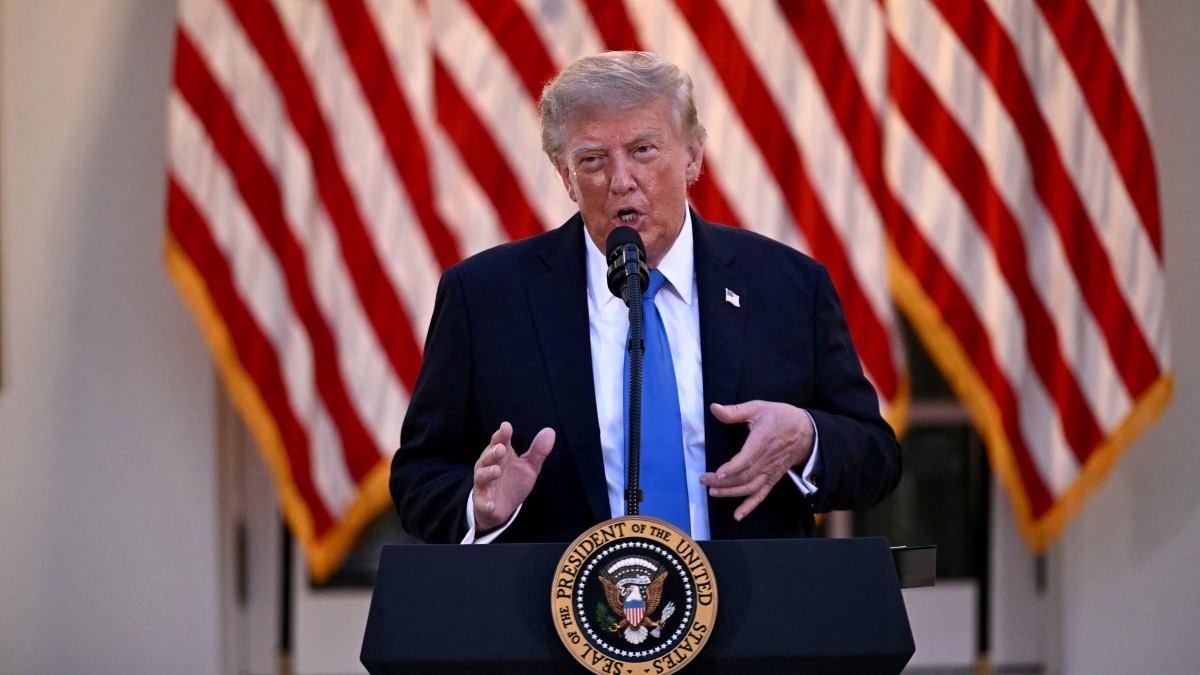
U.S. President Donald Trump speaks while hosting a Rose Garden dinner at the White House in Washington, D.C., on September 2, 2026.
BRENDAN SMIALOWSKI / AFP
The Ceuta crisis has taken on a new dimension with the U.S. president commenting on what is happening in the enclave in a television interview.
Donald Trump has entered the dispute directly with a harsh attack on Madrid while, almost simultaneously, another member of the Moroccan government has once again laid claim to the Spanish city.
In an interview broadcast by GB News on September 3, Trump said Spain “will be a ruined country” and described the mass influx recorded in Ceuta at the end of July as “very sad to see,” declaring that what happened “is worse than an invasion.”
The U.S. president also used the episode to revive another of his disputes with Madrid: military spending. Spain, he said, “doesn’t behave very well with respect to NATO” and “doesn’t pay what they should be paying.”
Trump said what happened was evidence of a loss of border control and warned that the consequences would not be limited to Spain. Migrants, he said, could subsequently “pour into” other European countries and even end up in the United Kingdom. However, he avoided attributing any responsibility to Morocco for the crisis.
That omission coincides with a new escalation in rhetoric from Rabat.
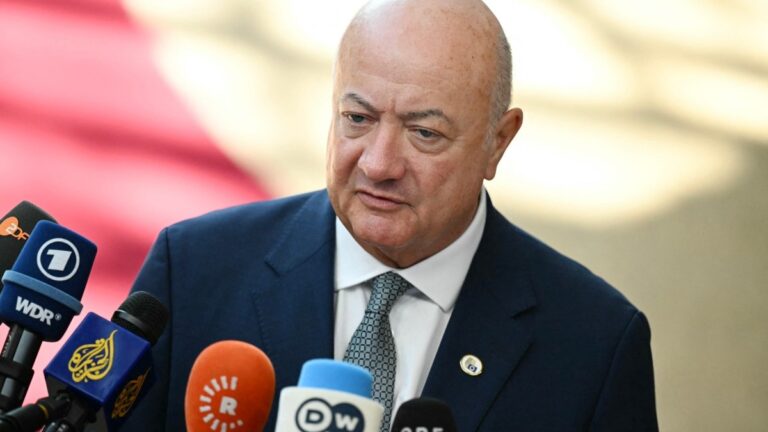
Nizar Baraka, Morocco’s Minister of Equipment and Water and secretary-general of the nationalist Istiqlal Party, said Spain is an “essential partner,” but added that Morocco “will not retreat a single inch of our national territory,” an explicit reference to Ceuta and to Rabat’s territorial claims over the Spanish cities in North Africa.
The statement carries particular weight because of Baraka’s position within Istiqlal, one of the parties historically associated with the expansionist doctrine of ‘Greater Morocco.’ Its leading territorial ideologue, Allal al-Fassi, defended an expansive conception of Morocco’s borders after independence in 1956 that included Ceuta and Melilla. What is happening today is a consequence of what was set in motion then.
Madrid, for its part, is trying to contain both fronts simultaneously. Pedro Sánchez has reiterated that Spanish sovereignty over Ceuta and Melilla is a red line and has described Morocco’s territorial claims as “unacceptable.”
At the same time, Sánchez maintains that there is still no “solid evidence” that Rabat organised the mass influx, despite a police report cited by several media outlets reportedly finding “total permissiveness” on the part of Moroccan officers and even actions aimed at directing people towards the water.
The crisis is no longer confined to migration management but is becoming a perfect storm: it now directly affects Spanish sovereignty, relations with Morocco, and Madrid’s relationship with Washington.