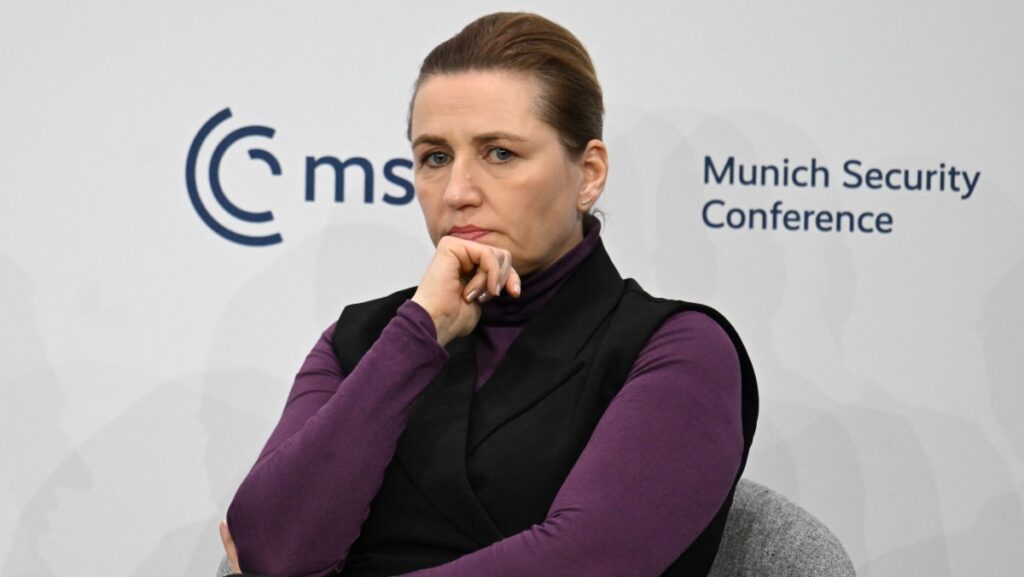
Danish Prime Minister Mette Frederiksen attends a panel discussion at the 62nd Munich Security Conference on February 14, 2026 in Munich, southern Germany.
THOMAS KIENZLE / AFP
There appears to be no cure for tax greed. Once politicians have set their eyes on any kind of wealth tax, they are willing to defy both experience and common sense in their pursuit of what they see as a goose that lays golden eggs.
In what can only be rationalized as a desperate pursuit of voters on the far-left fringe, incumbent prime minister Mette Frederiksen has made the reintroduction of the wealth tax a top priority. If she gets it her way and keeps her job after the March 24th election, the new tax will be exactly as draconian as a wealth tax can be:
The wealth tax, proposed by the social democrats, is designed in such a way that hundreds of taxpayers will have to pay every krona of their current income in taxes … Last time we had a wealth tax in Denmark, there was a brake built into it, ensuring that people’s current earnings were not eaten up entirely by taxes. … But the social democrats do not want this brake in their new wealth tax
In other words, government takes away so much that the taxpayers hit by this tax will be forced to start liquidating assets—just to pay their bills, have food on the table, and lights on in their homes.
A wealth tax can take many different forms, including
The first form of wealth tax is very unusual, for the simple reason that it would hurt middle-class and low-income taxpayers. Since a wealth tax, like all taxes, is paid out of current income, it is effectively an income tax; the Left knows this and therefore avoids taxing equity from the first dollar.
The two versions of the second form of a wealth tax differ only in how they define the tax base: one taxes both existing and added wealth above a certain threshold, while the other applies just to newly added equity.
The latter version is also referred to as a tax on ‘unrealized capital gains’ or UCG. It was at the epicenter of my recent review of wealth taxes. As an example of what the UCG tax does to people, I told the story about a Norwegian tax refugee. Fredrik Haga, who started a business in his native Norway. Being completely focused on building his business, Haga
took no income for a year; he maximized the capital in his business and developed its products and market reach; he recruited investors, created jobs, and paid taxes. When investors rewarded him with an infusion of capital, the market value of his business increased. At that point, the Norwegian UCG tax barged into his personal finances like a bull in a china shop.
The burden of the UCG tax was so bad that Fredrik Haga had to become a tax refugee: he moved to Switzerland to save his business.
He is not the first European to become a tax refugee, and he certainly will not be the last. In the 1970s, it was popular among entrepreneurs, investors, and wealthy artists and athletes in high-tax Nordic countries to move to Monaco or Switzerland. In the 1980s, Margaret Thatcher’s low-tax England also attracted wealthy individuals in search of tax refuge.
Tax migration is well known in America as well. Successful entrepreneurs leave high-tax California for lower-taxed states like Florida, Nevada, and Texas. This tax refugee migration has accelerated since California introduced a tax on ‘unrealized capital gains.’ This will also happen in the Netherlands, should their UCG tax be approved.
Denmark should expect similar consequences. In a report published on March 6th, Danish center-right think tank CEPOS insightfully examines the likely consequences of this tax. They explain the technical but economically essential consequences of the tax:
A wealth tax of 0.5 percent on wealth exceeding DKK25 million can increase the actual taxation to more than 100 percent on progressively taxed stock dividends and capital income. For an average composition of equity, as with progressively taxed stock dividend earners, the actual marginal tax rises from 58 percent to 84 percent.
And here comes the ‘Norwegian’ effect—the tax madness that forced Fredrik Haga to leave Norway for Switzerland:
A big tax increase will follow for owners of family-owned businesses who let their earnings remain in the business. For an owner who lets his entire net-tax business earnings remain with the firm, the actual taxation rises from 17.9 percent to 62.7 percent.
The CEPOS report notes bluntly that this “will lead to a thinning out” of the productive capital that the firm has at its disposal, as the owners have to withdraw income just to pay the tax.
As expected, the Danish Left is putting up a fight for this wealth tax. Back in February, the labor union federation FH released a pamphlet with ‘arguments’ for the wealth tax. Their first and supposedly strongest point suggests that the negative effects of the tax will be much smaller than what some critics suggest. They also refer to a research paper by economist Henrik Kleven, which allegedly shows “modest” negative effects of wealth taxation.
The problem with Kleven’s paper is that he and his co-authors are primarily concerned with the top-2% wealthy taxpayers. Entrepreneurs like Fredrik Haga are nowhere close to that demographic—at least not yet, and if the Left get what they want, the ranks of the ultra-wealthy will shrink.
The Kleven study contains another oddity. Its model for studying the reintroduction of a Danish wealth tax is based on the Swedish abolition of the same tax in 2007. However, they do so without taking into account differences in income taxes between Sweden and Denmark; while discussing income taxes and even simulating wealth taxes as an income tax, they do not adjust their model to the major differences between the Swedish and Danish income-tax codes.
This is a glaring mistake, since income taxes matter a great deal to the segment of the wealthy that are most likely to respond to a wealth tax: up-and-coming entrepreneurs. While Kleven wanted to know how the top 2% of the wealthy responded to the Swedish wealth-tax abolition, practically no entrepreneurs developing their new businesses would ever be ‘rich’ enough to qualify for it.
There is one more point that Kleven misses. When owners of start-up businesses leave a country, they take with them not only the jobs they have already created but all the jobs they will create in the future.
As the arguments against a wealth tax pile up, one question lingers in the back of my head. Why does the Danish government even want this tax? Is it only a matter of ideology or socialist principles of economic redistribution?
One thing is clear. There is no fiscal reason for this tax. The Danish public sector is awash in tax revenue. Figure 1 reports the net balance of the consolidated Danish government as a percentage of the total spending of that same government. The green line represents the average budget surplus over the past five years (minus Q4 in 2025, for which Eurostat does not yet have any numbers):
Figure 1
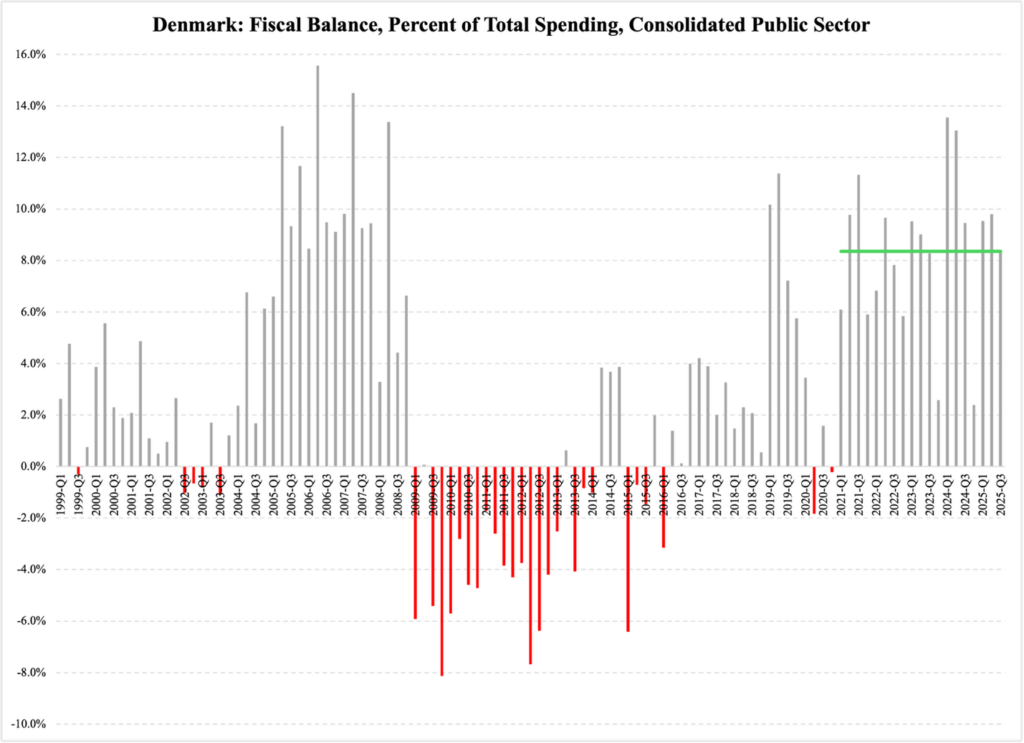
Without even a fiscal argument for the wealth tax, Prime Minister Mette Frederiksen and her social democrats are left with only one urge behind their idea: tax greed.