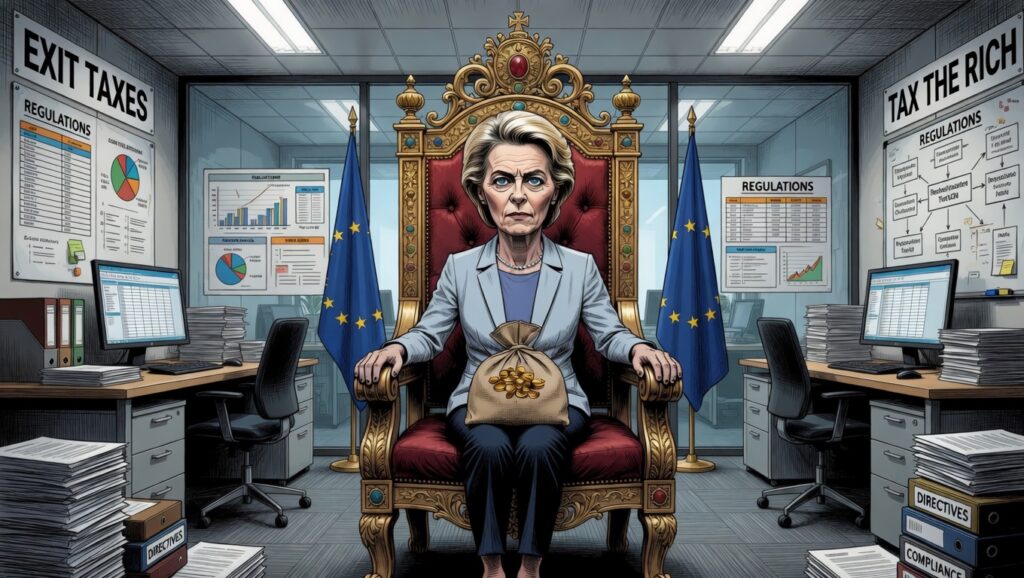
Sometimes, I wonder if politicians who consistently make the wrong decisions do so on purpose. After reading the European Commission’s new report (published in April), “Wealth Taxation, Including Net Wealth, Capital and Exit Taxes,” I am once again tempted to suggest willful ignorance.
The report favors a slew of new taxes on Europe’s richest: a tax on capital gains, both realized and unrealized; a broad-based, ‘avoidance proof’ tax on inheritance and gifts; and a tax on capital migration. If matched with heavy taxation on equity-based income, these hate-the-rich taxes would work as a confiscatory machine, vacuuming Europe clean of anything that resembles economic success.
Reading the report is a painful experience, especially since it is
The official purpose behind the publication is to alleviate ‘economic inequality’ in Europe writ large; between the lines, the report makes a thinly veiled case for giving the European Commission the powers to levy direct EU taxes on Europe’s financially most successful residents. In the boring, technical words of the nearly two dozen contributing authors:
the top 1% in the EU have increased their share of total household wealth faster than their counterparts globally. This trend is notable because global top-wealth shares have stabilised in recent years, while the EU continues to witness an upward drift. These patterns underscore the broader economic context for the present study: wealth concentration is becoming a structural feature of the European economic landscape, raising questions about how existing tax frameworks can ensure fairness.
It is easy to just browse through this paragraph and move on to the tax increases that the authors bring forward. However, that would be an implicit acceptance of the very premise that there is something wrong with big differences in income and wealth. Any such acceptance puts conservatives on the defense, where we have to play economic damage control; all we can do then is to try to limit the tax-hungry harm that statist leftists—the EU Commission preeminent among them—do to our economy.
A far more productive approach is to not accept any argument about ‘economic inequality’ at all. Instead, conservatives need to question the very notion that ‘inequalities’ exist. There are differences between individuals in terms of how much money they make every month or how much money they have in the bank, but none of those differences merit a morally pejorative term like ‘inequality.’
By making a problem out of differences in wealth, this report from the EU Commission makes it a problem that wealthy households have pulled away financially from less wealthy households. In other words, their focus is not on the extent to which people are actually better off than they were 30 years ago, but on how much better off some people are relative to others.
Again, this is the official story of the report, and it is not to be ignored. The debate over the taxes that the report suggests (more on them in a minute) will certainly be framed in terms of ‘a fight against inequality.’ Conservatives must be ready to fight back on that issue—or face defeat on both this ideological front and on the economically even more consequential tax-policy front.
In reality, the story of this Commission report, as it is convolutedly conveyed in the cited paragraph, is one of growing economic desperation on behalf of the EU Commission. If we look a little bit closer at how this report motivates its intent to reduce economic inequalities, the real point made is that wealthy Europeans have ‘pulled away’ from other Europeans—but wealth differences have not increased in the same way in other parts of the world.
A quick conclusion from this would be that Europe’s wealthy have invested with more success than the wealthy in, e.g., America or Asia. But that is not the case: the world’s wealthy—especially those who belong to the 1% cream of the crop—generally invest on the same global markets.
Therefore, there must be another explanation to why wealth differences have increased in Europe. We find it in Europe’s unending economic stagnation:
Since the European economy has been suffering from stagnation to a larger extent than comparable economies, middle-class Europeans find themselves financially trapped without meaningful savings to a larger extent than their peers in other parts of the world. In the meantime, the most affluent Europeans earn their money and maintain and grow their wealth on markets that are decoupled from the stagnant European economy.
This means, in plain English, that the problem with wealth stratification that the EU Commission now wants to address has nothing to do with wealth stratification at all. Its root cause is in the factors that keep the European economy trapped in stagnation:
You would think that the EU Commission, or at least its 21 experts who wrote this report on how to tax away wealth differences, would have enough economic scholarship among them to connect these dots. Sadly, they don’t. Instead, they do something that—given the context of why Europe’s economy is standing still—comes across as blatantly ironic: they admit that Europe is weak when it comes to innovation and entrepreneurship. But this admission is not related to the need for economic growth; it is part of a lamentation in the report where the authors decry the fact that Europe has so few ultra-rich individuals.
They notice that the elite of the European wealth elite, the top 0.01%, have seen their wealth grow less rapidly than the same top-of-the-top wealthy in other parts of the world. This, they explain, reflects “a smaller role for high-growth firms” both in providing meaningfully to the economy and in creating ultra-rich entrepreneurs and investors.
So what conclusion do they draw from this? Do they take a look at the American economy, where it is not just Silicon Valley that produces enormous wealth? No, they don’t. If they did, they would see entrepreneurs from all walks of life, like self-made billionaire Mike Lindell, who founded a company that makes pillows.
Instead of proposing a massive paradigm shift in Europe, the authors of the Commission report draw exactly the wrong conclusions. They make
an integrated assessment of recurrent and non-recurrent taxes on wealth and capital. This includes an analysis of how much instruments can contribute to revenue mobilisation and a fairer distribution of the tax burden, while limiting adverse effects on investment, entrepreneurship and growth.
Then they slab tax hikes all over the European economy. They want
But wait—we are not done yet. A recurring theme in this report is that Europe has a patchwork of tax systems, and that is not good. It would be far better, they say, if the same definition of ‘wealth’ or ‘gains’ or ‘assets’ applied to all corners of the EU. They bring up these differences in a negative tone in multiple parts of the report.
In short, say hello to EU taxation powers.
If this hate-the-rich tax package became reality, it would kill whatever is left of growth spirit in the European economy. If the EU Commission got the powers to levy the taxes listed above, the consequences for the EU economy would be outright destructive.