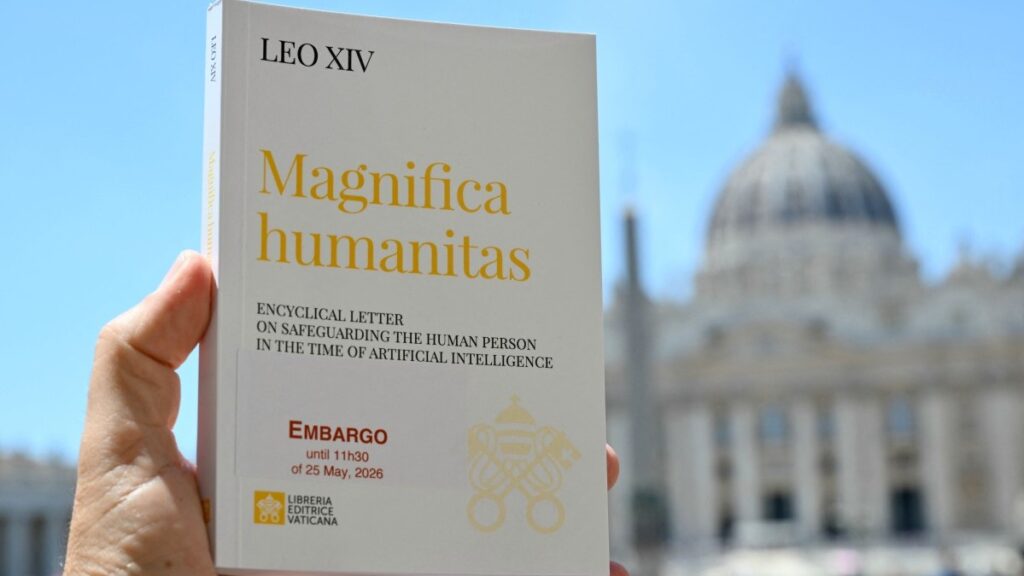
Pope Leo XIV’s Encyclical Letter Magnifica Humanitas, focused on the rise of artificial intelligence, in The Vatican on May 25, 2026.
ALBERTO PIZZOLI / AFP
For readers expecting a simple text presenting the Vatican’s policy regarding the usage of Artificial Intelligence, Pope Leo’s May 5 encyclical Magnifica Humanitas will have delivered far more of a catechetical lesson than they expected.
When word broke that Leo XIV’s first major papal text–an encyclical–was going to be on AI, it certainly raised eyebrows. Many welcomed it, anticipating it would set forth precise guidelines for how the Holy See deemed such technology should be used; others were surprised at the priority given to a non-spiritual matter by the successor to St. Peter. In actuality, both expectations were somewhat wrong.
True, Magnifica Humanitas without doubt deals with the question of AI and also technology somewhat more generally. Leo notes that “we are living through a rapid phase of transition” and that the “era of AI” has already arrived. He is also keen to note the link between Magnifica Humanitas and his name-sake Pope Leo XIII’s encyclical Rerum Novarum, which also dealt with the Catholic Church’s social doctrine and the manner in which the “the proclamation of the Gospel cannot overlook the concrete lives of people.”
But that is by no means the sum of the encyclical. In fact, one could argue that the text regarding AI forms but a strong minority of the text. What Leo has written is essentially a catechism for a secular world, in an attempt to school readers inside and outside of the Church about the true meaning of human existence and the resulting consequences of every action in light of that fact.
“We live at a time of significant spiritual and cultural blindness,” he warned.
Many of the concerns about AI usage and its rapid spread relate to the control which is swiftly being ceded to such technology, along with the consequent effects upon the labour force. Additional upset is linked to the pervasive manner in which AI systems are being used to conjure up images and videos with increasingly life-like realism, thus warping reality and the ability to determine the true identify of that which is before one’s very eyes.
Leo is aware of these and other issues, and he observed that so rapidly are such systems developing that it is hard to even suitably determine the potential impact on “both the dignity of individuals and the common good.” Given this aspect, the Pope preferred not to propose a definitive system of guidelines for using AI, but rather a revolution in how to determine the societal benefits of the technology.
Drawing from two Scriptural passages, Leo posed a question about whether society wishes to be like those who built the fated Tower of Babel or those who worked in harmony to rebuild Jerusalem after the Babylonian captivity: “a power that claims to dominate the heavens and a people who work together in the presence of God to rebuild the walls of fraternal coexistence.”
Just as technology is “not a solution to humanity’s problems,” neither is it “inherently evil” or “neutral,” since it is stained by the “characteristics of those who devise, finance, regulate and use it.” Hence in order to effect beneficial regulation of AI, Leo urged the society re-examine its own identity and moral code in order to change the people who utilize AI.
Such a process is effected by appealing to the “common good” a core principle of Catholic social teaching. “I ask everyone to abandon the construction of yet another Tower of Babel and to join forces in building up the common good, so that humanity will never lose its beauty, and the world once again will come to recognize the human heart as the place where God desires to dwell,” he wrote.
In Catholic circles the “common good” is a phrase widely known, but in order to ensure there was no room for doubt, Leo defined his term: “a city founded on the common good implies, first and foremost, building on a firm relationship with God.”
This, therefore, is the revolution which Leo is quietly proposing. Wrapped up inside an encyclical supposedly dedicated to AI is a blueprint for society to re-Christianize itself. Nor is it simply posed by way of a suggestion, but as a verifiable means of self-preservation against the rise and potentially devastating impacts of unchecked AI usage.
For the American Pontiff, such potential dangers are very real. Far from seeing it as a way to streamline human activity, Leo warned that AI risks stripping humanity of its very nature. “It is one thing to integrate technology within a human-centered, relational vision; it is quite another,” he wrote, “to be guided by an outlook that devalues human limits and promises a purely technical form of ‘salvation.’”
One such risk of divorcing oneself from the reality and dignity of human nature is the ability to equally detach from the moral weight of a decision. Perhaps nowhere is this more evident than with the advent of AI and technology into modern warfare. There is “the risk that technology, detached from ethics and responsibility, will render decisions about life and death more rapid and impersonal, and will present the use of force as an immediate and viable option,” lamented Leo.
Partly because of the impersonal nature of such current methods of conflict, “what was once considered unacceptable can now be carried out almost without hesitation, while the international response is increasingly influenced more by the interests of individual Governments than by the objective gravity of situations.”
Condemning also trans-humanism, Leo cautioned against viewing natural human reality–such as age, illness, suffering–through the prism of “a defect to be corrected, rather than as a reality through which our humanity matures and opens itself to relationship.”
On the contrary, he argued that if society wishes to use AI well and respect the dignity of all members of said society, then human nature should be clung to ever tighter, rather than be done away with: “In the era of artificial intelligence, when human dignity is threatened by new forms of dehumanization, ours is the pressing duty to remain profoundly human.”
Returning to his catechetical bent, Leo emphasized that man is not a project for advanced technology to fix but finds the meaning of his frail nature in Christ. “What saves humanity is not enhanced self-sufficiency, but a relationship that liberates, a communion that transforms.” This, he expanded later in the text, “is the divine love that descends into the most fragile point of our history and renews it from within.”
“We must lovingly safeguard the grandeur of humanity bestowed upon us and revealed in its fullness in Christ, the splendor of which no machine can ever replace.”
Whilst advocates of AI or transhumanism might view human weakness as a failure to be eradicated through the advent of technology, Leo argued that: “Our rule must be the acceptance of human limitations as a natural and positive reality, and should be characterized by shared responsibility and a language characterized by the Gospel.”
Leo’s encyclical is lengthy, but by no means record breaking. Yet what is contained within his nearly 250 numbered paragraphs is a blueprint for societal renewal, based on a fundamental shift. The Pope proposes that if the world is genuinely concerned about the advent of AI and equitable technology, then every member of society must examine themselves and commit to a life which has its meaning only through adherence to Christianity and the teachings of Christ.
His desire to prioritize such a document is now clear, since it is essentially a summary of his own concerns as Roman Pontiff, looking out onto a world which has largely forgotten the Christian civilization which once spread from continent to continent.