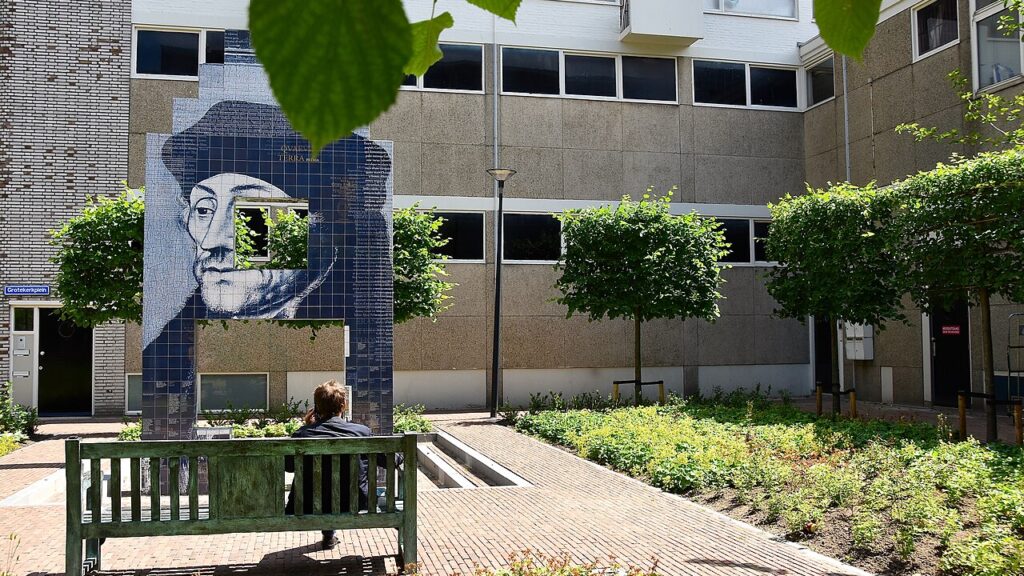
Artwork at the birthplace of Erasmus. “Quaevis terra patria” (“The whole world is my homeland” — Desiderius Erasmus, c. 1500 AD), a free-standing wall with a portrait of Erasmus on it by Dutch artists Diana de Graaf, Maaike Disco, and Reinier de Gooijer. The portrait of Erasmus and the entire wall are made up of colorful majolica tiles comprising texts written by Erasmus, including proverbs from ‘Adagia’.
FaceMePLS from The Hague, The Netherlands, CC BY 2.0, via Wikimedia Commons
As a child, I fell in love with maps. Old maps in particular, which highlighted the shifting political boundaries of Medieval Europe and the birth of familiar nations during the early modern period. In observing the European world in the year 1500 or so, you are instantly struck by its heavy fragmentation, particularly in the regions of modern Germany and Italy, which appeared as a patchwork of duchies, principalities, and bishoprics. It is hard to imagine traveling between these dominions without encountering a host of civil and cultural issues. Tensions raged between different dynasties, or even within dynasties; princes fought their emperor in what seemed like a state of perpetual civil chaos. While the state of politics at this time was, in fact, quite contentious, there was a latent civilization that underlay it, particularly from the Renaissance onward, known as the Respublica Litterarum—the Republic of Letters.
The phrase itself emerged in 15th-century humanist circles, and was popularized in the writings of Francesco Barbaro and Guillaume Budé, and later by the Dutch humanist Erasmus. However, the reality of the civilization it described was considerably older. As a function of the uniformity of the Catholic Church, medieval Europe had long possessed an international community of scholars united less by political allegiance than by a common intellectual inheritance. Latin functioned as its lingua franca, a useful tool for international correspondence. Christianity supplied its social philosophy and moral vocabulary. And classical antiquity furnished its literary canon, pulling in the great authors of the Greek and Roman world. The Republic of Letters did not arrive ex nihilo, as was later suggested by French secularists. It developed out of the maturation and self-awareness of an older, distinctively Latin civilization.
Its foundations had been laid centuries before through the metropolitan universities that began populating the continent. The ancient cathedral schools flowered into the great centers of education which are still recognizable to us today: the University of Paris, Bologna, Oxford, Salamanca, and Padua. The Renaissance humanists breathed new life into these older academic institutions and offered a renewal of interest in the life of the mind. Starting in the 14th century, Petrarch urged his peers to recover the eloquence and moral seriousness of classical antiquity, arguing that education should cultivate virtue in students as much as it fostered any sense of technical knowledge. Coluccio Salutati, Chancellor of the Florentine Republic, transformed civic life in the city by demonstrating that humanistic learning could shape the fabric of public administration and lay the foundations for legitimate republican government. Leonardo Bruni’s historical compositions presented classical civic engagement as a model for practical political leadership. The Venetian, Francesco Barbaro, argued that formal education ought to prepare men for active engagement in society, in the vita activa, rather than in the medieval and monastic retreat into private contemplation. University scholarship increasingly became more than just the custodianship of centuries of inherited wisdom. The renewal of Europe meant that civilization was able to adroitly challenge some of the ancient axioms which had previously governed society.
Some ages have personalities that are emblematic of the epoch. For the Republic of Letters, no one better embodied this vision more completely than Erasmus of Rotterdam. During his lifetime, he corresponded with hundreds of scholars from all over the wider Latin commonwealth. Erasmus regarded the art of education as a republic governed not by aristocrats, born into privilege by chance, but by discussion and well-reasoned arguments. He famously echoed the words of Socrates, describing himself as “a citizen of the whole world” (civis mundi), an aspiration that reflected the growing cosmopolitan ethos of the Republic of Letters. His critical editions of the Greek texts of the New Testament circulated throughout Europe and were best-sellers in his day. His personal correspondence exhibited the vast intellectual network that transcended political and petty confessional divisions. For Erasmus, disagreement was inevitable, perhaps even favorable as it triggered further discussion. However, it ought to occur through letters, books, and studied internal debate rather than moral and physical violence.
In the midst of all of this, the invention of the printing press transformed this scholarly Latin commonwealth, taking the exchange of ideas from expensive medieval libraries to continental conversation where larger ideas could be freely exchanged cheaply. Printing houses, such as the one operated by Aldus Manutius in Venice, made affordable editions of Greek and Latin classics available all across Europe without the expensive and time-consuming hand of a professional scribe. As such, the study of ancient tongues took a new place of centrality in formal study, a feature which would last until the early 20th century. The Parisian Guillaume Budé, who would also be involved in the founding of the Collegium Trilingue, promoted the study of Ancient Greek in France, while Johannes Reuchlin defended the genesis of Hebrew scholarship in German universities. These men broadened the linguistic horizons of Christian learning beyond the limits of Latin-only works and translations. Moreover, the fall of the city of Constantinople in 1453 brought with it a flood of ancient texts. Their recovery was not antiquarianism for its own sake. Humanists believed that in recovering the intellectual achievements of the past, they could cultivate a wiser citizen class, perhaps even more humane institutions.
By the birth of the 17th century, the Republic of Letters had become the principal engine of European intellectual life. Justus Lipsius revived the long-neglected world of Stoic philosophy as a guide for public ethics and prudent statecraft. Joseph Scaliger revolutionized historical chronology and, in the process, laid the foundations for the modern craft of historiography by comparing different ancient sources. Drawing upon Roman law, Christian theology, and classical philosophy, Hugo Grotius articulated a conception of natural law that would lay the foundations for our understanding of natural rights. His work De Jure Belli ac Pacis addressed the political interests of the young Dutch Republic but also the obligations of all civilized nations. Even today, it is surprisingly valid. It exemplifies the Republic of Letters’ conviction that our first loyalty is to the act of human reason, which possesses authority beyond the boundaries of any particular state.
While the technique and discipline of science were born out of the High Middle Ages, scientific inquiry found maturation within the Republic as well. Marin Mersenne, the French friar and polymath, maintained perhaps the most influential correspondence network of the 17th century, introducing sundry mathematicians, philosophers, and natural scientists to one another. Among his peers and associates were Thomas Hobbes, Rene Descartes, Etienne Pascal, and Galileo Galilei, to name a few. Through these lines of personal exchange between scholars, innovations and ideas traveled rapidly, at an otherwise novel pace, between various nations and universities. In Western Europe in particular, learned societies such as the Royal Society in London and the Académie des Sciences in Paris institutionalized collegial ideals that had first developed within the Republic of Letters and gave rise to the expansion of professional and scientific disciplines as well as the ethical standards that should properly govern them. That is to say, knowledge advanced most effectively through open communication, reasonable criticism, and collaboration rather than through closed society and scientific circles or through the sometimes nefarious state of political patronage.
None of this is to paint the Republic of Letters as some type of intellectual utopia. Its participants quarreled, flattered princes, harbored prejudices, and engaged in the same kind of petty rivalries that all of mankind is accustomed to. Their observations might be regarded as primitive in the face of our own expansive body of scientific and cultural knowledge. Nevertheless, they shared a remarkable conviction in the centrality and accessibility of the truth: that it was not the exclusive property of monarchs or the church, but the inheritance of humanity, a right to be guarded and transmitted to the next generation.
We often imagine ourselves to be more enlightened than previous generations because our correspondence travels instantaneously. We have access to a depth of information that would have been truly unimaginable even a generation ago. With some reservation, in the digital era, if it survives as a published document, scholars likely have access to it. Never have scholars communicated more easily across continents, and seldom have they possessed fewer common assumptions about truth, virtue, or even the purpose of education itself. We currently possess the digital infrastructure of a global Republic of Letters, and, at the same time, we increasingly lack the potency of the civilization that once sustained it. Digitalization has abolished the practical obstacles that separated Erasmus and his peers in their correspondence. A manuscript that once required months to cross the Alps can now circle the globe in milliseconds. The means of communication have never been easier or more pervasive, expanding beyond anything the Renaissance humanists could have begun to imagine.
However, communication itself is not civilization. Saliently, the Republic of Letters was a civilization, one that participated in a common moral and intellectual enterprise. They argued fiercely, experimented, and debated because they assumed there was something objective to argue about. These debates held their centrality because they believed reason could refine error into truth. Their disagreements were often profound, but they unfolded within a recognizable intellectual household which held the Aristotelian position that truth was unchanging and intelligible if human beings rightfully exercised their God-given wits.
The state of our universities is telling of the state of our civilization. While they continue to produce experts with an extraordinary range of technical ability, they frequently produce anchorless academics with little sense of any larger civilizational inheritance. The humanities, once regarded as foundational, as the common education of free citizens, are disappearing from the academic landscape. They are frequently justified only by their economic utility, if they are in fact justified at all. Public discourse, meanwhile, has become less an exchange of letters than an exchange of political slogans and commercial doggerel.
The lost Republic of Letters is not nostalgia for its quaint scholarly artifacts. It is the recognition that every flourishing culture rests upon deeper moral foundations, ones that they do not create or invent for themselves. Any lasting civilization has to believe that truth is the defining feature of knowledge. Our ability to reason must be trustworthy, our education must inform our character, and our learning must impose obligations upon the learned. Without those assumptions, the post-modern machinery of communication will only be the mechanism for distributing opinion at unprecedented speed.