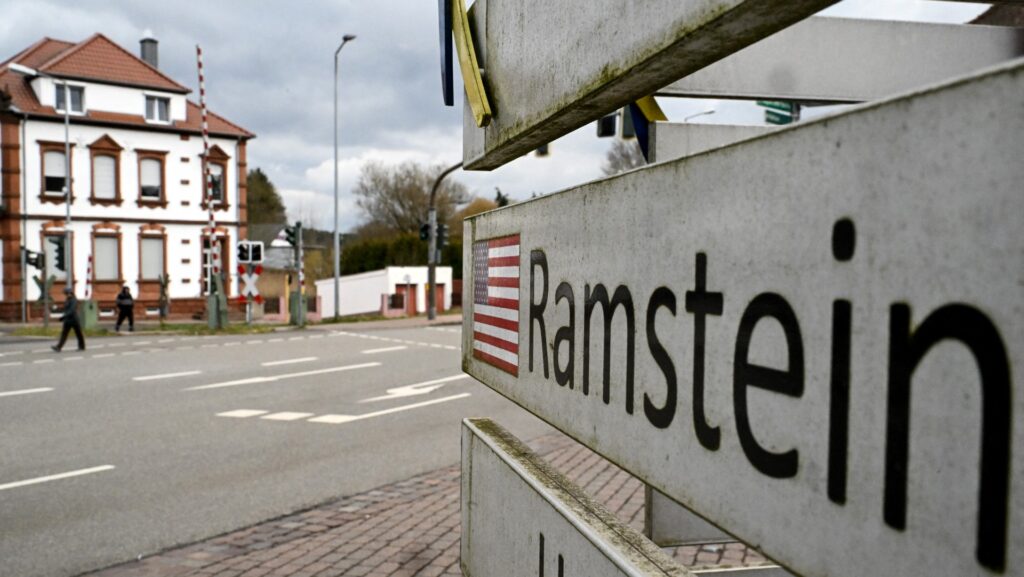
A U.S. flag is pictured in the city of Ramstein, near the Ramstein Air Base, western Germany, on February 26, 2025.
KIRILL KUDRYAVTSEV / AFP
Before Europe became a collection of nation-states, it was a civilization bound together by scholars, shared learning, and the pursuit of truth. As our capacity to communicate has expanded beyond imagination, the intellectual culture that sustained that world has steadily eroded.
Last week’s announcement of the withdrawal of around 5,000 U.S. troops from Germany—followed by Donald Trump’s warning that there will be “many more”—has shaken Europe’s strategic landscape at a particularly sensitive moment.
Not only because of the scale but because of the transatlantic context: direct political friction between Washington and Berlin, war in the Middle East, and a NATO that is once again questioning itself.
Germany remains the main U.S. military hub in Europe, with more than 36,000 personnel, key infrastructure such as Ramstein and Stuttgart, and a central logistical role for operations across three theaters—Europe, Africa, and the Middle East. The announced withdrawal affects only a fraction, but the message Washington intends to send carries greater weight.
Friedrich Merz has tried to downplay the impact. He insists there is no link between his criticism of U.S. strategy in Iran and the Pentagon’s decision. He maintains that these were troops deployed temporarily after the war in Ukraine and whose withdrawal had already been planned. But the timing and tone from Washington tell a different story.
Trump has not concealed the political link (as with other countries such as the United Kingdom, Spain, or Italy). He accused the German chancellor of “having no idea” and of failing to support the United States in the conflict with Iran. He went further, suggesting a much larger drawdown, reinforcing a recurring theme in his discourse—that Europe does not pay enough for its own security.
But herein lies the key point: the structural dimension is beginning to outweigh the immediate context.
The United States is not leaving Europe; it is reconfiguring its position. The partial withdrawal does not change the fact that Germany will remain the central node of the U.S. military system on the continent. But it does introduce political and operational pressure: less direct presence implies greater dependence on European capabilities and, at the same time, more room for conditionality from Washington.
We are working with the U.S. to understand the details of their decision on force posture in Germany. This adjustment underscores the need for Europe to continue to invest more in defence and take on a greater share of the responsibility for our shared security – where we’re…
— NATO Spokesperson (@NATOpress) May 2, 2026
The reactions this Monday from leaders in Brussels and NATO point in that direction. Kaja Kallas, the EU’s High Representative for Foreign Affairs, described the announcement as “surprising” but used it to reinforce an already established line: Europe must do more. This is not nuance; it is an implicit acknowledgment of vulnerability.
NATO Secretary General Mark Rutte was more explicit in his political reading, not surprising given several media controversies over his near non-existent autonomy from Donald Trump. He acknowledged U.S. “disappointment” with European allies over their response to Iran but added that they have “got the message.” Operational translation: more logistical support, greater availability of bases, more alignment. In other words, greater subordination and higher costs to bear.
In parallel, Berlin is accelerating its own agenda. The stated objective—to become Europe’s leading conventional military power by 2039—is no longer a theoretical framework but a strategic necessity. Defense Minister Boris Pistorius has made it clear that Europe must assume more responsibility if it wants to remain transatlantic.
The key lies in how this process is structured.
Germany can strengthen itself without breaking U.S. primacy. Its rearmament is conventional, dependent on NATO interoperability and, above all, on capabilities that remain American: nuclear deterrence, intelligence, advanced systems. This limits any real autonomy.
Within this balance, another key player emerges: France.
Paris retains the EU’s only fully sovereign nuclear deterrent and an autonomous strategic culture. But its weight does not automatically translate into control over Europe’s military axis. The eastern flank—where the continent’s security is now defined—is increasingly shaped by Germany, Poland, and the NATO architecture led by the United States.
A division of roles is thus taking shape: France as a strategic power with projection capabilities, Germany as the industrial and conventional pillar,and the United States as the ultimate guarantor of the system.
The partial troop withdrawal fits into this framework more than it disrupts it. Because the key question is not how many soldiers leave, but who defines the conditions of security. And on that ground, Washington still holds the structural advantage.