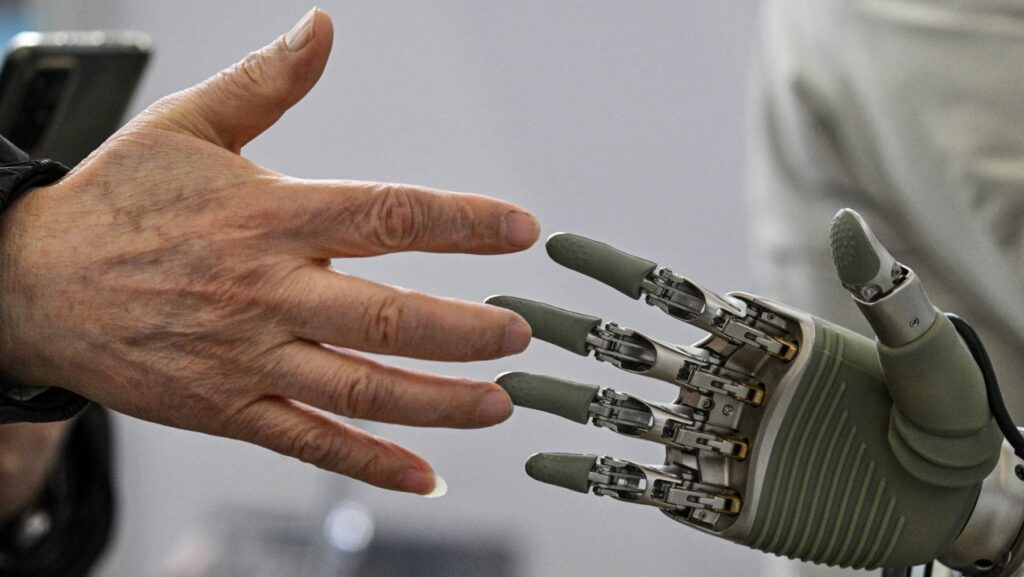
A man touches a robotic hand from OY Motion during the Global Developer Conference, organised by the Shanghai AI Industry Association, in Shanghai on February 21, 2025.
Hector RETAMAL / AFP
China now accounts for roughly 30% of global manufacturing value added and has established itself as the world’s dominant manufacturing power. Europe once believed that globalisation would make such concentrations of economic power largely irrelevant. Today, however, policymakers in Brussels are increasingly discovering that economic dependence can quickly become a strategic vulnerability.
The implications of that concentration are becoming increasingly difficult for European policymakers to ignore. As the European Union debates tariffs on Chinese electric vehicles, investigates state subsidies, and seeks ways to shield domestic industries from unfair competition, it is confronting a reality it has long preferred to overlook: economics and geopolitics can no longer be separated.
The issue is not only one of trade balances or market access but also of resilience, competitiveness, and Europe’s capacity to act autonomously in an increasingly contested international environment.
The debate over tariffs and industrial competition reflects a broader concern about China’s growing dominance in industries expected to define the twenty-first-century economy. The power processes roughly 90% of the world’s rare earth elements, materials essential for electric vehicles, wind turbines, defence systems, and advanced electronics, and it produces more than three-quarters of global lithium-ion batteries and dominates significant parts of the solar panel supply chain. Through decades of state planning, subsidies, favourable financing, and industrial policy, Beijing has secured positions that are difficult for competitors to challenge.
European manufacturers increasingly find themselves competing not merely against Chinese companies but against the strategic priorities of the Chinese state itself. The concern in Brussels is not simply that Chinese firms are succeeding, but it is that industries central to Europe’s future prosperity could become dependent on technologies, materials, and supply chains controlled elsewhere.
This concern is more visible in the automotive sector. Chinese electric vehicle exports to Europe have expanded rapidly, prompting the European Commission to launch anti-subsidy investigations and impose additional tariffs on several manufacturers. European officials argue that state-backed overcapacity allows Chinese producers to sell vehicles at prices that European competitors struggle to match, threatening an industry that directly and indirectly supports millions of jobs across the continent.
Yet China’s rise alone does not explain Europe’s current predicament. Beijing’s success explains part of the challenge, but the continent’s vulnerabilities are also the product of choices made in Europe itself.
For decades, many European governments assumed that industrial capacity could be taken for granted. Manufacturing was often viewed as a legacy sector rather than a strategic asset, while policymakers focused on regulation, finance, services, and climate governance, paying comparatively less attention to maintaining competitive production. At the same time, energy costs rose, permitting procedures became increasingly cumbersome, and businesses faced mounting regulatory obligations.
The consequences of these choices are becoming harder to ignore. Energy-intensive industries have faced growing pressures, particularly since the energy shock triggered by Russia’s invasion of Ukraine. Sectors such as chemicals, steel, fertilisers, and heavy manufacturing continue to struggle with energy costs that remain significantly higher than those faced by many international competitors. Germany, long considered the industrial engine of Europe, illustrates these concerns particularly clearly, as companies including BASF have reduced domestic investment and expanded production abroad, citing competitiveness challenges and higher operating costs.
These trends are not merely economic concerns. They raise a broader question about whether Europe can remain strategically autonomous while key sectors of its industrial base steadily lose competitiveness. A continent that cannot produce enough of what it consumes or maintain leadership in critical industries risks having its political choices constrained by economic realities beyond its control.
Europe spent decades championing open markets and rules-based commerce, only to discover that many of its competitors were operating according to different assumptions. China pursued industrial dominance through state intervention and long-term planning. The United States, meanwhile, has returned to industrial policy through initiatives such as the Inflation Reduction Act and the CHIPS and Science Act, committing substantial public resources to strengthening domestic manufacturing and technological capacity. While Europe often viewed economics through the lens of regulation and market governance, others increasingly viewed it through the lens of national power.
It is precisely this growing awareness of vulnerability that is reshaping European thinking. The renewed interest in projects such as the India–Middle East–Europe Economic Corridor (IMEC) reflects this shift. While often presented as a connectivity initiative, its broader significance is strategic, as it reflects Europe’s growing desire to diversify supply chains, strengthen partnerships with emerging powers, and reduce excessive dependence on any single external actor.
Recent developments suggest that the corridor remains politically relevant despite the regional instability that has complicated its implementation. The appeal of IMEC lies not simply in its commercial potential but in what it reveals about Europe’s changing understanding of economic security. For decades, policymakers assumed that global supply chains would remain stable and politically neutral. Recent disruptions, from the pandemic to the war in Ukraine and growing tensions with China, have demonstrated that trade routes, infrastructure, and supply chains are also instruments of geopolitical influence. Diversification is increasingly viewed as a matter of resilience rather than efficiency alone.
Yet diversification is only part of the answer. New corridors can reduce dependency, but they cannot compensate for a weakening industrial base at home. If Europe wishes to remain competitive, it must address the structural issues that have undermined its productive capacity: high energy costs, excessive bureaucracy, slow permitting procedures, underinvestment in strategic industries, and a political culture that too often treats production as secondary to regulation.
The broader lesson of the China debate is that economic competitiveness, security, and geopolitical influence are increasingly interconnected. Europe’s confrontation with China is therefore about much more than electric vehicles, batteries, or tariffs. It is a reckoning with assumptions that have guided European economic thinking since the end of the Cold War. The continent is beginning to recognise that sovereignty is not merely a legal or political concept, as it also rests on the capacity to produce, innovate, and sustain economic power.
The debate over China ultimately reflects a broader challenge facing European policymakers. As concerns about economic security, industrial competitiveness, and strategic autonomy increasingly converge, the question is not simply how Europe should respond to China’s rise but how it intends to strengthen the foundations of its own resilience. Trade measures may alleviate immediate pressures, but Europe’s long-term position will depend less on how it responds to China than on how successfully it strengthens its own productive and technological foundations.
The success of that effort will shape not only Europe’s economic future, but also its ability to act with confidence and autonomy in an increasingly contested global order.