Inflation is on the rise again. The break with the relative stability in prices over the winter is clear, sharp, and alarming.
To date, Eurostat has published April figures for 20 EU states and for the euro zone—and the numbers are worrying:
There is no shortage of troubling numbers to go around. Inflation in Cyprus doubled from 1.5% to 3%, with Italy closely behind: from 1.6% in March to 2.9% in April. France, an economy in perennial standstill, experienced an uptick from 2% to 2.5%.
With its 5.4% rate, Croatia leads the inflation league among these 20 countries. In March, only
Romania beat the Croatian inflation rate (9% to 4.6%); there is no Romanian April inflation figure yet. There is no doubt, though, that both Romania and Croatia are in big trouble: while the former has suffered from Europe’s highest inflation rate for months, the latter just saw its rate rise from 3.6% to 5.4%.
The Greek inflation trend is perhaps even more troubling. After hitting a low of 1.6% back in October, Greece experienced a bit of a rebound, stabilizing around 3% over the winter. Now, suddenly, it stands at 4.6%.
In view of these numbers, there is some relief in the fact that inflation declined in the Netherlands (2.6% to 2.5%), Estonia (3.5% to 3.3%), Finland (2.5% to 2.3%), and Latvia (3.4% to 3%). However, these were mild downticks that weigh lightly in comparison with the large majority having rising inflation.
For the euro zone as a whole, inflation ticked up from 2.6% to 3.1% in April. This came after several months with inflation in the currency area hovering around 2%.
With these numbers in mind, I am baffled that there is such resistance to rate hikes at the ECB. On May 2nd, I commented on the end-of-April decision by the ECB to keep interest rates unchanged. I noted that the central bank refused to use the word ‘stagflation’ to describe the economic situation that Europe is heading into. Instead, they went out of their way to say ‘stagflation’ without saying it—a word salad that I characterized as
fancy speak for the ECB expecting higher inflation and slower economic growth. It is also a thinly veiled hint that the central bank is worried about Europe sliding into stagflation. A stand-still economy is an economy with high unemployment; a stand-still economy with high unemployment that also experiences higher inflation is an economy in stagflation.
The inflation figures that I discuss here were well-known to the ECB economists when the bank’s governing board made the decision in the last days of April to keep their interest rates unchanged. It was also well known to them—as my May 2nd article explained—that unemployment remains high without any tendency to decline. With this in view, the bank’s refusal to respond appropriately makes it complicit in allowing inflation to rise further—and in allowing the threat of stagflation to grow significantly bigger.
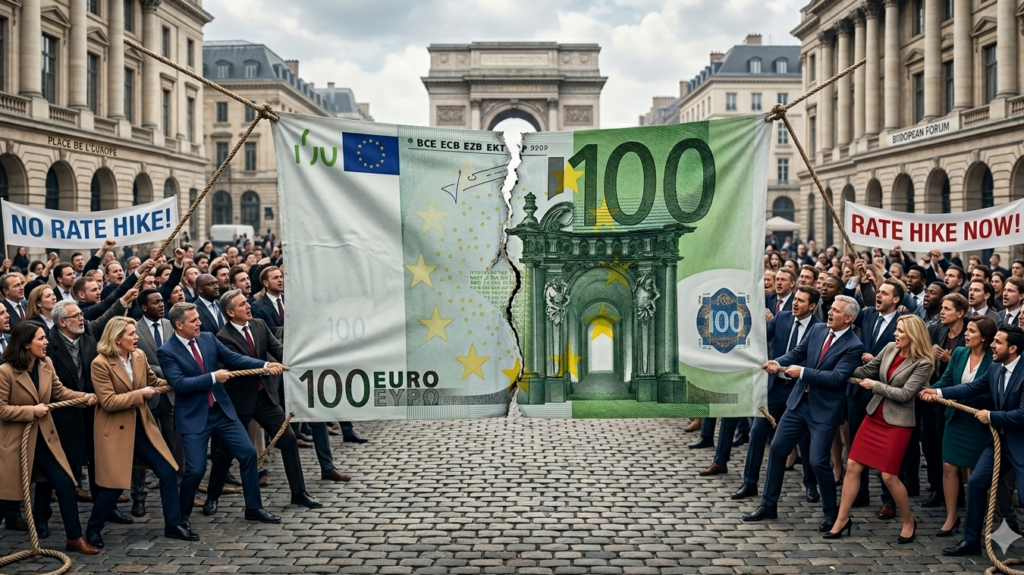
As if their denial to raise rates in April was not enough, ECB officials are doing their best to spread doubt about future interest rate increases. On the one hand, there is a camp of ‘rate hike hawks’ that favors a stern response. One of them is Joachim Nagel, president of Germany’s Bundesbank. On May 4th, he made it explicit that the ECB “may need to raise interest rates in June” unless inflation figures go the opposite way of what they are currently doing.
On May 10th, Bloomberg reported that there will be two rate hikes this year, but only two days later, a rift became visible between rate-hiking ‘hawks’ and no-hike ‘doves’ at the ECB. From Politico Europe:
The European Central Bank is edging closer to raising interest rates to prevent the latest oil shock from morphing into a broader inflation spiral … Bank of Malta Governor Alexander Demarco broke with fellow policy doves
On the other hand, the dovish no-rate-hike side appears to be gaining strength. On May 13th, Yahoo Finance reported:
With oil prices not spiking as high as many feared, no wider inflation spillover yet from the ramp-up in energy costs and the euro zone’s 20-nation economy stagnating, officials appear to be shifting their views.
This reluctance is difficult to understand. While it is true that higher interest rates would temper consumer spending, it is also true that stagflation would do the same, only with considerably more force and more lasting consequences. Rate hikes do not inject nearly as much uncertainty into the economy as inflation and unemployment do; the more uncertain consumers feel about the future, the less inclined they are to commit to any kind of future spending.
In other words, the dovish officials at the ECB need to realize that they have only two bad options to choose from; there is no such thing as a good option here. They have to choose the alternative that inflicts the mildest, most short-lived harm on the European economy.
That alternative is a decisive rate hike in June.