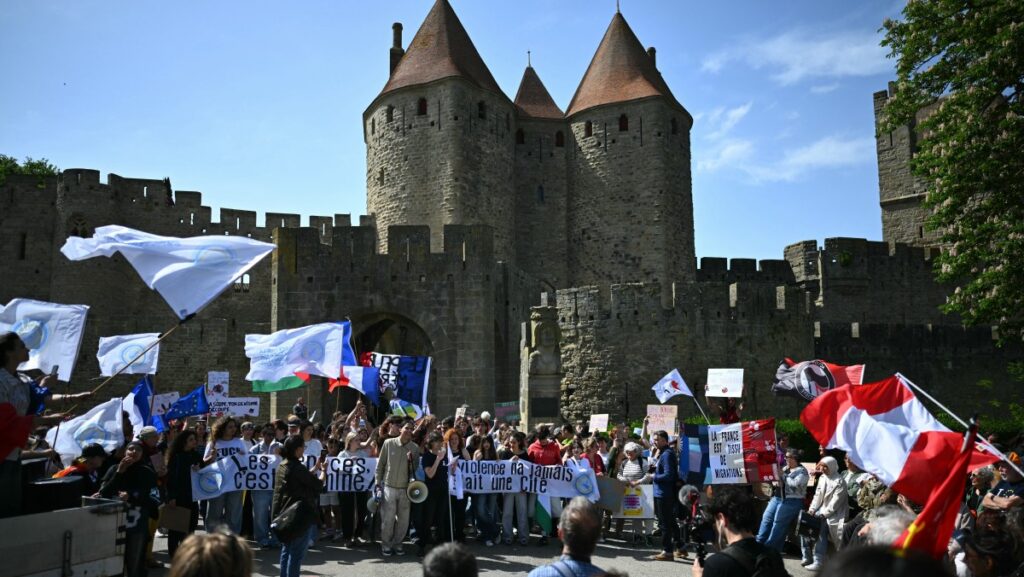
Protesters wave flags as they demonstrate in front of the medieval citadel at the call of the ‘Nous Carcassonne’ collective against the decisions taken by Carcassonne’s newly elected mayor, representing Rassemblement National, in Carcassonne, southwestern France on April 29, 2026.
LIONEL BONAVENTURE / AFP
It has been just over a month since the Rassemblement National (RN) took office for the first time in a whole host of town halls across France. The Left is crying foul and expressing concern at the prospect of sweeping cuts to funding for community organisations and culture. But this is precisely why Jordan Bardella’s party has been entrusted with the reins of so many towns: to put an end to the shameless squandering of public money that has long ceased to benefit French citizens.
Since the last local elections, the towns now under RN administration have become political showcases under close scrutiny. The new RN mayors have swiftly implemented symbolic and concrete measures designed to mark a break with the former ruling parties. For their supporters, these measures respond to a demand for local engagement, a sense of local identity, and firmness in municipal management. For the Left and community organisations, these measures are a cause for concern.
Among the first decisions highlighted in several municipalities led by the RN is the reallocation of municipal grants. According to Valeurs actuelles, several mayors have chosen to scrap or reduce funding for certain associations deemed to be activist or overly politicised. Instead, they claim to want to prioritise local organisations focused on neighbourhood activities, popular traditions, or direct services to the public.
This approach has been illustrated by decisions affecting cultural festivals and community events. In Vierzon, the mayor made headlines by prioritising Joan of Arc over the commemoration of the abolition of slavery. In La Flèche, a theatre company working with migrants and performing in schools lost nearly half of its municipal grant.
The new municipal executives have stepped up symbolic gestures. In Carcassonne, the ‘pig festival’ has become a media symbol of this shift: RN councillors present it as a way of embracing French traditions without reservation and defending a local cultural heritage sometimes deemed under threat or undervalued.
The removal of the European flag from certain town halls is also among the most talked-about measures. Several RN mayors have explained that they wish to give priority to the French flag in public buildings to reaffirm national identity and local sovereignty.
On the Left, there is panic. There are concerns about the policy of ideological selection that is now expected to prevail in the allocation of grants. In many cases, it is not a matter of redirecting funds to other, more compliant organisations but, above all, of putting an end to easy public money: a revolution for certain associations that have never learnt to operate any other way. Take the Human Rights League, for instance, which has come under fire from the Carcassonne city council for opposing the anti-begging bylaw introduced by the new mayor. The association believes that its existing reserves will allow it to continue operating as normal for five to six months. Beyond that, it will have to reassess its priorities and consider redundancies. For the RN, this is no loss, given the lack of representativeness of these organisations, which have, for decades, grown accustomed to believing themselves indispensable to public life. The same applies to the trade unions, which, until now, had benefited from free council premises and have been asked to move elsewhere.
The MP for La France Insoumise (LFI) Manon Aubry has played along with the game of commenting on all the ‘unfair’ measures taken over the past month by RN mayors on her X account.
🗣️ « Le RN et l’extrême droite, on n’a jamais essayé »
— Manon Aubry (@ManonAubryFr) May 13, 2026
En 1 mois voici le bilan de ces maires.
Personne ne pourra dire qu’il ne savait pas. ⤵️
Liévin
• Volonté initiale de supprimer la cérémonie d’hommage aux « gueules noires », mineurs du bassin houiller
• Exclusion des…
On closer inspection, one realises how laughable these accusations are. For instance, in Moissac, Mayor Romain Lopez is accused of undermining the “diversity of cultural programming.” In reality, the mayor merely opposed a grant aimed at highlighting “Papuan culture,” preferring local culture and the preservation of the town’s Romanesque abbey—one of the finest in Europe.
Whilst the press is alarmed by a perceived shift, filling its pages with alarmist terms denouncing the influence of the ‘far right,’ these measures nonetheless strike a genuine chord with a section of the population. If voters chose to cast an RN ballot, it is because they expect change: greater local engagement, a reduction in spending deemed ideological, and a stronger emphasis on French traditions.
The discourse on local public finances is central. RN mayors emphasise a desire to redirect public money towards concrete priorities: security, cleanliness, local festivals, or support for local shops. Against a backdrop of budgetary strain for local authorities, this promise of ‘refocusing’ finds support among residents who feel that municipalities fund organisations that are overly politicised or unrepresentative of the local population.
Behind these budget cuts lies an issue with national implications. With a view to the 2027 presidential election, these municipalities will seek to demonstrate their management capabilities at a local level. During the previous term of office, several towns already under RN control highlighted what were seen as sound budgetary records and an improvement in the quality of life, which explained their comfortable re-election, often securing victory in the first round. RN councillors are highlighting improved local security, a greater focus on public order, and a commitment to making town centres more attractive. For decades, the lack of local roots has largely worked against the RN, which is determined, this time, to reverse the trend.