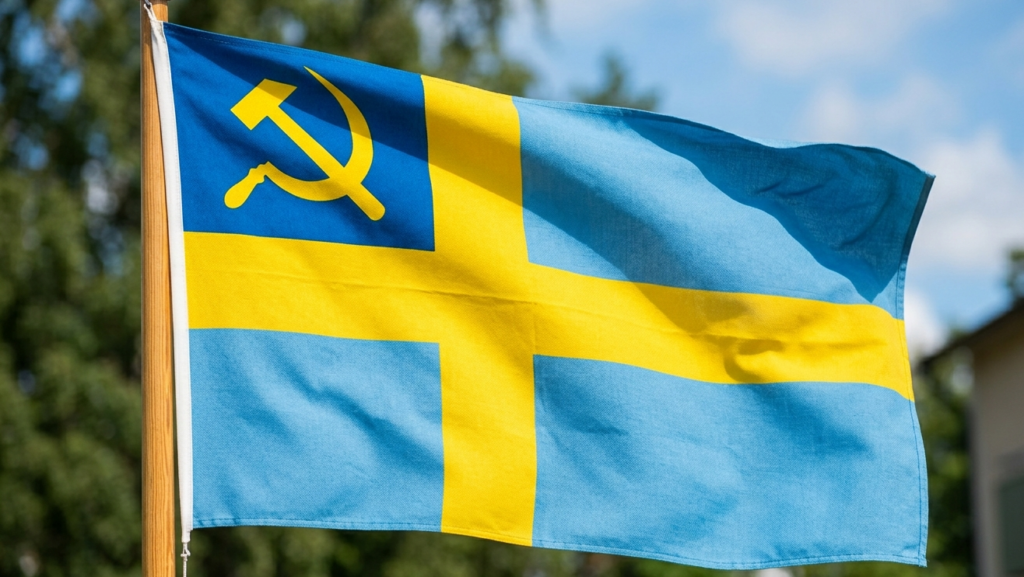
On May 11th, the Wall Street Journal ran a story about Sweden where they made the amazing claim that
For decades, Sweden was shorthand for the brand of high-tax, high-spend government that managed people’s lives from cradle to grave through state-run hospitals, schools, and care homes. No longer. With little fanfare, this Nordic country … has embraced capitalism.
As ‘evidence’ of this capitalist revival, the Journal opines:
Today, nearly half of primary healthcare clinics are privately owned, many by private-equity firms. One in three public high schools is privately run … School operators are listed on the stock exchange.
Soon after, Fox Business ran a segment where, based on the Journal’s article, the hostess promptly declared that “Sweden has privatized its economy.” One of the panelists claimed that Sweden started out after World War II as a capitalist economy, then went socialist, and went back again. The Journal makes a similar claim, suggesting that the construction of the socialist welfare state began in the 1960s.
This is nothing short of historic illiteracy. Sweden had a socialist government from 1932 to 1976; why would that government idle in its office for 30 years and then suddenly, one day, wake up and start building a socialist society?
In reality, as I explained in my book The Rise of Big Government, in this article, and on numerous other occasions, that very same government began transforming Sweden in the image of socialism already in the late 1930s. In 1958, Gunnar Myrdal—the economist and ideological architect of the Swedish welfare state—gave the Storr Lectures at Yale University. There, he triumphantly declared that the Swedish socialists had completed the transformation of the country and that the welfare state was so popular that the conservative political opposition would have to accept it in its entirety or be eliminated at the ballot box.
This historical background is important. It shows how deeply entrenched the Swedish welfare state really is. By now, 90 years after the socialists began building it, four generations of Swedes have grown up under it. The very idea that Swedes would summarily throw out this monstrous socio-economic edifice, which affects every part of a Swede’s life, is simply naive.
Sweden is about as socialist today as it was in the last century. Socialism has not disappeared with the emergence of private primary care clinics or private schools. There were private businesses in the communist countries under the Soviet system; does that mean the Soviet-controlled countries in Eastern Europe were not socialist?
Just like private farms in communist Czechoslovakia had nowhere else to sell their products but to the government, private primary care clinics in Sweden have only one source of funding: the taxpayer. When it comes to the sectors of the economy that the Swedish government controls, it is every bit as intrusive as the Soviet governments were: it decides when, where, why, and if private businesses can operate in health care, education, child care, elderly care, pensions, income security, and mass transit.
All these sectors are funded and regulated by government. This explains why—as we shall see in a moment—government taxes and spends about half the Swedish economy.
A private provider in health care or education must ask government for permission regarding location, time for opening, and size of operation. If government thinks there are enough private clinics already, or if its budget simply cannot afford another clinic, the application is denied.
Private schools are even more tightly regulated. An application to open a private school has to be approved by both a local and a national government agency. If the applicant cannot prove that he is adding something that the public schools are not already providing, his application is denied.
There is an explicit ideological reason why the ‘privatization’ program in Sweden was designed this way. It is called socialism: since government funds health care and education, it controls who gets access, and on what terms. The goal is to eliminate any advantage associated with private funding; the small sliver of the health care market that is covered by supplementary private insurance—so small it is barely statistically visible—is under heavy scrutiny and threatened by new regulations if the Left wins the election in September.
By the same token, private schools are banned from charging tuition on top of the tax-paid vouchers they get per enrolled student. Although the funding formula for private schools has changed over time, the prevailing principle has been to put them at a disadvantage vs. public schools.
With no opportunity to innovate on funding sources, private schools are forced to slim down on student-oriented functions that public schools provide. This has led to a debate where the Left—which currently leads the polls by more than ten percentage points—has promised to severely tighten the operating conditions for private schools.
In other words, government remains in solid control of the Swedish economy, especially the sectors where it has staked a funding monopoly. And that is precisely the core issue here: government funding, not the formal ownership of the service provider, is the key to understanding the ideological profile of an economy. Since government maintains its funding monopoly over all the aforementioned sectors, it comes as no surprise that as of 2025, government took in 48.8% of the Swedish economy through taxes, fees, and other charges.
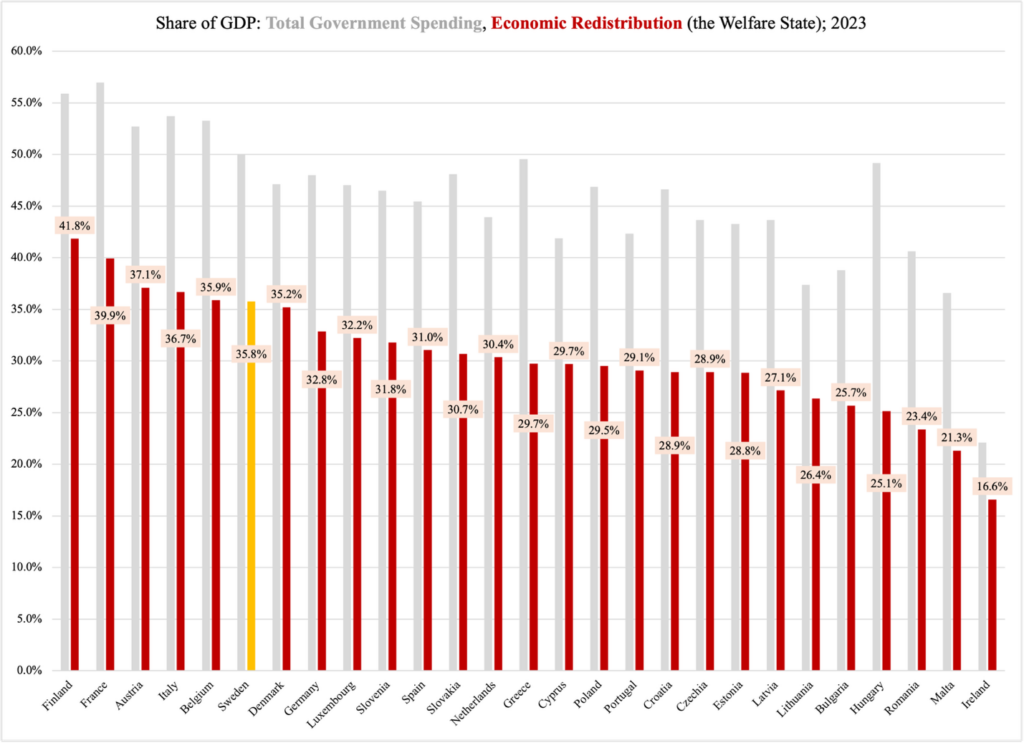
By the same token, it is not surprising that the Swedish government spends 48.9% of GDP. To be fair, this share is lower than it has been in the past; Sweden is no longer above the 50% line where Finland, France, Belgium, and Austria are fighting for the sordid top spot.
As for the claim in the Wall Street Journal article that Sweden spends less than one-quarter of its GDP on social benefits, that is a statistical ruse. The real concept is the welfare state, which includes all spending programs that are designed to redistribute income and consumption between citizens.
Why is it important? Because socialism is not about who owns the business. Socialism is about economic redistribution—about taking from Paul to give to Pete until they have exactly the same standard of living.
Figure 1 has the story:
Figure 1
The bigger the welfare state, the more distant people become from market-based economic incentives. Distortionary, progressive income taxes paired with government-provided benefits that cover a large part of a family’s needs gradually erode workforce participation, weaken interest in career development, and undermine risk-taking and entrepreneurship.
If the welfare state’s influence on the private sector is invasive enough, its negative economic incentives discourage all economic activity, domestic and foreign.
Speaking of the latter, foreign direct investment—a key indicator of how business-friendly a country is—in Sweden has stalled in recent years. In stock terms, there has actually been a small decline since 2021.
This is unusual. Most countries see a rise in the FDI stock over time. Denmark is one example: its FDI stock increased by 25% from 2021 to 2024 (the latest year for which UNCTAD has data). Finland grew its stock of foreign investments by 7% over that same period of time.
Hungary experienced a 14% increase; the Italian FDI stock increased 11%.
In 2021, Poland had an FDI stock of $280.3 billion. Over the next three years, that stock increased by 23% to $345.2 billion. This is remarkable, especially from a Swedish viewpoint: if this trend continued through 2025, then Poland would by now be a more popular FDI goal than Sweden.
It is not surprising that Sweden is having problems attracting FDI. The Wall Street Journal can quote whoever they want saying that Sweden has a more favorable tax system than the United States (thank you, Larry Kudlow on Fox Business, for making some corrections on that point). A business that considers where to invest will look at everything from income taxes for both corporations and individuals to labor costs, mandatory union contracts, and onerous hire-and-fire laws. They will look at environmental regulations, fees, and other charges.
Not only does the business have to live in Sweden—so do its employees. If the total cost of living is unfavorable compared to other countries, then Sweden loses out. If employees fear being stuck in long waiting lines to get health care, they will balk at taking a job in Sweden.
Private primary care clinics notwithstanding, health care is one of many sore spots on the Swedish economy. To take one example from the OECD’s healthcare database, in 2023, more than 30% of patients in Sweden waiting for cataract surgery had to wait for more than three months—and that is after they had been referred for surgery by a specialist. That time does not even include the waiting lists to see the specialist.
Hungary, Italy, Poland, and the United Kingdom are among the countries that offer faster treatment than Sweden does.
In 2021-2023, 45-50% of all patients in need of hip replacement had to wait more than three months between specialist and surgery. Danish, Polish, Hungarian, and Italian health care were quicker to treat these patients. A Swede who needed knee replacement had a 66% chance of waiting more than three months.
The Swedish government has passed a law that says it must provide a specialist appointment or medical treatment within 90 days. Unsurprisingly, the Swedish government notoriously breaks its own law: one year ago, 206,000 patients were waiting longer than the statutory maximum, either to see a specialist or to be treated for their medical conditions.
To put this in a U.S. perspective, that is the equivalent of 6 million American patients having to wait more than three months for a specialist appointment or for medical treatment (including surgery).Imagine having to wait over 3 months just to get an appointment with a specialist and then having to wait another 3+ months before you can actually get the treatment or operation you need.
All these problems might be alleviated if the Swedish economy would actually grow at any meaningful rates. Regardless of what official news stories purport, the real outlook is not very optimistic. Swedish GDP is not pulling away from the rest of Europe. A quick look at Eurostat’s national accounts database tells us that in 2025, Sweden’s inflation-adjusted GDP growth rate was 1.5%. This is equal to the growth rate for the 27-member EU. It is minimally better than the euro zone’s 1.4%.
Last year, 14 EU member states outperformed Sweden in real GDP growth.
I wish mainstream media would stop with its propagandistic stories about one of Europe’s most socialized economies. Nothing in Sweden gets better with these stories; if anything would make Sweden an attractive place to invest in, start a business in, and live in, it would be if the mainstream media began telling the truth about the country.