‘Strategic autonomy’ has become one of Europe’s favourite phrases, signalling independence and geopolitical maturity and suggesting a continent ready to assume greater responsibility for its own defence and less willing to rely indefinitely on American guarantees. Yet the real challenge has never been in declaring this ambition but in giving it institutional form, military substance, and political coherence.
That difficulty is now becoming harder to ignore. Article 42(7) of the Treaty on European Union, the Union’s mutual defence clause, is legally binding and politically significant, yet still remarkably vague in operational terms. It commits member states to aid and assist a fellow member that is the victim of armed aggression on its territory, but it leaves unanswered the practical questions that determine whether such a commitment is credible in a crisis.
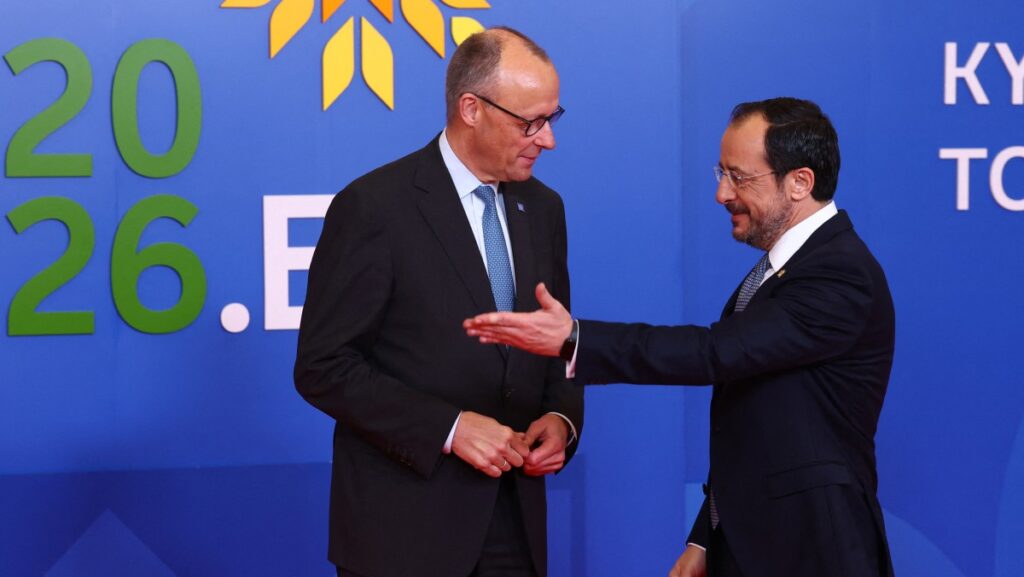
Recent discussions, driven in part by Cyprus’s current Presidency of the Council and by President Nikos Christodoulides, have brought renewed attention to that ambiguity. At the informal meeting of EU leaders on 23–24 April 2026, Article 42(7) was discussed explicitly in view of the broader geopolitical situation, with leaders examining how the clause could function in practice and the High Representative reporting on ongoing work. Christodoulides has argued that the Union needs a clear operational mechanism and a structured plan rather than improvised solidarity if the clause is to carry real meaning.
That is why the issue matters beyond Cyprus itself. The problem is not simply that Article 42(7) remains vague. It is that its vagueness exposes a wider weakness in Europe’s strategic discourse, namely the desire for autonomy without a fully developed architecture of defence.
For years, the European Union has spoken the language of power, invoking strategic autonomy, geopolitical responsibility, and the need for a stronger European pillar of security. But rhetoric, however polished, cannot substitute for capability. A serious defence commitment requires institutional clarity, agreed procedures, operational planning, and a political willingness to define who acts, how, and under what authority. On Article 42(7), Europe still lacks that clarity.
The clause is solemn enough. It binds member states to provide aid and assistance “by all the means in their power” if another member suffers armed aggression on its territory, but it says little about sequencing, burden-sharing, command structures, or the relationship between EU action and NATO mechanisms. The obligation exists. The mechanism does not. What appears, on paper, as a serious expression of mutual defence still depends in practice on political improvisation.
Cyprus is an especially revealing case because it sits precisely at the intersection of Europe’s unresolved security tensions. It is a frontline member state, under Turkish occupation, exposed to regional volatility, but, unlike most EU members, it is not part of NATO. That alone sharpens the significance of Article 42(7). For many other member states, NATO’s Article 5 remains the ultimate guarantee in a major security crisis. For Cyprus, the EU clause carries a different weight. It is not merely symbolic reassurance. It raises a practical question about what the Union’s solidarity would amount to if tested under pressure.
That question becomes even sharper in the Eastern Mediterranean. The weakness of Article 42(7) lies not only in its vagueness, but also in the kind of crises Europe is most likely to face. A clause framed around armed aggression sits uneasily with a strategic environment shaped increasingly by hybrid tactics, maritime coercion, and escalation carefully calibrated to remain below the threshold of open war. For Cyprus in particular, this matters because the most plausible forms of pressure are unlikely to resemble a conventional military assault in which the triggering conditions of the clause are politically obvious.
That is what makes the current debate so important. It does not mean Cyprus is seeking to replace NATO with the EU, but that it is exposing the awkward reality that the Union has long maintained a binding mutual defence clause without fully deciding how it should work when circumstances become serious.
The broader problem is one Europe has often preferred to postpone. Strategic autonomy has always sounded more coherent in speeches than in institutions. It is easy enough to call for Europe to act independently and become a serious geopolitical actor, but it is much harder to build the military capabilities, procedures, and political chains of responsibility that such autonomy requires.
And the timing is not accidental. The clause is being revisited not out of institutional curiosity but because the strategic environment has changed. As Europe confronts a more unstable security landscape, transformed by the war in Ukraine and tensions in the Middle East, and can no longer assume that American backing will always be politically automatic, the old habit of leaving key defence commitments strategically undefined has become increasingly difficult to justify.
This has obvious implications for NATO. Much of Europe’s actual defence credibility still rests on the Atlantic alliance, with American capabilities remaining indispensable in deterrence, intelligence, logistics, and command. That remains true regardless of how often European leaders speak of autonomy. In practice, Article 42(7) has long existed in NATO’s shadow, politically useful but rarely treated as the primary instrument of collective defence.
But that shadow is no longer entirely comfortable. If the transatlantic relationship becomes more volatile, Europe cannot afford to leave one of its own treaty commitments without an agreed operational grammar. The issue is not whether Article 42(7) should replace NATO. It should not. The issue is whether the Union can continue to present itself as a geopolitical actor while leaving one of its most consequential security obligations strategically indeterminate.
That has consequences not only for defence planning but for Europe’s broader international credibility. A Union that makes binding commitments but hesitates to specify how they would function in a crisis invites doubt from adversaries and anxiety among its own members. Strategic ambiguity can sometimes serve deterrence. Institutional ambiguity is something else, signalling uncertainty about who is responsible, who is capable, and who is prepared to act.
This is where Christodoulides’ intervention matters, as it points to the gap between legal commitment and strategic preparedness. He is also forcing the Union to confront a question it has long managed to avoid: whether strategic autonomy is meant to be an organising principle of European defence or merely a recurring aspiration that dissolves the moment operational clarity is required.
This is also why Article 42(7) matters so much. It is not just another treaty provision. It is a lens through which Europe’s wider defence confusion becomes visible. The clause suggests a Union that wants to be taken seriously in matters of war and peace, but its operational vagueness suggests a Union that is still uncertain whether it is willing to accept the institutional and military consequences of being taken seriously.
None of this means the clause is worthless. Legal commitments matter. Political signals matter. And the fact that leaders are now working toward greater clarity is itself an admission that the status quo is no longer sufficient. But that is precisely the point. Europe is only now trying to give practical shape to a commitment it has long preferred to leave undefined. That gap between treaty ambition and operational preparation is difficult to ignore.
The question, then, is not whether Article 42(7) should exist. It is whether Europe is prepared to decide what it means. If the Union wants strategic autonomy to be more than a slogan, it must give Article 42(7) institutional clarity and military credibility. If it does not, the clause will remain what it has long been: legally binding, politically useful, and strategically indeterminate.
And that, in the end, is the deeper problem. Europe has grown comfortable with the language of security without fully resolving the obligations that security entails. Cyprus has simply made that ambiguity harder to ignore.