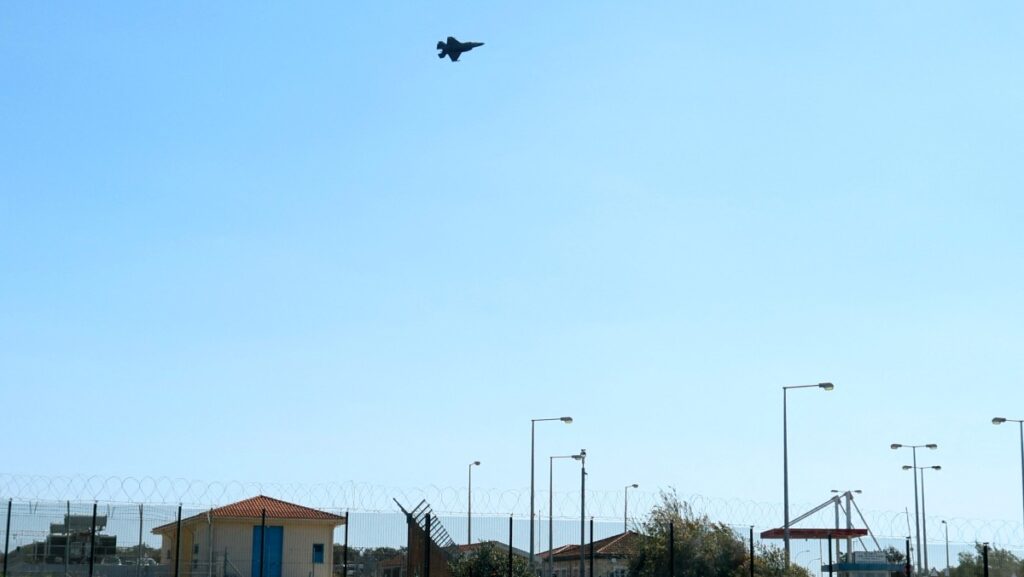
A fighter jet takes off from RAF Akrotiri base, Cyprus, following two reported drone attacks near Limassol on March 2, 2026.
AFP
Israel’s strike on Iranian territory marks more than another episode in the long instability of the Middle East. It signals the exhaustion of an era. For years, confrontation between Jerusalem and Tehran unfolded in the shadows through proxies, cyber operations, deniable sabotage, and calibrated ambiguity. That shadow conflict allowed both sides to test limits without openly crossing them, generating friction without forcing direct accountability.
That framework is now eroding. What had been indirect has moved into the open. When states confront one another directly, the logic of escalation changes. Ambiguity narrows, and reputational stakes increase. Each action becomes more visible and therefore more difficult to absorb without response. In such conditions, restraint becomes harder to calibrate and miscalculation more likely.
For Europe, this development should not be interpreted as a distant quarrel between regional rivals. It signals something larger. Hard power, long treated as an uncomfortable residue of the past, has reasserted itself as a defining feature of international order.
This shift becomes clearer when one considers the structure of the conflict over the past decade. Israel repeatedly targeted Iranian infrastructure in Syria and disrupted weapons transfers to Hezbollah. Iran, in turn, relied on allied militias in Lebanon, Iraq, Syria, and Yemen to project influence while avoiding direct war. The system was tense yet structured. It depended on indirection and plausible deniability to prevent escalation from becoming uncontrollable.
Once direct strikes replace proxy confrontation, that stabilizing opacity disappears. Leaders must respond not only to military realities but also to domestic perception and deterrence credibility. Strategic space compresses. Europe has grown accustomed to viewing such confrontations as containable, yet containment relied precisely on the ambiguity that is now fading.
At the same time, the reported death of Iran’s Supreme Leader adds a new dimension of uncertainty. In authoritarian systems, succession is rarely a purely procedural matter. It becomes a recalibration of power among institutions capable of coercion. In Iran’s case, this dynamic strengthens the Islamic Revolutionary Guard Corps, which oversees missile forces, regional networks, and significant economic interests.
Periods of transition heighten sensitivity to perceived weakness. External confrontation during internal consolidation magnifies that pressure. While this does not automatically lead to war, it increases insecurity. History suggests that regimes facing both external challenge and internal transition often adopt firmer postures to demonstrate continuity and resolve. Europe should not assume that leadership change necessarily produces moderation, particularly when deterrence credibility is under scrutiny.
Beneath these immediate developments lies a deeper structural concern. Iran’s nuclear program has advanced in ways that shorten the timeline required to accumulate weapons-grade material. Even if weaponization is not imminent, the threshold of capability itself alters strategic calculation. Once a state approaches irreversible capacity, deterrence dynamics shift profoundly.
Israel has long maintained that it will prevent adversaries from reaching such positions. If its leadership concludes that a decisive threshold is near, preventive action becomes a strategic imperative within its doctrine. From Tehran’s perspective, however, external strikes may reinforce the belief that credible deterrence, potentially including nuclear capability, is the only reliable guarantee of regime survival.
Europe once invested considerable political capital in diplomatic frameworks intended to manage precisely this dilemma. That architecture has weakened. The expectation that proliferation crises can be stabilized indefinitely through negotiation alone now confronts a harsher geopolitical environment in which military logic increasingly shapes outcomes.
The role of the United States further shapes this landscape. Washington remains the decisive external security actor in the region. Its posture underwrites Israel’s deterrence and constrains Iranian escalation. Yet American decision-makers also face limits. Strong alignment reassures allies but increases exposure, while strategic distance reduces immediate risk but weakens credibility.
Europe’s position is even more constrained. Despite repeated discussion of strategic autonomy, crises of this magnitude continue to hinge on American calculations. The continent’s security structure, anchored in the North Atlantic Treaty Organization, remains indispensable. At the same time, reliance on that structure underscores Europe’s limited capacity to shape events independently. Should escalation widen, Europe will feel the consequences in energy markets, trade routes, and migration pressures without necessarily directing the response.
Geography reinforces this vulnerability. The Middle East is not peripheral to Europe but intimately connected through commerce, energy, and history. Hezbollah retains the ability to open a northern front against Israel; Iranian-aligned militias in Iraq can target Western assets, while in Yemen, Houthi forces have demonstrated the fragility of maritime routes in the Red Sea. Even limited disruption can reverberate through European supply chains and inflation levels.
The incident at Akrotiri in Cyprus offers a tangible illustration of this exposure. During the recent escalation, a drone linked to the broader regional confrontation fell in the vicinity of RAF Akrotiri, the United Kingdom’s sovereign base area located on Cypriot territory. Although the incident did not result in significant damage, its symbolism is instructive. Cyprus is a member state of the European Union, and Akrotiri represents Western military infrastructure embedded within European soil. When aerial systems associated with Middle Eastern conflict physically reach the territory of an EU member state, the distinction between external instability and internal security begins to erode. Geography compresses. What may be framed diplomatically as a regional crisis manifests operationally within Europe’s immediate strategic environment.
Energy considerations deepen the concern, as a significant portion of global oil transits the Strait of Hormuz, and markets respond not only to closures but also to credible signaling, such as naval maneuvers or temporary detentions.
The experience of the war in Ukraine showed how energy shocks can reshape domestic political stability across Europe. Another prolonged disruption would once again test cohesion within the European Union.
These developments also revive a fundamental debate about law and power. Israel’s strike raises questions about anticipatory self-defense and the interpretation of Article 51 of the United Nations Charter. Expanding preventive logic to address emerging strategic capability rather than imminent attack stretches established legal boundaries.
For a continent whose postwar identity rests on a rules-based order, this evolution is uncomfortable. Yet legal norms do not operate independently of strategic reality. As technological change compresses timelines and reduces warning periods, states increasingly act before threats fully materialize.
If preventive thresholds become normalized, the implications will extend beyond the Middle East. Europe must confront the tension between its legal commitments and the realities of power politics, recognizing that law without credible force risks erosion.
In this context, the most probable outcome is neither immediate regional war nor swift reconciliation. A more likely scenario is a higher-intensity equilibrium characterized by sustained tension, visible deterrence, and periodic flare-ups. Direct confrontation replaces indirect buffering. Leadership transition increases uncertainty. Nuclear urgency compresses decision-making. Energy vulnerability magnifies consequences.
If stability is preserved, it will depend less on diplomatic optimism and more on disciplined power management supported by credible deterrence.
For Europe, the lesson is sobering. The era in which distance and procedural diplomacy insulated the continent from hard geopolitical shocks is fading. Power vacuums rarely remain unfilled. They are claimed by actors prepared to assume risk and exercise force.
The confrontation between Israel and Iran is therefore not an isolated regional episode. It forms part of a broader reordering in which deterrence, credibility, and strategic capacity once again determine outcomes.
Europe must decide whether it will continue to absorb the secondary effects of crises shaped elsewhere or whether it will accept that sovereignty requires preparation, resilience, and clarity of purpose.
The return of hard power is not a temporary deviation from the liberal international moment. It is a structural condition of the emerging era. Europe cannot remain a spectator to transformations that so directly affect its security and stability.