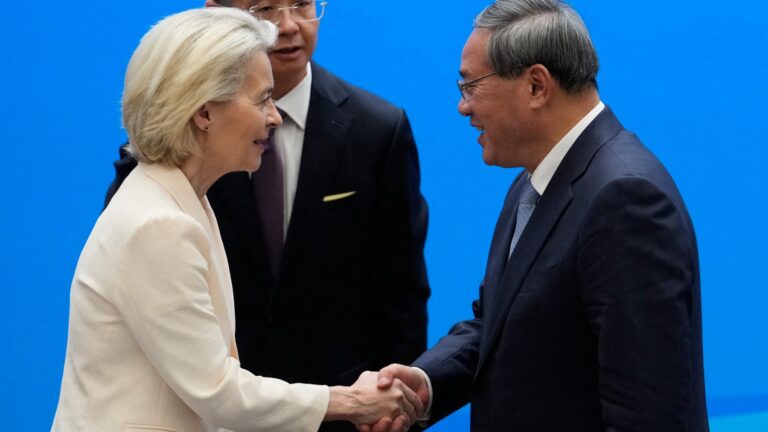
French Rassemblement National (RN) party leader Marine Le Pen waves to supporters as she leaves a campaign gathering in the city hall of La Fleche, western central France, on July 8, 2026, a day after she announced her candidacy for the 2027 French presidential election.
FRED TANNEAU / AFP
Marine Le Pen caused a surprise by announcing her intention to stand as a candidate in the 2027 presidential election during her televised address following her conviction on appeal in the European parliamentary assistants’ case. In doing so, she is making a bold gamble, which will undoubtedly set the tone for a campaign that is already shaping up to be completely out of the ordinary.
On Tuesday, July 7th, the Paris Court of Appeal upheld the conviction of the former president of the Rassemblement National (RN), finding her responsible for a scheme that enabled her political party, between 2009 and 2016, to have parliamentary assistants funded by European funds whilst they were employed on tasks of national interest to the party.
However, the verdict was more lenient than might have been expected: the prison sentence was reduced, and the period of ineligibility was not extended, meaning that, in this specific regard, she is deemed to have already served her sentence. Regaining eligibility was, of course, the first condition she needed to fulfil in order to stand as a candidate. The second condition was that she be exempt from wearing an electronic tag. Le Pen decided to take matters into her own hands to secure this by announcing her intention to appeal to the Court of Cassation, which allows her to suspend the enforcement of the modified prison sentence to which she was subject. Furthermore, she once again benefits from the presumption of innocence whilst awaiting the final judgement.
With this decision, Le Pen has sent a powerful political message: she intends to remain in control of her own destiny and has no intention of allowing the system to dictate her fate. Her supporters have clearly understood the message.
Another option was available to her: to serve the initial part of her sentence whilst wearing an electronic tag and to rely on a likely reduction in her sentence—a common occurrence in this type of conviction—which could take place in December or January, leading to her definitive release. Le Pen rejected this scenario for two reasons: first, she wishes to send the signal that she still considers her conviction to be unjust and politically motivated. She intends to prove her innocence and clear her name—a trait of character inherited from her father. Second, she refuses to cause her party to lose a few precious months of the campaign while there is uncertainty as to whether she will actually secure a reduction in her sentence. She wants to be able to campaign at full throttle from the outset and have complete freedom of movement.
Le Pen’s strategy is unprecedented, involves a great deal of risk, but is politically understandable. For the time being, it would appear she has made the right choice, according to the first opinion polls published following the verdict. Voters have no intention of changing their vote because of Le Pen’s conviction. Across the country, public frustration is so intense that she will continue to be seen as the only credible alternative to the system.
Much will depend on the timetable. The trial is now entering a new phase: the appeal to the Court of Cassation. Before this court at the top of the judicial hierarchy, proceedings in such cases are usually quite lengthy, taking up to two years. Given the highly specific and urgent nature of this case, these could be shortened to around nine months. Le Pen has already secured an accelerated judicial timetable for the appeal proceedings, so there is every chance she will be granted the same conditions.
The Court of Cassation’s ruling is therefore expected in February or March 2027. From there, two possibilities arise.
Either the Court of Cassation will rule in Le Pen’s favour, and she will be cleared by the courts. She will have been right to make the gamble and, right in the thick of the campaign, will benefit from a positive spotlight of rare intensity. The RN’s traditional slogan, inherited from the days of Jean-Marie Le Pen—“clean hands and head held high” (mains propres, tête haute)—will then take on its full meaning.
The alternative scenario is that the Court of Cassation upholds the first two judgements and confirm the conviction. The ruling will come at the height of the presidential campaign, at a time when, given current trends, it is highly likely that the RN will still be leading the polls by a wide margin. It will then be easy for her to play to her advantage the card of the system’s persecution of its main opponent and to credibly denounce the Machiavellian machine set up to prevent her election. In this scenario, a parallel can be drawn with Trump’s trajectory in 2024—even if the national contexts are radically different. Perhaps, at that point, she will be forced to withdraw, particularly if the Constitutional Council—responsible for officially validating candidatures—deems that she is no longer eligible to stand due to her conviction. Bardella will then take her place, enjoying considerable support, and will see his standing as the leading challenger further strengthened.
It is a bold gamble, but one that may prove to be a shrewd move. In any case, it is worth the risk, and Marine Le Pen no longer needs to prove her unwavering fighting spirit.
The announcement of her candidacy has been met with mixed reactions from the French political establishment.
On the Left, one can already glimpse the talking points that will be repeated ad nauseam over the coming months. Socialists, Communists, Greens, and La France Insoumise will go to great lengths to portray Le Pen as a criminal. But in doing so, they may find themselves trapped by their own arguments and deprive themselves of the opportunity to challenge her on the substance of her ideas and her programme. On the centre-right, too, there is a critical stance: the candidate for Les Républicains, former Interior Minister Bruno Retailleau, accuses Le Pen of “holding the justice system hostage.” He knows he has every reason to fear facing a determined, battle-hardened opponent, well-versed in every dirty trick, who has nothing left to lose. The favourite candidate of the Macron camp, former Prime Minister Édouard Philippe, has, for his part, adopted a more cautious stance, stating that she is free to make her own choices and that it will be up to the French people to decide at the ballot box. On the Right, the mood is one of unity and enthusiasm.
And what of Bardella in all this? The current president of the RN has no choice but to put on a brave face and bide his time. As Jean-Yves Camus, a specialist on the National Front, pointed out on the evening of Tuesday, July 7th, on France Info, Bardella and Le Pen are, more than ever, an inseparable pair: neither can hope to win without the other’s support, both in terms of the electorate and the manifesto.
With her sensational statement, Le Pen has pulled off a brilliant gambit: she is the one who will dictate the pace of the campaign. From now on, anything goes.