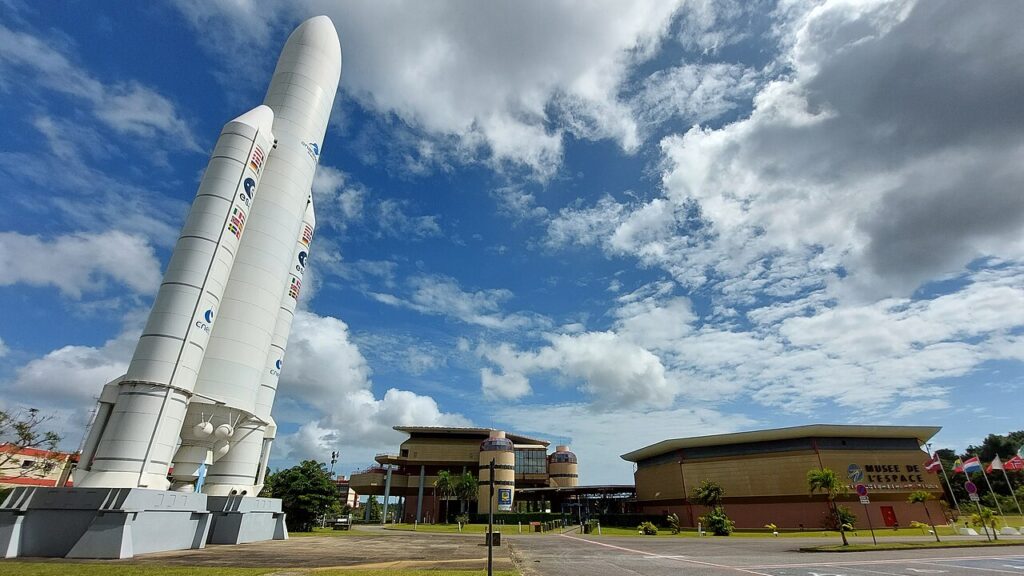
Guiana Space Centre Welcome Area
Don-vip, CC BY-SA 4.0, via Wikimedia Commons
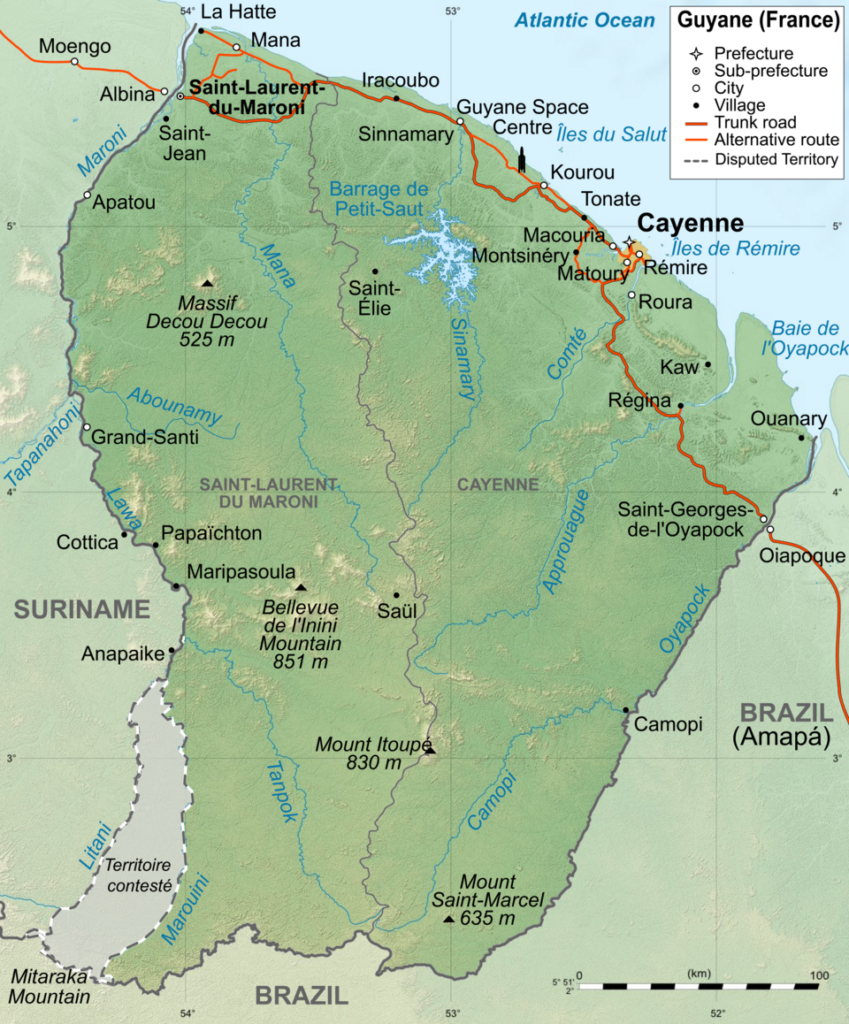
French Guiana is not a peripheral territory. It is the largest department of France, covering 83,846 square kilometres—roughly 16% of metropolitan France’s land area, comparable in size to Portugal. It is a fully fledged French department and an outermost region of the European Union, hosting Europe’s main spaceport, the Guiana Space Centre, in Kourou, officially classified as a priority defence facility by French authorities. Yet this same territory contains one of the most porous borders in South America. Just a few kilometres from the Ariane launch pads, the Oyapock and Maroni rivers, which separate French Guiana from Brazil and Suriname, can be crossed by pirogue—a flat-bottomed dugout canoe—in under ten minutes.
This proximity creates a structural asymmetry: on one side, the full body of strict European Union law applies; on the other, significantly more permissive jurisdictions. Transnational hybrid networks have systematically exploited this gap for years. Illegal gold, cocaine trafficking, and—since 2024–2025—sophisticated fraudulent carbon credit schemes have allowed criminal actors to convert high-risk illicit activities into financial flows integrated into the European legal and financial space. French Guiana is no longer merely a local crime problem. It has become a laboratory of the European Union’s strategic vulnerabilities in the twenty-first century.
As a French department and EU outermost region, French Guiana is subject to the full application of European law, including the strictest anti-money-laundering directives, GDPR, and foreign investment screening rules. On paper, this should create one of the most robust regulatory environments in the world. In practice, the two river borders remain extremely difficult to control continuously. Every day, hundreds of small boats cross them, carrying people, goods, and—crucially—illicit financial flows.
On the Brazilian side, a 2021 study by Instituto Escolhas found that in 2020, approximately 19 tonnes of gold exported from Brazil—17% of total exports—had no verified origin or valid mining permit. On the Surinamese side, the 2024 EITI Validation gave the country a score of only 58.5/100 (“fairly low”), with significant gaps in artisanal mining data and limited state presence in remote mining areas.
The result is predictable: high-risk activities—illegal extraction inside protected areas such as the Amazonian Park of Guiana, land grabbing, mercury pollution, and cocaine trafficking—can be conducted in more permissive jurisdictions, then integrated into the European legal space once the goods or money cross into French Guiana. According to French gendarmerie estimates cited by the Pulitzer Center in November 2024, roughly eight tonnes of illegal gold are produced annually in French Guiana, compared with only one tonne of declared legal production.
Gold remains the principal vector. Between 2015 and late 2025, the price of an ounce rose by approximately 280%. What was once a marginal activity has become one of the most attractive revenue sources for organised crime in the Amazon. At the regional level, the Guiana Shield corridors are estimated to channel between 80 and 120 tonnes of illegal gold per year.
The actors involved form a classic hybrid configuration: Brazil’s Primeiro Comando da Capital (PCC), which uses front companies and legal refineries to launder gold (as exposed in Operation Eldorado in 2023); the Colombian ELN, which taxes mining sites in Venezuela’s Orinoco Mining Arc; Chinese networks financing heavy equipment and operating through trading posts on the Surinamese side of the Maroni River, and Lebanese networks linked to the Barakat clan, designated by the U.S. Treasury’s Office of Foreign Assets Control (OFAC) in 2004 for providing financial and logistical support to Hezbollah.
In December 2025, Brazil, French Guiana, Guyana, and Suriname conducted Operation Guyana Shield, supported by Interpol and the EL PACCTO 2.0, the European Union-funded international cooperation programme focused on fighting transnational organised crime between the EU and Latin America and the Caribbean. It resulted in 198 arrests and significant seizures. However, the flows quickly reorganised. This pattern—episodic enforcement followed by rapid adaptation—has characterised responses to illegal gold mining in the Guiana Shield for over a decade.
The most recent and concerning development is the convergence between illegal gold economies and fraudulent carbon credit schemes. Since 2024–2025, Brazilian federal police investigations have exposed financial structures—notably the Banco Master / Reag Investimentos network—suspected of receiving capital flows linked to the PCC.
Their method involved creating unidades de estoque de carbono (carbon stock units) on public lands in Amazonas, particularly the Fazenda Floresta Amazônica in Apuí—approximately 150,000 hectares belonging to the Brazilian Union and designated for agrarian reform. Any private generation of carbon credits on these lands is illegal by definition. Nevertheless, in 2023 roughly 168.8 million theoretical units—without verified emission reductions, additionality, or real buyers—were transferred to companies controlled through Reag-managed funds. The combined valuation of these companies reached approximately R$45.5 billion without a single verified carbon credit being sold.
On 28 August 2025, the Federal Police, Receita Federal and São Paulo Public Ministry launched Operation Carbono Oculto. The operation targeted a network of around forty investment funds, many linked to Reag, suspected of laundering proceeds from fuel fraud and other crimes. Reag’s shares collapsed, and in January 2026, the Central Bank of Brazil placed the company in liquidation.
Investigators named this mechanism the ‘Green Exit’: illicit capital from illegal gold and other crimes can be reinjected into the economy through investment vehicles presented as ‘green’ and ‘ESG,’ attractive to European investors. Physical and legal risk remains externalised upstream (illegal extraction in the Guiana Shield, land grabbing in Brazil), while financial integration occurs downstream in São Paulo’s financial architecture, with European ESG and carbon markets as a potential final destination.
These dynamics have direct implications for the European Union. They simultaneously affect the integrity of the EU’s external borders, the resilience of European financial markets to laundered capital, the integrity of the EU carbon market, and strategic autonomy in space, since French Guiana hosts Europe’s main spaceport.
NATO and the European Union have elevated hybrid threats to a core strategic priority. Yet the sustained exploitation of jurisdictional gaps in an EU outermost region undermines the credibility of European sovereignty claims and creates exploitable seams for criminal networks and potentially state-adjacent actors.
A further geopolitical layer compounds the problem. In 2025, tensions between Venezuela and Guyana escalated. On March 1, a Venezuelan naval vessel entered Guyana’s exclusive economic zone and approached ExxonMobil’s Liza Destiny floating production, storage, and offloading vessel (FPSO) for oil in the Stabroek Block. Georgetown denounced a sovereignty violation; France, the United States, and several regional organisations condemned the incursion. These tensions create persistent instability in the Guiana Shield and open additional space for the criminal and hybrid networks already active in gold and drug corridors, with potential spillovers onto French Guiana’s river borders.
Cocaine follows the same routes as gold. In 2024, 2.8 tonnes were seized in French Guiana after flows shifted to the Grand Port Maritime. The prison population in France’s overseas territories rose by 47% between 2013 and 2023, partly due to drug-related cases. The European Union spends roughly three times less on supply-side reduction than the United States.
Finally, the Sillon Nord region of French Guiana, currently being surveyed by the BRGM under a major mineral resources inventory programme (2025–2029), contains potential deposits of lithium, niobium, and tantalum. Any future development of these critical resources will only be secure if the hybrid vulnerabilities already identified—jurisdictional asymmetry, porous river borders, and transnational criminal networks—are addressed first.
Five concrete axes are required.
First: establish an interministerial command for hybrid resilience in overseas territories, bringing together the Armed Forces in French Guiana, customs, justice, intelligence services, and the French National Centre for Space Studies (CNES) under the authority of the French General Secretariat for Defence and National Security (SGDSN) or Directorate General for International Relations and Strategy (DGRIS).
Second: transform ad hoc cross-border cooperation into a permanent trilateral mechanism with Brazil and Suriname, including joint information fusion centres and reinforced joint riverine patrols on the Oyapock and Maroni, building on EL PACCTO 2.0.
Third: impose mandatory traceability for gold and carbon credits entering the European Union, integrated into the Corporate Sustainability Due Diligence Directive (CSDDD) and the Carbon Removals and Carbon Farming Certification (CRCF) framework.
Fourth: strengthen foreign investment screening and beneficial ownership transparency for structures operating in French Guiana, particularly in mining, logistics and finance.
Fifth: explicitly integrate French Guiana into the hybrid threat exercises and planning frameworks of the EU and NATO. The territory must no longer be an afterthought in European security planning.
French Guiana is no longer simply a local problem of illegal mining or border management. It has become a genuine laboratory of Europe’s strategic vulnerabilities in the twenty-first century, where organised crime, environmental fraud and financial engineering converge. What were once treated as technical legal gaps have become strategic seams.
If France and its European partners remain in a logic of episodic operations and reactive adaptation, they will sustain criminal revenues and the progressive erosion of their sovereign credibility in their outermost regions. It is time to move toward a durable strategy of transboundary resilience that treats French Guiana not as a distant exception but as a central element of European sovereignty.